Digital literacy in the age of brain rot
As social media engagement changes, intentional media consumption becomes more necessary.
By MIA AREVALO & RAFA HORLE

As social media engagement changes, intentional media consumption becomes more necessary.
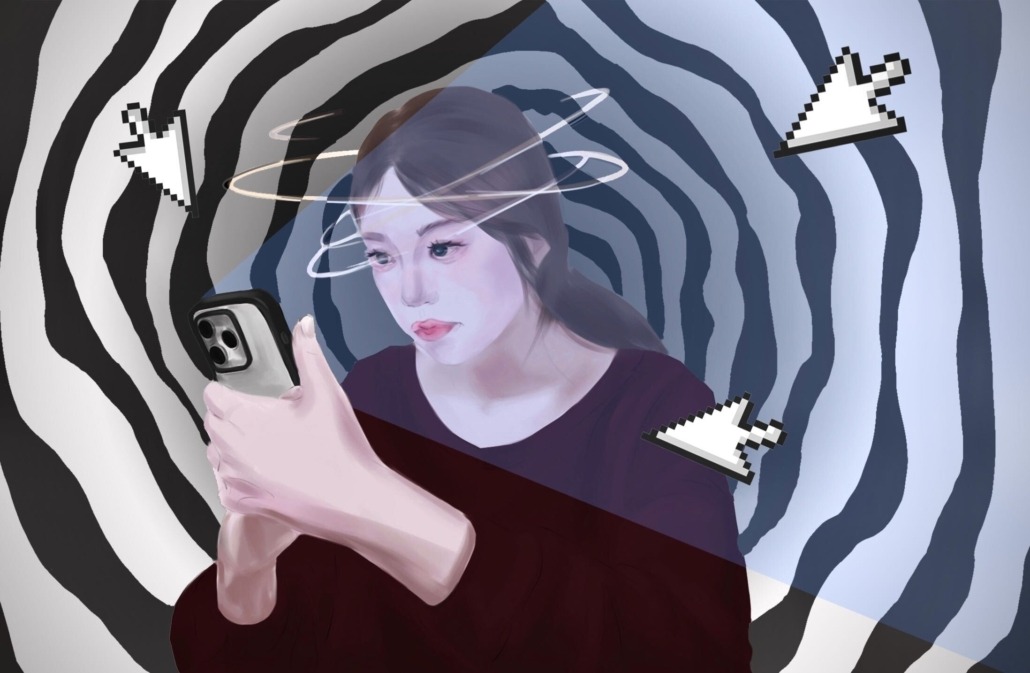
Social media was created with the optimistic ideal of bringing people together. Now, a couple of decades down the line, millions use these same platforms to watch artificial intelligence-generated content of jacked fruits and dancing cappuccinos. This strange, almost absurdist form of content has become known as brain rot.
Merriam-Webster defines this phenomenon as “material of low or addictive quality, typically in online media, that preoccupies someone to the point it is said to affect mental functioning.” This is typically an indication that one’s doomscrolling has officially gone too far.
Brain rot can vary in format. Sally Lao, a junior majoring in music industry, primarily consumes AI-generated cat videos.
“It’s not productive for me. It’s not helping me expand my horizons,” Lao said. “It’s just entertainment.”
But that doesn’t necessarily mean consuming such content is worthless.
“I don’t have to think about what I have to do for class for these five minutes [when I’m scrolling], which is really great. It’s kind of therapeutic for me,” Lao said.
In a digitized world where seemingly anything and everything can be monetized, and constant productivity has become the ideal, brain rot offers an escape for young people.
Still, countries are increasingly pushing for legislation to protect children from internet addictions. Literacy rates among high schoolers in the United States are decreasing, leading to questions surrounding the irreversible damage of social media consumption on young people’s minds and development.
Does being literate require us to engage critically with everything we consume?
Freddy Tran Nager, associate director of the Digital Social Media master’s program at the Annenberg School for Communication and Journalism, said the definition of literacy is shifting alongside technology.
“Digital literacy means understanding what this content is about. Is it entertainment? Is it misinformation, disinformation? We have to apply more and more critical thinking as technology evolves,” Tran Nager said.
Part of that critical thinking, Tran Nager said, is figuring out who is behind what we see. Traditional media offered a visible source, but content on the internet could be made by anyone, even a bot, Tran Nager said.
In an era of addictive algorithms, Tran Nager is skeptical that literacy alone can counter platform design.
“I don’t think [platform design] so much affects literacy as it does creating an addiction that you just can’t stop,” Tran Nager said. “Media literacy is understanding when you’re falling down a rabbit hole, understanding that these algorithms are not your friend, that they just want you to sit there and consume more content and watch more advertising.”
Yet Tran Nager resists the idea that scrolling for pleasure is new or inherently bad. Instead, Nager suggests it is an evolution of the deeply human desire to vent and express creativity. After all, differentiating between mindless and stimulating content is not always an objective task.
“I think it’s a way of venting. We have the tools at our disposal, and human beings are inclined to express themselves creatively … whether it’s writing on a cave wall thousands of years ago or going to an open mic night at your local comedy club,” Tran Nager said. “Who’s to judge whether something is mindless as opposed to something that’s simulating?”
Tran Nager worries about young people consuming too much of it.
“When you are being spoon-fed video content, you’re not exercising your brain. There’s nothing for your imagination to do. The colors, the shapes, the dialogue — it’s all being fed to you,” Tran Nager said.
Still, he sees absurdist humor as part of a longer cultural pattern. Tran Nager called it a rejection of “influence creep,” where everyone is expected to be a brand, comparing brain-rot content to jazz, punk and rap before it. For Tran Nager, such content is an example of what popular culture has been doing forever.
Tran Nager didn’t offer a tidy verdict. If media literacy today means understanding algorithms, sources and our own moods, it may also mean understanding why we sometimes choose not to analyze at all.
When students at USC were asked about this tension between critical engagement and deliberate respite, their answers were similarly complicated.
Several interviewed students expressed a desire to reduce their screen time, despite using social media for keeping in touch with friends, finding new places to explore and keeping up to date with popular culture. It wasn’t until they were asked about brain rot specifically that they confessed to consuming that content.
Mailene Polanco, a master’s student studying global media and communication, ascribes cultural capital as one of the reasons why, despite feeling guilty about consuming brain rot, young people continue to do so.
“[Brain rot] can be like a cultural capital, what you’re watching is of the moment and of the world right now. People are feeling the same things. People are watching the same things,” Polanco said. “There’s value in that, and being able to reference things with your friends that you’ve only seen online.”
Younger generations’ relationship with social media, AI content and digital literacy is not as simple as fear-mongering narratives have made it out to be. While there are valid concerns regarding algorithms and digital overconsumption, younger generations remain capable of critical thought.
Digital literacy does not mean refusing to consume mindless content or scrutinizing everything one comes across online. It means discerning when to apply critical thinking, when to indulge and when it’s finally time to turn off the phone. For Tran Nager, that discernment starts with a question.
“We’re spending all our time and our effort and our imagination creating content, hoping it goes viral, hoping it gets us more followers, when we should be thinking: ‘What’s truly valuable to me in life?’” Tran Nager said. “If social media were to disappear today, what would we value more?”