More than murals, South Central Arts creates with intent
A local art collective preserves the neighborhood’s culture and community.
By CECILIA DONATO & CONNOR MERRIHEW
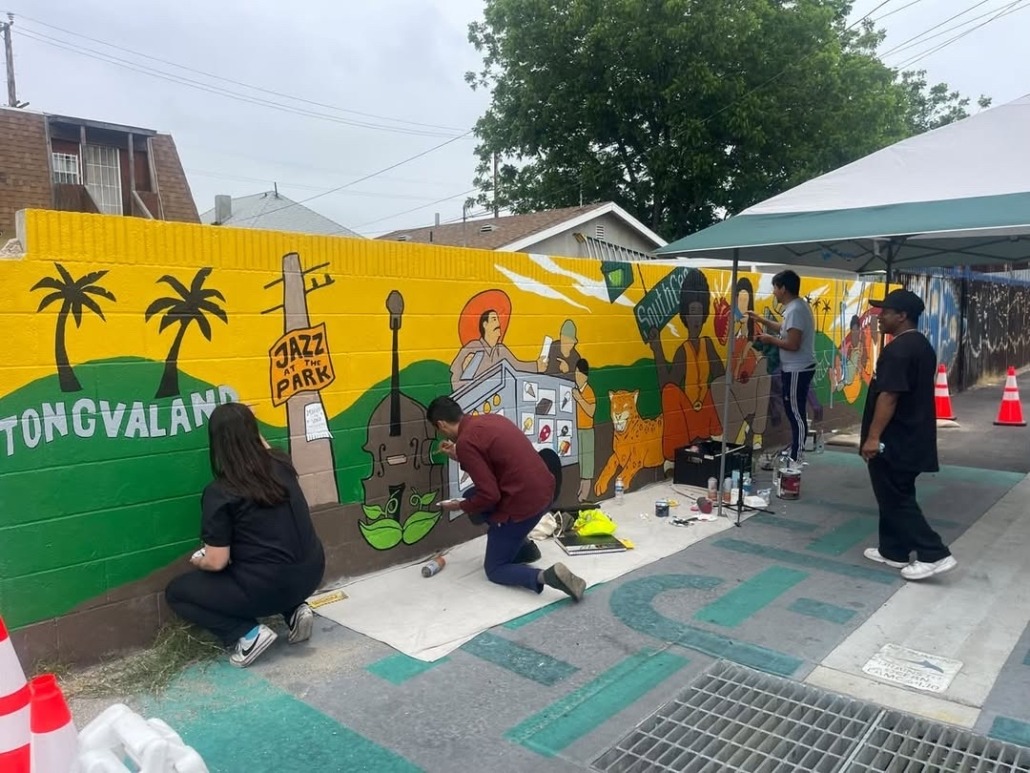

A local art collective preserves the neighborhood’s culture and community.
As the sun begins to set over South Central, voices fill the air. Residents stop by on their way home as children get the chance to showcase their talent for the first time. In these moments, art becomes something to be shared rather than simply observed.
For USC students moving to South Central, entering the neighborhood can mark the beginning of a new story. But in reality, the place they’re coming to already has a deep cultural history of its own.
South Central’s identity has been shaped by generations of communities creating culture in the face of exclusion and change. In the early 20th century, discriminatory housing covenants and redlining concentrated much of Los Angeles’ Black population along Central Avenue, which became a hub for Black business, jazz and cultural life. Later, growing Latine and Central American communities added new layers to the region’s cultural identity.
In 2017, growing gentrification put South Central’s cultural identity at risk, and, in response, the South Central Arts — an organization of artists and allies focused on uplifting the artwork of their community — was born.
“It was only a matter of time for South Central to be a target. So we mobilized,” said William Flores Diaz, the founder of the South Central Arts as well as a poet.
Flores Diaz said he has a deep connection to the region himself: He’s lived in South Central since he was five years old, when he moved from Pico Union with his parents, who had come to the United States from El Salvador.
“Everything that I’ve done has an identity connected to South Central — poetry being one of them,” Flores Diaz said.
He said he developed his artistic voice at a young age, going from singing about his day while walking home from school to writing his first poem in high school; a dedication to his neighborhood even made it into his latest poetry collection.
“[It’s about] just being able to tell my story through what I call ‘self-literature’: telling my own story instead of having somebody else write the story for us,” Flores Diaz said.
The idea of telling one’s own story extends beyond Flores Diaz’s poetry. The South Central Arts has been an essential network through which local artists can shape how the neighborhood is represented and preserve its history.
“Those first opportunities are crucial for a young artist to start believing in themselves,” said Daniel Villa, a USC alum who has handled the South Central Arts’ behind-the-scenes work in the past.
Villa first worked with Flores Diaz at the South Central Arts in 2017, when Flores Diaz called together a handful of South Central artists to pitch his idea. Villa immediately saw where he could help.
Villa set up the digital support necessary to transition the South Central Arts from an idea into something much more permanent.
For almost a year, the group held a monthly open mic at Central Avenue Jazz Park run entirely by volunteers.
“[We] had permission from the [City] Council District 9 office to hold [an] open mic night at the Jazz Park for almost a year,” Villa said. “A lot of it is just the artists themselves putting it together. … We’re not a 501(c)(3), so we don’t have donations or anything like that. So it was out of everybody’s volunteer time.”
This idea of using art to share a neighborhood’s story has manifested on the walls themselves. Jackelinne Gallardo, known by her artist name Magical Youniverse, is a muralist who grew up in South Central. She connected with the South Central Arts after attending one of its Jazz Park events, and was later invited to paint live alongside other artists. In her murals, she likes to utilize vibrant colors.
“I feel that those communities need color,” Gallardo said. “A lot of walls are empty and a lot of them don’t really have art on them. … [Using color] helps make the area also feel a little safer and can hopefully help uplift people.”
Through her work with the collective, Gallardo’s definition of a mural shifted into something interactive.
“Creating something on the spot while community members are passing by and seeing you create art for their communities, it invites conversations,” Gallardo said. “People do stop by and ask, ‘Oh, what are you all painting?’ Or they stop and share their appreciation.”
One conversation from a South Central Arts event stayed with her: an older muralist, now an art teacher, whose painting had pulled him out of a hard childhood.
“It just made me realize how important self expression in general is, and having spaces where that is encouraged for young people. … Younger people, when they look at who’s painting, they might see themselves doing that as well,” Gallardo said.
For Flores Diaz, the murals were made to be a reflection of the community, by the community, allowing residents to see their own experiences portrayed in their surroundings.
However, Flores Diaz pointed to the criminalization of graffiti as an example of the gap between public art’s perception as opposed to its experience within the neighborhood.
“[With proximity and geographical communities] there’s a certain identity that gets adopted,” Flores Diaz said. “Because of this affinity, we’re able to relate and co-relate to each other and each other’s lives … regardless of how we look, how we identify or represent ourselves as an individual.”
Gallardo believes the negative connotations surrounding the South Central community are misleading, harmful stereotypes which she hopes the South Central Arts can combat.
“We’re just trying to uplift everyone,” Villa said. “It’s a collaboration. We’re trying to beautify the community.”
That’s the impact South Central Arts is making, one open mic and one mural at a time: showing that a misjudged neighborhood is full of talent, culture and beauty.
“There’s a lot of beauty, and there’s a lot of talent,” Gallardo said. “A lot of the cultures that people bring flourish here, and people create a home away from home.”