USC will not hold Latinx/e Heritage or other cultural month celebrations
Students say institutional recognition is important for cultural visibility.
By APRIL MAO
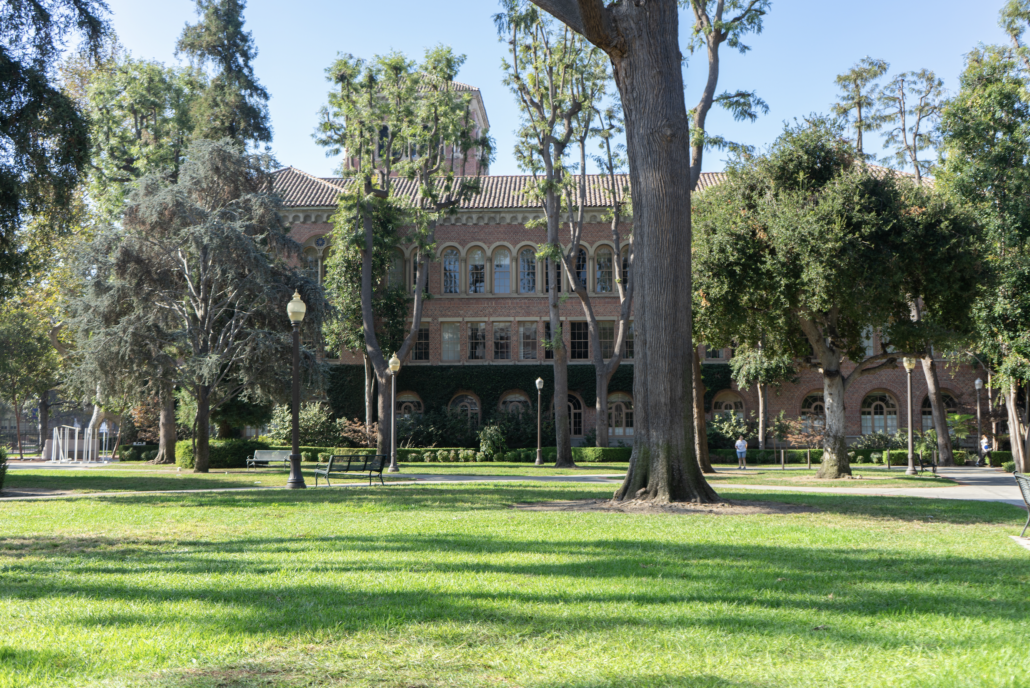

Students say institutional recognition is important for cultural visibility.
Last October, the music of Mariachi Los Troyanos and the steps of Grupo Folklórico filled Founders Park as more than 650 people gathered for Noche de Cultura. Trojans joined together to enjoy Mexican food, watch live performances and close out USC’s 2025 Latinx/e Heritage Month with a university-wide celebration.
This year, however, celebrations will look a little different. As of Sunday, USC had not announced an official kickoff or closing celebration event for Latinx/e Heritage Month. The month runs from Sept. 15 to Oct. 15.
Instead, the University is shifting its responsibility for the Latinx/e Heritage Month programming toward student organizations.
“The university is seeking to give Recognized Student Organizations (RSOs) a greater role in leading and planning cultural heritage month events,” USC wrote in a statement to the Daily Trojan. “This approach responds to students seeking more voice in shaping this programming and aligns with how many institutions support these activities.”
Last year, Noche de Cultura was hosted by the Office of the President and the USC Latine Student Assembly.
In April, the Undergraduate Student Government passed a resolution asking the University to include at least two students in the planning process for cultural heritage and history events and at least one student speaker after the Middle Eastern and North African Student Assembly and Native American Student Assembly claimed that USC told students they were not permitted to speak.
In a statement to the Daily Trojan in Nov. 2025 regarding a lack of banners during heritage months, they wrote that banners promoting cultural heritage are going to be displayed on digital signs rather than physical banners along Trousdale Parkway due to high costs.
Student organizations, including La CASA, have continued to hold events throughout the month, such as La Mesa de Guatemala, Bajo La Misma Luna Movie Night and Raíces y Ritmos. However, with around 17% of USC’s admitted first-year student population in 2026 being Latine and Hispanic, the lack of centralized programming has raised concerns from some students within the community.
Gian Marco Velásquez, a senior majoring in journalism and president of USC’s National Association of Hispanic Journalists chapter, said he learned through word of mouth that there would not be a university-wide celebration.
“I remember when I was a sophomore [and] a freshman, I took part in a lot of these cultural events that represent and that celebrate Hispanic Heritage Month,” Velásquez said. “To not have it in a time that’s usually programmed, it was definitely shocking.”
Velásquez said USC’s approach carries a particular weight as a higher education institution with a diverse student body.
“Schools should cater to their students, and now more than ever, we’re at a time when people are feeling marginalized,” Velásquez said. “The schools and college campuses have long been these spaces of discourse that oftentime mimic what’s going on on a national level. Whether that be politics, whether that be economics, whatever the case is, a lot of these conversations are being had in college campuses.”
Elizabeth Sandoval, a junior majoring in sociology, said even though events held by student organizations make her feel represented on campus, the University should explain why it did not organize the usual centralized celebration events.
“The problem will come [as] the year progresses,” Sandoval said. “Other communities who are represented in the university culturally in its student body, if their celebrations go on, and ours didn’t, we are obviously going to have a point of contention, and we’re going to need answers as to why.”
For future event planning, Sandoval said she would like to see the inclusion of first-generation and transfer student groups. She thinks there should be events featuring a variety of live music and dance, along with food that allows students to build community by “breaking bread.”
“It’d be pretty great to have the different kinds of music that [are from] particular regions of Latin American countries, so that everyone has a chance to say, ‘Oh yeah, that’s for my country!’” Sandoval said. “I know that USC has a folklórico [group], and I know USC has a mariachi [group], so it’s definitely possible to incorporate that because it already exists.”
Allan J. Lopez, an adjunct instructor at the Annenberg School for Communication and Journalism, said that a sense of cultural belonging at a large university like USC also helps students achieve longer-term goals. He pointed to the Spanish journalism outlet Dímelo as an example.
“That’s really important for students who are coming in, who are navigating a lot of things like imposter syndrome, or they’re first gen and they’re struggling to navigate,” Lopez said. “Once they find their little family, their little unit, their bubble, they really connect with that. And that makes a big difference in their graduation rates and their student success [and] academic success.”
Lopez said the celebration events can transform shared campus spaces into visible expressions of Latine culture, especially when the community is undergoing the “ever-changing” encounter with the U.S. Immigration and Customs Enforcement and President Trump.
“Those events for Heritage Month and Noche de Cultura and the kickoff events, they’re really important. … Those events really go a long way to make you feel your unique self, to celebrate your culture in a way that you feel comfortable and embraced,” Lopez said. “Just listening to Spanish music on campus at an event makes a difference to everyone to really feel like we’re part of this community, that we’re recognized and that we’re seen.”
Correction: A previous version of this article incorrectly stated that USC issued a statement regarding the use of digital signs instead of physical banners during heritage months in November 2026. The article was updated on Oct. 5 at 7 p.m. to reflect that the statement was issued in November 2025. The Daily Trojan regrets this error.