‘Saffron Robe’ follows one monk’s mission
The alums’ documentary explores spirituality, human connection and endurance.
By SARA MCCARTHY

The alums’ documentary explores spirituality, human connection and endurance.
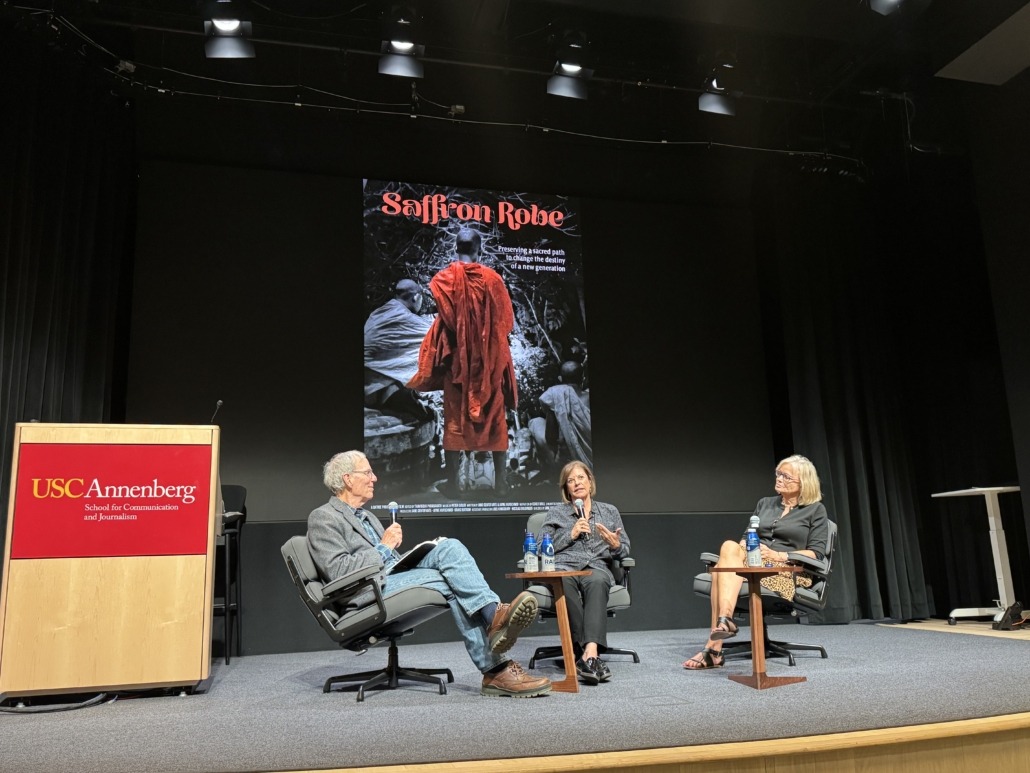
When Jane Centofante and Jayne Hufschmid graduated from USC in the 1970s, they never anticipated their friendship would lead to an original documentary film set across the world in a remote region in northern Laos. Decades later, they came back to their alma mater on Friday to discuss their documentary, “Saffron Robe” (2025), at a panel at Annenberg Auditorium.
Centofante and Hufschmid first met at USC when Hufschmid worked as a teaching assistant for a class Centofante was taking. It wasn’t until 2012, when Centofante found herself across the globe, that their decade-long friendship became a professional partnership.
“In 2012 came my first trip to Southeast Asia, where I went to visit a dear old friend who happened to live in Laos,” said Centofante, director, writer and producer of “Saffron Robe.” “That trip really changed the course of my life in terms of finding the story there and trying to decide what to do about it, and that’s where [Hufschmid] came in.”
“Saffron Robe” follows Abbot Onekeo Sittivong, a Buddhist monk in Luang Prabang, in the remote mountains of Laos, who founded and leads a Lao Theravada Buddhist school. His school holds a mission that goes beyond spiritual education: preserving and revitalizing this ancient Buddhist way of life.
The panel included scene screenings of “Saffron Robe,” recounting Sittivong’s history growing up in a time of intense political upheaval, in a country facing the repercussions of the Vietnam War that led to the dismantling of a 600-year-old monarchy and the loss of Lao culture. However, Laos’ Buddhist spirit could not be erased, and monks such as Sittivong dedicated themselves to its protection.
“Part of the abbot’s mission was not just to educate these children, but also to revive some very important Buddhist customs that had been sometimes suppressed over the years because of the communist government,” said Hufschmid, the documentary’s writer and producer. “There’s a light about him and there’s a light in terms of what he was doing, the goodness of what he was doing, and I think that really grabbed hold of us.”
Centofante and Hufschmid discussed how, despite having no prior experience in filmmaking, their history in storytelling and Sittivong’s extraordinary work gave them the fearlessness to pursue the project head-on.
“We never looked at the downside of what we could not do,” Hufschmid said. “We always looked at, ‘What do we need to learn in order to be able to do this, and who do we need to surround ourselves with in order to bring this story [together]?’”
After 10 years of consistent visits, filming and production of “Saffron Robe,” which included six to eight weeks of filming in Luang Prabang each trip, Centofante and Hufschmid said the most rewarding aspect of the experience was bringing the film home to Sittivong.
“His reaction to the film validated the whole project. If nothing else happened to the project, that alone made the whole journey worthwhile,” Hufschmid said. “When he turned around towards us with tears streaming down his face … it made the entire journey worth it.”
Centofante and Hufschmid described how Sittivong and his school of 500 boys grew from a singular story to a story of humanity.
“We recognize the universality of the story too, the fact that these are children who want to learn,” Centofante said in an interview with the Daily Trojan. “There’s a teacher who wants to educate them, and there’s families that want the best for their children. If that’s not universal, I don’t know what is.”
With their return to USC to present the screening and panel on “Saffron Robe”, Centofante and Hufschmid emphasized how the lessons they learned at USC aided their journey.
“Part of what USC opened up for us was this world that you can explore. You don’t have to be pigeonholed into something,” Hufschmid said in an interview with the Daily Trojan. “[Communication] and journalism really gives you that. You have to have a curiosity.”
For audience member Emma Sun, a freshman majoring in business administration who is working on a documentary project of her own, the panel wasn’t just education, but inspiration.
“It definitely makes me feel the Trojan Network,” Sun said. “To see two alumni doing something very similar to what I’m trying to start, it’s a very cool role model-ish way of being able to say, ‘OK, you have resources from people [and] you have access to talk to these people who have … accomplished this incredible feat.’ It’s cool that we have so much support because of that.”
The official panel event concluded with a networking reception where guests could engage with the panelists along with fellow creators and producers of the film. With the conclusion of the event, Centofante and Hufschmid left guests with an inspiring story of the pursuit of storytelling and the reward of curiosity.
“Sometimes stories get hold of you, and they insist on being told,” Hufschmid said. “That was our experience: It would not let go of us.”