
Students discuss diversity in STEM education, work
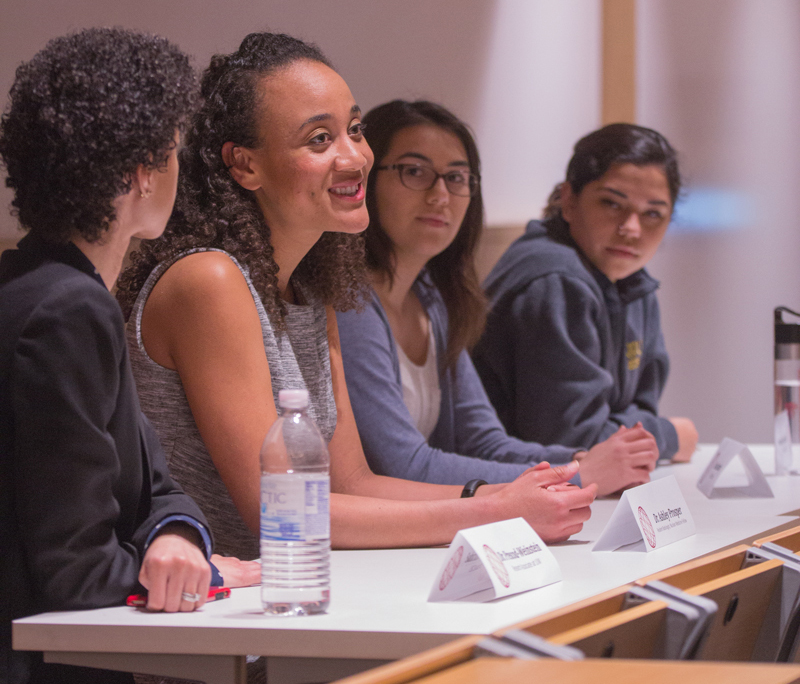
The USC Academic Culture Assembly hosted a discussion, “Stories Behind the Stats: Intersectionality in STEM,” Wednesday night. The panel on diversity was part of a series of events for EdMonth.
EdMonth, also put on by ACA, lasts all of March and aims to bring awareness to the state of education in America by empowering students, especially marginalized ones, that may have more difficult access to schooling. Wednesday’s discussions focused on the lack of diversity in STEM fields and how race, sex and socioeconomic factors influence success in the field.
The panel featured four women in STEM, all of whom had faced discrimination in their respective fields. USC students Dora Gerardo, a junior studying mechanical engineering, and Sabrina Enriquez, a sophomore math major, are both minorities in their majors.
“Mechanical engineering is a white-dominated field,” Gerardo said. “In my class, there are five women and 30-something males. Of everyone, there are four Latinas. It really shows the lack of diversity.”
Despite being a math major, Enriquez found many of her peers came in knowing a lot more about math than she did, as she was not offered the same opportunities at her poorly funded public school.
“You can’t really make up that gap. You’re always trying to catch up,” Enriquez said.
But these hardships often leave a determination to succeed.
“[Others] had all these resources in high school. Yeah, they have had all these opportunities, but I’m in the same room as them. I’m here too,” Gerardo said. “I’m going to make my mark, and I think I have made my mark.”
USC isn’t the only place where there is a lack of diversity in STEM. Research Associate in Physics at the University of Washington Chanda Prescod-Weinstein studied at Harvard University for her undergraduate degree and found her sex, race and socioeconomic status a difficult point of difference.
“I knew things didn’t feel good for me,” Prescod-Weinstein said. “I was the only person in my 15-person study group study group that had work-study.”
Even getting to college was difficult for Prescod-Weinstein. She self-taught herself much of AP Calculus AB, as her class had too many students to get through all the material. Despite being proud of herself, she still missed out on the benefit of traditional learning.
“I had missed out on the bit where the teacher teaches you how to solve problems and be systematic,” Prescod-Weinstein said.
The panelists acknowledged the competitive nature of STEM fields, something that is exacerbated by their need to prove themselves.
“STEM can be very unsupportive, even if you are a rich, cis, straight, blond guy who is very good-looking, and for the rest of us, it can be more difficult,” Prescod-Weinstein said. “There are many, many things we could do in the scientific community to stop feeling [alienated] … We just don’t do them.”
USC, however, does have some programs that attempt to create a sense of community for minorities in engineering, including the Society of Women Engineers, the National Society of Black Engineers and Queers in Engineering, Science and Technology, among others.
Now a research associate that teaches and mentors other students, Prescod-Weinstein has a word of advice.
“You have to have the confidence of a mediocre white guy,” she said.