Bereishit Dance Company fuses culture, communication
Through two acts, director Park Soon-ho meditates on violence and harmony.
By MIRANDA HUANG
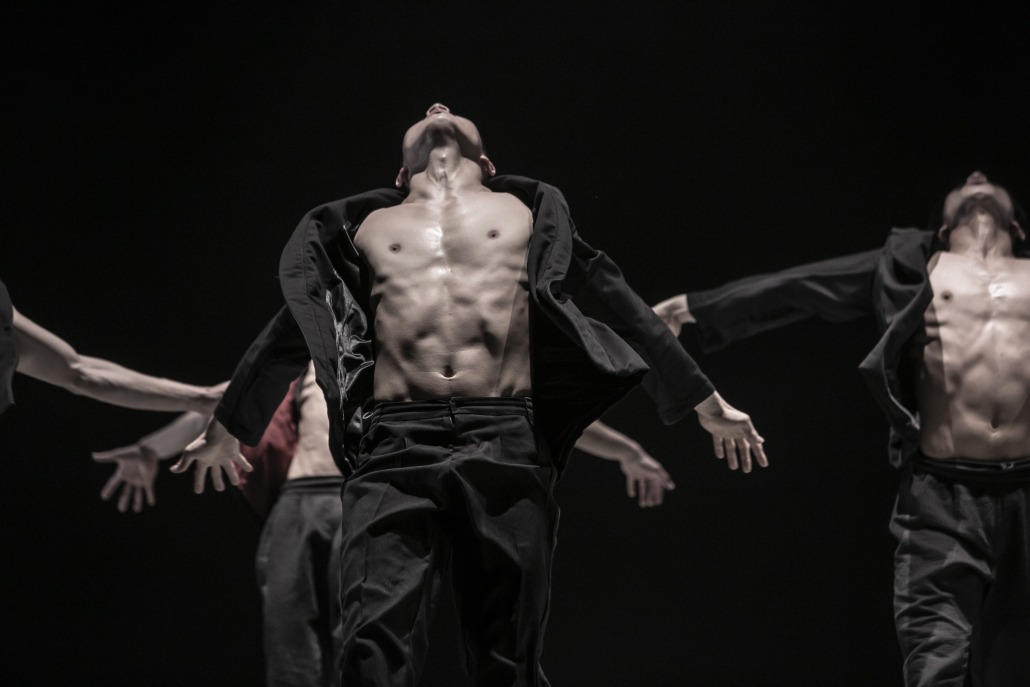

Through two acts, director Park Soon-ho meditates on violence and harmony.
Thumping snare drums, intimate lighting and sweeping, animalistic movements were just some of the hallmarks of Bereishit Dance Company’s performance, held in Bovard Auditorium by USC Visions and Voices on Sunday. The show, directed by Park Soon-ho, featured two acts: “Judo” and “Balance & Imbalance,” and welcomed USC students, faculty and staff to witness the immersive, multimodal art.
Named for its fusion of martial arts with contemporary dance movement, “Judo” took audiences down a tension-packed path brimming with bouncy, repetitive motions, athletic leaps, heavy breathing and evolving formations. The act replicated controlled chaos — at once sporadic and deliberate, pensive and carefree, and lighthearted and angry.
“The overall concept of the first performance, ‘Judo,’ was trying to explain the two traits of humans, which are violence and willingness to do something,” Park said.
As a pulsing red glow illuminated the space, a textured platform of mats that formed an oblong shape came into view. The cast soon entered with the same mats on their head, and a sensual rhythm picked up. The dancers’ small grooves, made apparent by the fluid swipes of their arms and samba-like back-and-forth of their feet, reflected the jazzy feel of the music.
However, this tranquil mood was soon dimmed by a cascade of intense, symbolist movement. As silence cloaked the auditorium, the sound of loud breaths and bare feet against mat filled the void, drawing further attention to the two performers on stage.
This sensual partner-work piece soon morphed into a somber group display where one individual, covered by the cast’s black blazers, was led across the empty space between the mats, manipulated to move where the red color of the mat was absent.
Fiona Liow, a sophomore majoring in chemical engineering as well as East Asian languages and cultures, observed these intricate choices.
“I think incorporating what your stage elements give you with your choreography is a really smart thing to do,” Liow said.
After the blazers were recollected, dancers spread out on stage, hitting the mat sporadically in a display of rage. The clap of the clothing against the mat was soon imitated by the brusque slap of blazer against skin.
According to Park, the movement replicates an Arabian religious practice, Tatbir, in which one hits themself with a metal chain. Park applied his knowledge of this exercise in order to amplify the dance’s theme of violence.
With a whirlwind of flying bodies, the act finished with a stark display of brutality. Dancers leaped over one another, knocking down their peers or tumbling to the stage floor. After multiple cycles of these aggressive blows, only one dancer, Na Ji-Hun, remained on stage.
Each time he attempted to get up, he was stunned again by a dancer leaping across the space. The act ends as Na Ji-Hun steels himself, bracing for impact, and the red light fades to black. The dancer spoke about how to navigate this physical intensity.
“Aside from eating well and sleeping well, you have to be very aware of your body itself, since it’s such a physically demanding thing to do. You have to know how your body is, and always keep that in mind when you’re practicing,” Na said.
The animalistic and jarring movement of “Judo” was offset by the second act’s more intimate exchange between bodies. A portrait of strength and poise, “Balance & Imbalance” reflected a juxtaposition between stillness and change as dancers walked toward one another and held gravity-defying poses that forced audience members to marvel at the integrity of the human body.
With wide arms and stiff torsos, dancers became statues, their movement challenging the flexibility of the human figure by making abstract squiggles in space.
Unlike “Judo,” “Balance & Imbalance” saw the dancers in everyday garb with contrasting colors. Additionally, performers were basked in a simple white light, as opposed to the hazy red of the first performance.
“I really enjoyed the playing with the stage size and then the lighting, especially when they move forward, move backward and transition,” Liow said. “It gives so much intention, and context-wise, after I knew the story, it was like fighting — there was light, there was dark, there was you win, I lose. Push and pull, give and take.”
Later during the act, live music performers immersed themselves in the dance. Narrator and singer Kim Eun-kyung not only folded humor into the act by cracking jokes on stage but also shared a traditional Korean story called Sugungga through pansori, a Korean musical storytelling mode and tradition.
According to Eun-kyung, the story follows animals who are fighting to be the leaders of the land, therefore demonstrating how humans resemble animals in the way they interact. Using varied intonation, Eun-kyung plunged the audience into narration.
“When she was singing, she tried to emphasize a lot of the accents so it would match the movements of the dancers,” said Junha Park, translator for Eun-kyung and a master’s student studying arts leadership.
The involvement of Eun-kyung and the other live musicians, Kim Jeong-uk and Ko Maeng-ka, reflected the director’s greater vision.
This diverse use of dance, acting and storytelling emphasizes Park’s attention to the multiple angles that build a society, just as his focus on community attests to his dedication to observing the human condition.
“Every dancer and musician has a different background, and to perform that and put that all together is what [I wanted] to do,” Park said.