ABC delivers final nail in coffin to American late-night television shows
Willow Bay’s silence on host Jimmy Kimmel’s censorship threatens USC free speech.
By LEILANI YBARRA
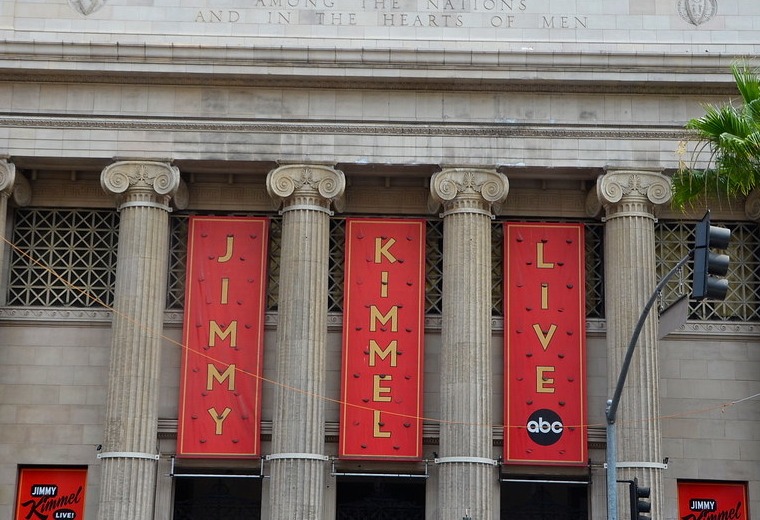

Willow Bay’s silence on host Jimmy Kimmel’s censorship threatens USC free speech.
On Tuesday night, more than 6.26 million people — at least 5 million more than average — tuned into ABC for what would become the most anticipated run of Jimmy Kimmel’s late-night talk show yet.
Last week, news of Kimmel’s indefinite termination broke following his Monday night monologue, in which he stated, “We hit some new lows over the weekend with the MAGA gang desperately trying to characterize this kid who murdered Charlie Kirk as anything other than one of them and doing everything they can to score political points from it.”
These comments about Kirk’s death, coupled with his likening of Trump’s grieving to that of a child mourning a “goldfish,” did not land well with conservatives.
After Brendan Carr, the chairman of the Federal Communications Commission, expressed his distaste for the monologue, a mouse-shaped shadow loomed over Kimmel in view of these low-punch quips. Shortly after, due to the mounting pressure on its executives, ABC pulled the plug on “Jimmy Kimmel Live!”
Late-night television shows have already been steadily declining since the introduction of streaming services: Monologues that only make you faintly exhale through your nose, clips of celebrities eating weird foods, and sound bites that would find their way on YouTube and TikTok the following morning came to define the genre.
If late-night television had already been stabbed by streaming giants, ABC’s recent attack on Kimmel was a deliberate twist of the knife. However, this wasn’t the first case of a prominent late-night show being cancelled: In July, Stephen Colbert announced that CBS would be ending “The Late Show” in May 2026. It’s worth noting that Colbert has been similarly outspoken against Trump.
As such, late-night show hosts have been falling like dominoes since the pandemic and our newfound penchant for streaming. Kimmel’s recent censorship may be a telltale sign that late-night television may never recuperate in our current sociopolitical state. What once was an untouchable institution of American culture has been reduced to occasional X virality, further deprecated by the Trump administration’s overt suppression of critique.
But let’s backtrack to the cancellation of Kimmel specifically: At the front lines of Kimmel’s studio-induced suspension was Bob Iger, CEO of Disney, which owns ABC. Notably, Iger is the husband of Willow Bay, dean of USC’s Annenberg School for Communication and Journalism.
Annenberg is among the country’s top journalism and communication schools, boasting a whopping 2,300 students — both undergraduate and graduate — currently attending. On the school’s website, you’ll find echoes of its founders’ belief in “the right to free communication” as the crux of the school’s mission.
How can its dean encourage students to “inquire” and claim to provide a haven for “critical conversations,” according to Annenberg’s website, when her husband retaliates against Kimmel as soon as he threatens Trump’s agenda with his jokes? How can we expect Bay and Annenberg as a whole to offer the journalistic vigor it so ardently promotes when she turns a blind eye to her husband’s encroachment on free speech?
You cannot deem journalism as a keystone of democracy — as Bay did in a LinkedIn post last week on the International Day of Democracy — yet stay silent when your husband bends the knee to Trump and his foot soldiers by stifling criticism.
Free speech is not a liberty you can cherry-pick, for better or for worse. It doesn’t exclusively protect the speech the government likes; in fact, it especially protects the speech the government hates. How truly stable is a democracy if it begins to tremble in the face of scrutiny by its people?
Now that we’ve reached this détente, it’s easier to reflect on the implications of late-night television on our broader political state. Kimmel’s short-lived termination revealed that our belief in political liberty, by which our entire democracy is contingent, has eroded.
We all can agree that incitement of political violence is inherently bad — or so I hope — but how, precisely, to distinguish “free” speech from “hate” speech is where the water gets a little murky. But this isn’t the job of the government: It’s the job of its people.
If we allow the government, and similarly powerful institutions like higher education, to arbitrarily ban free speech, we create a slippery slope of censorship. Cracking down on free speech breeds the kind of environment that Kirk’s assassination was predicated on, where nuance is abandoned in favor of violent extremism.
As we witnessed, the outcomes of such political shifts first surface on college campuses.
If Kimmel’s return to television has taught us anything, it’s that speaking out works; when the outpour of protests to the show’s cancellation flooded in, from everyday people cancelling their Disney+ subscriptions to celebrities condemning the actions of ABC, the tide began to shift.
Similar to how the United States defied government censorship through public pressure, we students can hold our administrators accountable and guarantee our institutions are making citizens who are well-equipped to deal with conflict in the public sphere.
What we must do is reject this intentional stifling. Everyone needs to be heard: Do not let the drum of authoritarianism drown you out. Whether you’re studying communications or accounting, you still have a fundamental right to speak your mind.