‘Homebound’ reminds us of our shared humanity
USC Kathaa hosted a screening of India’s official entry for the 98th Academy Awards Best International Feature Film and a Q&A session.
By LIA ARNOLD
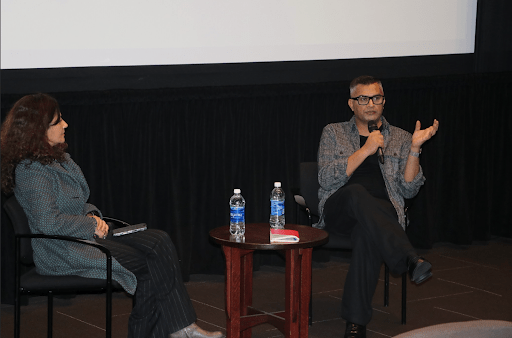

USC Kathaa hosted a screening of India’s official entry for the 98th Academy Awards Best International Feature Film and a Q&A session.
As the audience flowed into the theatre and took their seats, the house lights dimmed, and two men running to catch a train on screen foreshadowed the emotional journey that awaited the audience.
On Tuesday night, USC Kathaa, the University’s South Asian film club, hosted a screening and held a discussion celebrating “Homebound,” a Hindi film released Sept. 26. The screening at Broccoli Theatre was followed by a conversation with Priya Jaikumar, professor in the Division of Cinema and Media Studies, and director Neeraj Ghaywan.
Based on a 2020 New York Times article by Basharat Peer, “Homebound” portrays two best friends from a North Indian village. Their determination to earn respect by becoming police officers strains and strengthens their relationship as they struggle with systemic discrimination present in their lives.
The film highlights the silent struggle of marginalized communities such as Dalits — considered the lowest in India’s caste system — and how systemic inequities shape access to opportunity and dignity. Simultaneously, it interweaves moments of humor and friendship.
During the second-half of the event, Ghaywan reflected on his motives and the purpose of “Homebound,” released a decade after his last film “Masaan” in 2015. Ghaywan said in an interview with the Daily Trojan after the event that he tried to humanize marginalized communities.
“How can we take away from the statisticization of migrants?” Ghaywan said. “I wanted it to dismantle the victimhood and talk about the real human side … like what do they eat? What do they love? How do they make fun of each other?”
For people not a part of marginalized communities, he said that if they view marginalized communities with dignity and a sense of accountability, it would serve as a form of reparation, which is urgently needed.
Ghaywan said “Homebound” and its themes were made to apply to the lives of people across all backgrounds.
“The film was based on the fundamental emotion of friendship that’s universal,” Ghaywan said. “Regardless of if you don’t understand any cultures, you will definitely at least understand the warmth of friendship.”
Between main characters like Chandan (Vishal Jethwa) and Shoaib (Ishaan Khatter), Ghaywan’s idea of “connection as a form of resistance” recurred not only throughout the film but also through the entire night of the event.
He said during the interview that, “a friend is like a second home,” someone you can turn to and confide in, or share experiences that you can’t with your family members.
“Universally when we talk about how we need to empathize even with our adversity, friendship becomes a great vehicle. The connection between two marginalized communities is the form of thing that speaks against the tyranny of structures and institutions, that sort of invisibilizers,” Ghaywan said.
Siddharth Dutt Roncon, a sophomore majoring in business of cinematic arts and a member of Kathaa, said Ghaywan inspired his own filmmaking.
“I’m currently writing a script about a child prostitute in Mumbai who is also someone who’s been ostracized from society and goes through so many struggles,” Dutt Roncon said. “He gave me the confidence to tell that story.”
Later in the interview with Ghaywan, the director discussed leaving home after starting as an engineer in the corporate world. Soon after earning his MBA, he moved to a new city. Despite this physical move, he said that his definition of home is beyond a premise.
“Home becomes this quiet window that you can sit by and look outside and reminisce a time that has gone by, and when that feeling returns, or when you listen to your favorite music by that nook in the house that you like, you can travel back to a time that was totally yours. Home is something I think we carry in our hearts,” he said.
After the screening ended and the credits rolled, several audience members sat in silence, taking a moment of digestion for the culmination of the film.
During the discussion section, Veer Khanna, founder and president of Kathaa, said that after watching three Ghaywan films, he decided to study film, switching from his initial plans at USC his freshman year to study architecture.
“He has this incredible capacity to kind of dwell on the human condition in a really sensitive manner,” said Khanna, a senior majoring in cinema and media studies.
The Q&A concluded with a student’s question about how cinema can respond to social division and conflict.
“No matter what we go through in our lives, there will be moments of anguish. There will be moments of despair, but what builds us back up is the moments of warmth and happiness and joy that helps us keep our humanity intact,” Ghaywan said in the interview. “”We got to find beauty in the middle of the terror that we inflicted by from every corner.”