USC’s ChatGPT Edu subscription costs $3.1 million per year, provost says
The University will not buy previously promised carbon offsets.
By ADAM YOUNG

The University will not buy previously promised carbon offsets.
The University’s annual institutional subscription to ChatGPT Edu cost $3.1 million for 80,000 users, Provost Andrew Guzman wrote in a statement to the Daily Trojan on Wednesday.
“This includes all user subscriptions and advanced credits for deeper research using the platform while also providing data privacy users were not getting with individual subscriptions,” the statement read.
USC launched its ChatGPT Edu workspace on Jan. 13, which can now be accessed by active students, staff and faculty. The program lets users with USC emails use advanced models from OpenAI’s chatbot service, ChatGPT, for free, paid for by the University.
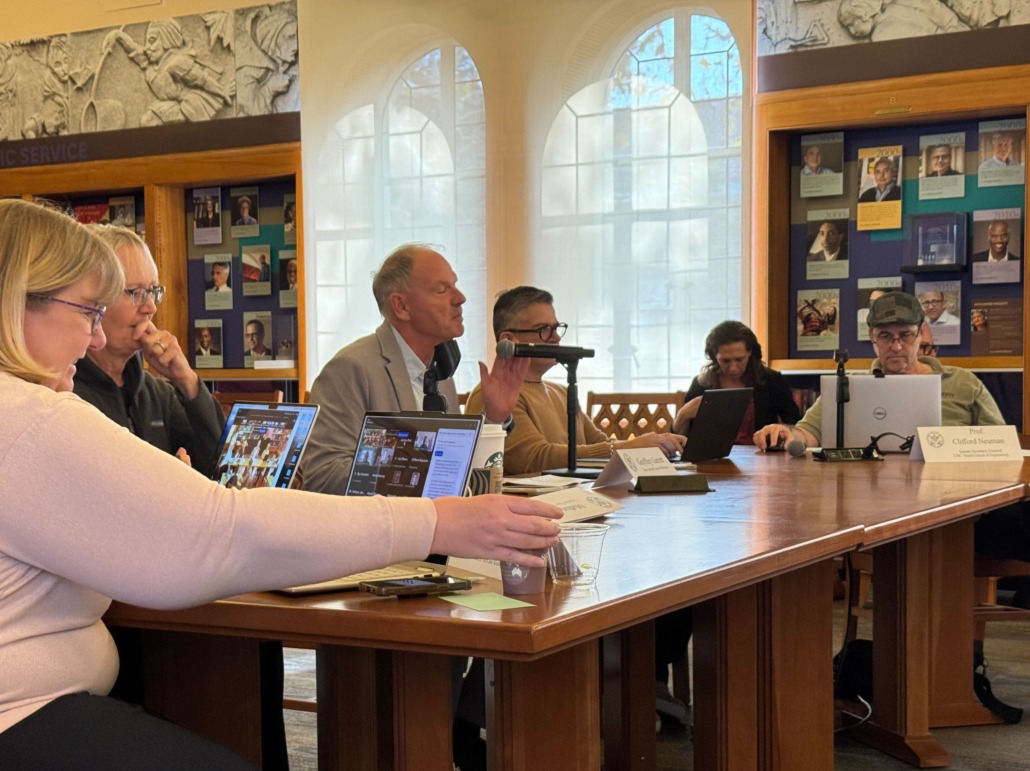
In an Academic Senate meeting Wednesday, faculty in attendance asked interim Chief Information Officer Midhat Asghar and Ashley Smith, associate chief information officer for application services, how much ChatGPT Edu cost.
Asghar said the negotiations with OpenAI started with $1.5 million per year for 5,500 subscriptions, but it was negotiated down to $2.50 per user per month. At $2.50 per user per month for 80,000 users, the cost for just user subscriptions is roughly $2.4 million. Guzman wrote that the total cost includes subscriptions and advanced credits for deeper research.
The explanation answered questions laid out by faculty in recent months, 12 of whom criticized the University in a letter to the Daily Trojan for not communicating the cost of the OpenAI partnership, considering the more than 1,000 faculty and staff that USC laid off last semester.
The USC community also has access to Gemini and Copilot, Google and Microsoft’s chatbots, respectively, which were a part of the University’s prior contracts with the tech companies, Asghar said.
From a data privacy perspective, Smith said only USC’s Copilot enterprise subscription should be used for USC data, like student IDs and USC internal memos.
Smith said more advanced features for ChatGPT Edu will be evaluated at a later date because they are currently too costly. One example of an advanced feature is a customer support chatbot in the corner of a website that uses ChatGPT’s “application programming interface” to power it.
Geoffrey Garrett, chair of the President’s AI Strategy Committee and dean of the Marshall School of Business, said the committee is focusing on using chatbots in undergraduate education. He said the committee will not prioritize researching AI and incorporating chatbot tools into management roles within the University.
There will be no mandates to use chatbots in undergraduate education, Garrett said, referencing Purdue University, which announced AI competency graduation requirements for undergraduates students starting in 2026.
“That’s not the way USC works,” Garrett said during the meeting.
Garrett said he wants to instead give undergraduates the practice to be fluent in using chatbots. He also invited schools to make AI majors for the discipline, saying that chatbot usage is different from every major, from physics to the creative arts.
The committee will also not focus on graduate education because many graduate schools are already using chatbots in their own way and Garrett said he did not want to stifle that.
Two topics Garrett said the AI committee hasn’t addressed yet are how the ChatGPT subscription would affect academic integrity and how to incorporate chatbots into USC’s healthcare system.
Garrett said the University released a survey about AI usage to students, faculty and staff in November, but it only had 1,000 responses. When asked about the survey results, Garrett said the responses showed that faculty were more concerned about chatbots than staff and students, but the results should be taken with “a grain of salt” because of the survey’s small sample size.
The University will soon host an Open Dialogue forum on the use of AI’s impact on student learning in the next few months, Garrett said, which may discuss the “Your Brain on ChatGPT” study that found that consistent chatbot users “consistently underperformed at neural, linguistic, and behavioral levels.”
The senate also heard from Chief Sustainability Officer Mick Dalrymple and Director of Energy and Sustainability Zelinda Welch, who updated faculty on USC’s current sustainability projects.
Welch said the University installed rooftop solar panels on Ginsburg Hall, Carol Little Building, Bloom Football Performance Center and the new baseball stadium, Dedeaux Field.
Dalrymple said the University will not be purchasing carbon offsets “in any substantive quantity” to neutralize fiscal year 2025’s emissions because of budget constraints. Carbon offsets are purchasable certificates that fund emission reduction activities elsewhere.
In September, Dalrymple told campus media that carbon offsets may play a significant role in meeting 2025’s sustainability goals. He also said the University’s assessments have shown that purchasing carbon offsets is cheaper than converting its energy consumption system to be more sustainable.