‘MAJOR’ highlights the beauty of the Black femme community
Ogemdi Ude’s performance blended vocal recitals and Black majorette movement.
MIRANDA HUANG
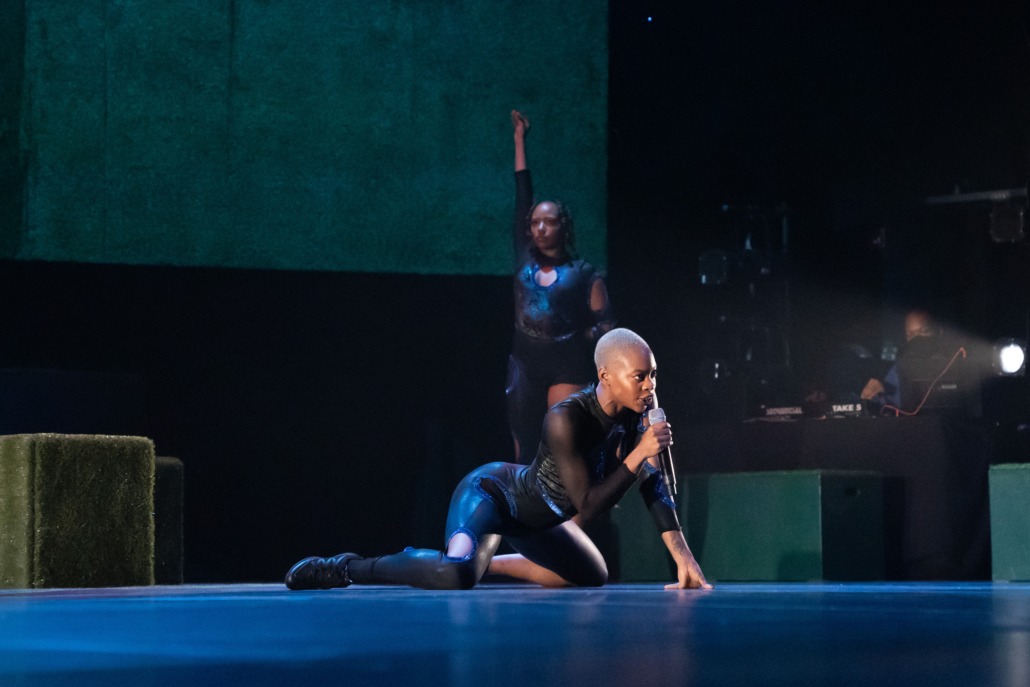

Ogemdi Ude’s performance blended vocal recitals and Black majorette movement.
Fusing oral history and diverse choreography, “MAJOR” by Ogemdi Ude welcomed a vibrant audience to Bovard Auditorium for the Visions and Voices event on Wednesday to witness Black femme creativity and engage with what it means to return to the body and a distant art form.
Synthesizing various music genres and movement forms, the performance draws its name from majorette dance, a style typically represented at historically Black colleges and universities that blends jazz, hip hop and pom, pairing with sound produced by the associated school’s marching band.
“We are a team of dancers who are very excited to re-enter this form, but we’re also doing it with the understanding that we’re learning it, we’re unpacking it, we’re unraveling it,” said Ude, choreographer and director of “MAJOR.”
According to Ude, highlighting local majorette teams and marching bands helped individualize each performance’s ending. Members from USC’s majorette dance troupe, Cardinal Divas, joined Trojan Marching Band players on stage, localizing the impact of the tour.
“It felt really important in this tour to go find the people who have been connected to [majorette] in some way. Let’s bring it directly to them, even if it’s just a handful of people in the audience who have that connection. It’s worth us performing directly for them,” Ude said.
The performance opened with one dancer undulating. While murmuring broken phrases building up to “I can be a grown girl,” the dancer reacquainted herself with her limbs and surroundings, folding in majorette movement in the process.
“I always feel like language is an extension of movement. Very intensely. It feels like when you don’t know what your body can do, your mouth will figure it out. And when your mouth doesn’t know what to do, your body will figure it out,” Ude said.
As the act progressed, six dancers came to command the stage, which was sparse save for a few cubes covered in a turf-like textile. A playful and sensual set dedicated to twerking, a dance move that originated with Black American culture in the 1990s, animated the crowd as audience members cheered and rose from their seats.
“All I wanted as a kid, in some weird way, was to be both sexy and appealing,” Ude said. “I’m loving it, and then at the same time I’m confused by it, and I don’t know what to do with it.”
The energetic mood soon shifted as one dancer shouldered the weight of another and handed her a microphone. An oral intervention followed, infused with urgent poetics, repeated commands and emboldened phrases such as “watch me be grown.”
“I was very excited to hear the poetry,” said Courtney Greer-Brown, an audience member who grew up surrounded by majorette dance. “As [the dancer] continued on, and it got louder and faster, it got more powerful. It felt like there was a giving birth to the self, giving birth to this sense of confidence.”
In addition to moving beyond the physical, “MAJOR” defied the constraints of the stage as two dancers took to opposite aisles and attempted to converse, both linguistically and physically, across the wide space.
“I think a lot about grieving my younger self and the person who I thought I was going to be versus the person that I am,” Ude said. “In my work, I’m often trying to honor the desires of that younger self while also honoring the space that I’m in now.”
The dance continued with urgent, high-strung movements, balanced by moments of stillness and fluidity as members from Cardinal Divas soon joined a select few from the Trojan Marching Band.
“I appreciated that the Cardinal Divas were included because they are the premiere majorette organization here at USC,” said Lika Dozier, a University relations program specialist. “Going to football games [puts them on] a big stage, but they don’t necessarily get screen time. So to give the platform to a more mainstream and wider audience I think was really interesting.”
Returning to the phrase “I can be a grown girl too,” one dancer rounded out the performance with broad and sweeping majorette moves. Unlike in the beginning, the performer projected the phrase without interruptions, highlighting a recurring macro theme of growth and girlhood.
“We’ve been socialized as Black girls. We all share very distinct experiences as to how people look at us, as to how people would tell us we’re acting too grown,” Ude said. “That feeling of aspiring for something that at the same time people are telling you to push against felt really important to us.”
Ude said she hopes audiences reflect on what it means to rediscover past selves as well as consider the beauty and solidarity of the Black femme community.
“It’s very important to carry on these conversations, these traditions, these histories, because we are the way that they survive,” Greer-Brown said. “We are the vessels that continue on this legacy and this piece of our very important culture of Black family life in America.”