On paper, USG senators had a slow year. We asked them why
The senate has passed fewer bills than past years, instead focusing on advocacy goals.
By SEAN CAMPBELL & NATHAN ELIAS
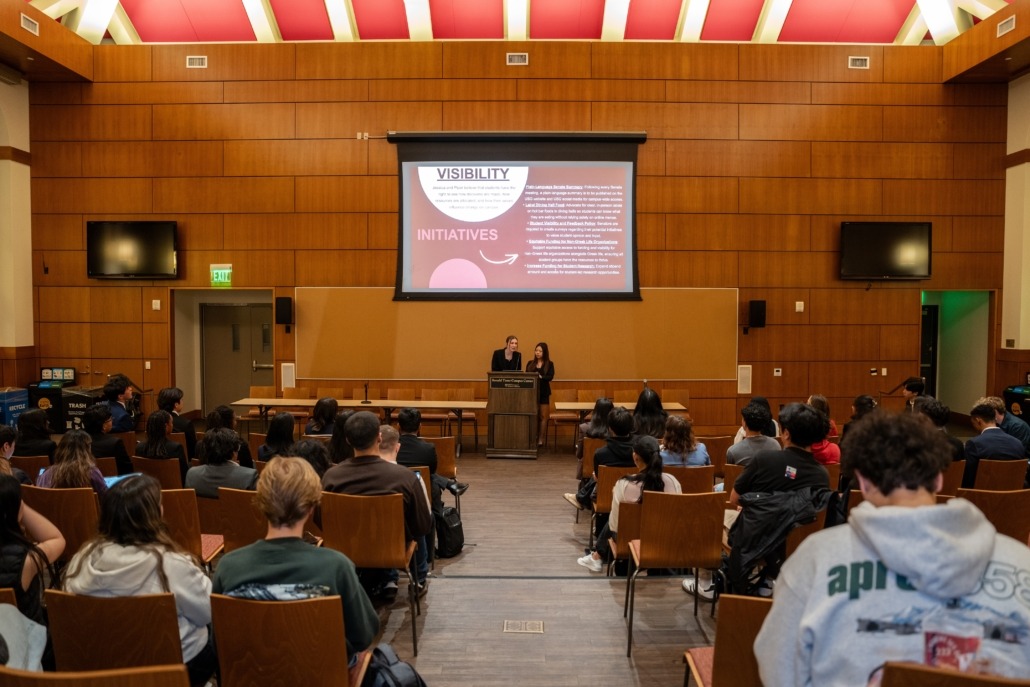

The senate has passed fewer bills than past years, instead focusing on advocacy goals.
What do Undergraduate Student Government senators actually do?
It’s a question that comes back year after year. Students campaign with big promises to bring new fast food restaurants to campus and secure student discounts. In practice, the work of the senate takes months to produce results in any given year, if at all. But the 2025-26 senate has been especially quiet.
The senate has passed 16 bills as of publication, at least 10 fewer than it did in the same time for the past two years. Less than half of the 16 bills passed this academic year have made a direct impact on students; the rest were related to internal USG operations, including yearly updates to guidelines and rules and a logo change.
The Daily Trojan reached out to each member of the senate to find out why.
Senate shifts focus away from projects due to restraints
The foundation for the current senate’s approach extends from last year. In a February 2025 interview with the Daily Trojan, then-USG president Brianna Sánchez said the organization would need to shift its approach away from project-based work and focus more on advocacy. The need came from the limitations of one-year terms, financial and operational restrictions within USG, and USC’s $200 million structural deficit, she said.
Vice president Emma Fallon told the Daily Trojan in an interview Wednesday that a major reason the senate has had fewer deliverables this year is because senators are reaching out to administration and stakeholder groups to gather data before launching projects.
“A lot of past bills and resolutions often were presented without some of the legwork of talking to [administration] and things like that,” Fallon said. “So it was something we wanted to focus on this year.”
Among the bills that have more directly impacted students this year are: a mid-year reallocation of USG’s budget, which gave $155,400 more to programming assemblies and committees; allocation of money for developing rest areas in Leavey Library; and several changes to the USG election code, including the creation of a committee to review appeals independent from the judicial council, which has historically reviewed code violations.
Senate declines to make public statement on Trump’s compact
A major part of the senate’s output in previous years has been resolutions — public statements advocating for specific outcomes, often addressed to USC administrators. Some resolutions passed in the last two years asked USC to take down the fencing at campus entrances and around Alumni Park and reinstate the Academic Achievement Award and Exceptional Funding.
The fencing was put in place during the Spring 2024 pro-Palestine encampment protests. The awards allowed students with multiple undergraduate degree goals or with certain merit scholarships to take some extra units at no added cost.
So far this year, the senate has passed one resolution, which asked USC to add the Office of Sustainability as a support system on all academic syllabi. Jeremiah Boisrond, USG’s speaker of the senate, said the senate focused more on meeting with administrators to present survey results and advocate for changes.
This approach took center stage in October, when the Trump administration sent USC its Compact for Academic Excellence in Higher Education, proposing a series of conservative policy changes in exchange for preferential access to federal funding and other benefits. Boisrond said USG did not move forward with a resolution urging USC to reject the compact as was proposed by leaders of the Environmental Student Assembly.
The senate instead focused on a survey to gather opinions from students before president Mikaela Bautista and Fallon met with then-interim President Beong-Soo Kim, Boisrond said. The Graduate Student Government, on the other hand, released a statement urging Kim to reject the compact, while more than 30 faculty speakers urged the same at an Academic Senate meeting. Kim later rejected the compact.
Many campaign promises needed pivots
Senator Sudeepta Murthy came into her term eager to secure a partnership between USC and Waymo to expand access for students. But after weeks of work over the summer, she said USC Transportation informed her that the University would not have the money for such a program due to budget restrictions. She said she faced a similar roadblock when seeking a partnership with DoorDash.
“Every single time I would try to come [up] with an idea, somebody would say, ‘We’re strapped for cash. We’re strapped for cash,’ which is true,” Murthy said.
Murthy said she has found more success with a project to make study rooms available in Leavey Library’s basement and the Crow Center for International & Public Affairs without needing a reservation, a project that she said took roughly two months to implement from brainstorming to coordinating with administrators. USG announced the change in early December.
In an email statement, senator Kevin Hoang wrote that he had to abandon his promise to bring Kentucky Fried Chicken to USC due to “vendor and contract restrictions,” though he wrote in his email that “KFC” also represented the acronym “Kevin for Change.” Hoang wrote that he needed to pivot several of his projects to maximize their impact: His pitch to create more accessible dining options, for example, shifted into advocacy for clear wait times to be listed for restaurants at Tutor Campus Center.
Senator Jad Kilani wrote in a statement that his proposal to provide eco-friendly laundry strips did not pass an internal vote of confidence, but he is in talks with the Office of Student Basic Needs to provide prepaid cards for students to pay for laundry. In 2024, the senate allocated $4,000 to a laundry stipend project, which gave 80 students $50 to subsidize laundry costs.
Despite limitations on many projects, senators made progress on several projects according to USG’s legislative branch project tracker, including a system that allows units to roll over semester-by-semester and a survey to gather input after USC cut back the start time of USC’s free shared Lyft service by one hour. The senate also advocated to restore 24/7 access to the Jefferson Boulevard Parking Structure after its hours had been cut, organized a tenants’ rights workshop and purchased 500 blue books to distribute to students for free.
Senators Karim Debian, Zach Garcia, Sabeeh Mirza, Zehran Muqtadir, Kian Salek, Justin Shih and Moy Valdez did not respond to the Daily Trojan’s request for comment in time for publication. The Daily Trojan did not contact senator Noa Foruzanfar, who recently started her term Jan. 20, or former senators Dakota Driemeyer and Andrew Cardenas, who have both resigned.
Disclaimer: Andrew Cardenas serves as the Spring 2026 Diversity, Equity, Inclusion and Accessibility director, as well as editor of the Talkin’ Troy podcast, at the Daily Trojan. He was not affiliated with the paper as a USG senator last semester and is not involved with USG coverage this semester.