USC projected to have a balanced operating margin in fiscal year 2026, Kim says
President Beong-Soo Kim said he wants to bring “operational excellence” to the University on Wednesday.
By ADAM YOUNG
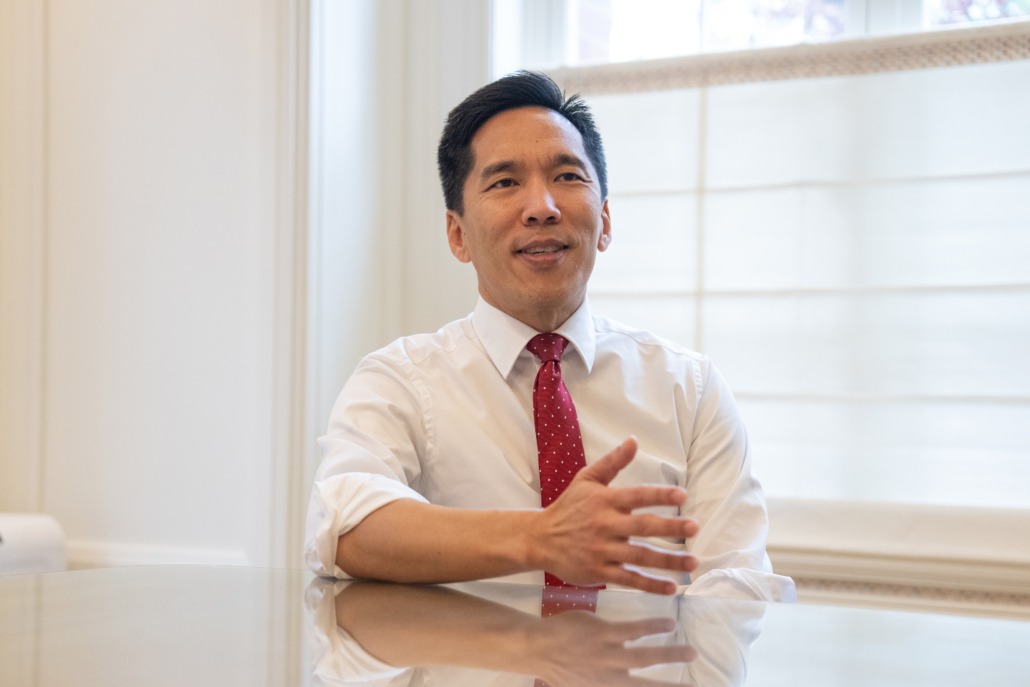

President Beong-Soo Kim said he wants to bring “operational excellence” to the University on Wednesday.
President Beong-Soo Kim said USC is projected to maintain a balanced operating margin for fiscal year 2026 at Wednesday’s Academic Senate meeting.
In Fiscal Year 2025, the University ran a $251 million operating deficit, which Kim wrote in a November email was one of the contributing factors in the decision to lay off over 1,000 faculty and staff in Fall 2025. Now past the deficit, Kim said he wants to bring “operational excellence” to USC by using the University’s existing resources to make it more valuable and easier for schools to collaborate.
Currently, Kim said, cross-school collaborations happen, not because of the University, but despite it. Amid the growth of the artificial intelligence industry, Kim said USC should focus on human values and integrate the arts more with health and technology disciplines.
When the discussion was opened to faculty questions, Michael Andersen, an associate professor of clinical physical therapy, asked Kim if the University would re-evaluate changes related to Diversity, Equity and Inclusion made on Feb. 14, due to federal pressure subsiding.
In March 2025, USC changed its DEI unifying value to “Community,” citing at the time the Trump administration and the Department of Education’s released policies targeting DEI and race-based decision-making. In February 2025, the Department of Education released a letter announcing that higher education institutions must eliminate the use of race in all other aspects of student, academic and campus life or risk losing federal funding.
In January, court filings showed that the Trump administration dropped its appeal of a court ruling that blocked its campaign against DEI policies in higher education. It was dropped due to it violating the First Amendment and federal procedural rules.
Kim said the underlying executive orders and rules about DEI programs are still fully intact, so the University’s policies will remain.
During open discussion with Kim, Bridgid Fennell, a social and behavioral sciences librarian, said faculty no longer have the opportunity to travel to conferences for professor development, which she said is critical due to ethical issues arising with generative AI in higher education. In March 2025, USC restricted spending on non-essential business travel due to financial strain.
In response, Kim said the University is currently re-evaluating the travel expenses policy implemented last year, and may lighten the restrictions so faculty can travel to conferences.
On the topic of research grants, a faculty member told Kim that the hiring freeze — also implemented in March 2025 due to financial strain — has affected the efficiency of grant applications, saying faculty are disincentivized to apply for research grants because of financial barriers.
In response, Kim said there needed to be a more streamlined way of doing pre-grant work and a change to how the University administration thinks about the research review apparatus, so it can do multi-school grants. Kim also told faculty not to stop submitting grants because it is the reason why research expenditures have been going up.
Another point Kim talked about was fostering a teaching culture on campus rather than creating mandates. He said he wanted to create a campus culture where professors want students to come into class so that the student improves.
Michael Bodie, associate professor of practice of cinematic arts, said to Kim that the relationship between the University and faculty has become more extractive, referencing the Spring 2025 cuts. Bodie also echoed the sentiment that faculty are disincentivized to improve and asked Kim if there would be more support for faculty.
Kim said he wished he had an answer for that and recognized that Los Angeles is an expensive city. He also said that there was an issue with the uneven distribution of effort and productivity among tenured faculty.
In response to another faculty member’s comments about the tenured faculty population changing at USC, Kim said a student group that is part of the Open Dialogue Project told him that adjunct faculty do a better job at facilitating open dialogue in the classroom than tenured professors.
Kim also said during the meeting that the University was approaching its 150th anniversary. With the anniversary and the 2030 Summer Olympics approaching, Kim said it was time to reflect on why USC exists.
Going forward, Kim said the University should think about its impact on challenges the world is facing, like threats to democracy, a spiritual lack of meaning and challenges in medicine. Kim said USC can lead the way in solving these major challenges in the coming years.
“If I had to pick any point in my entire life to be a university president, it would be today,” Kim said.