VITAL SIGNS
Who gets to be an athlete?
As an improbable competitive athlete, I believe we can broaden our definition of athleticism.

By SOEFAE CHEN

As an improbable competitive athlete, I believe we can broaden our definition of athleticism.
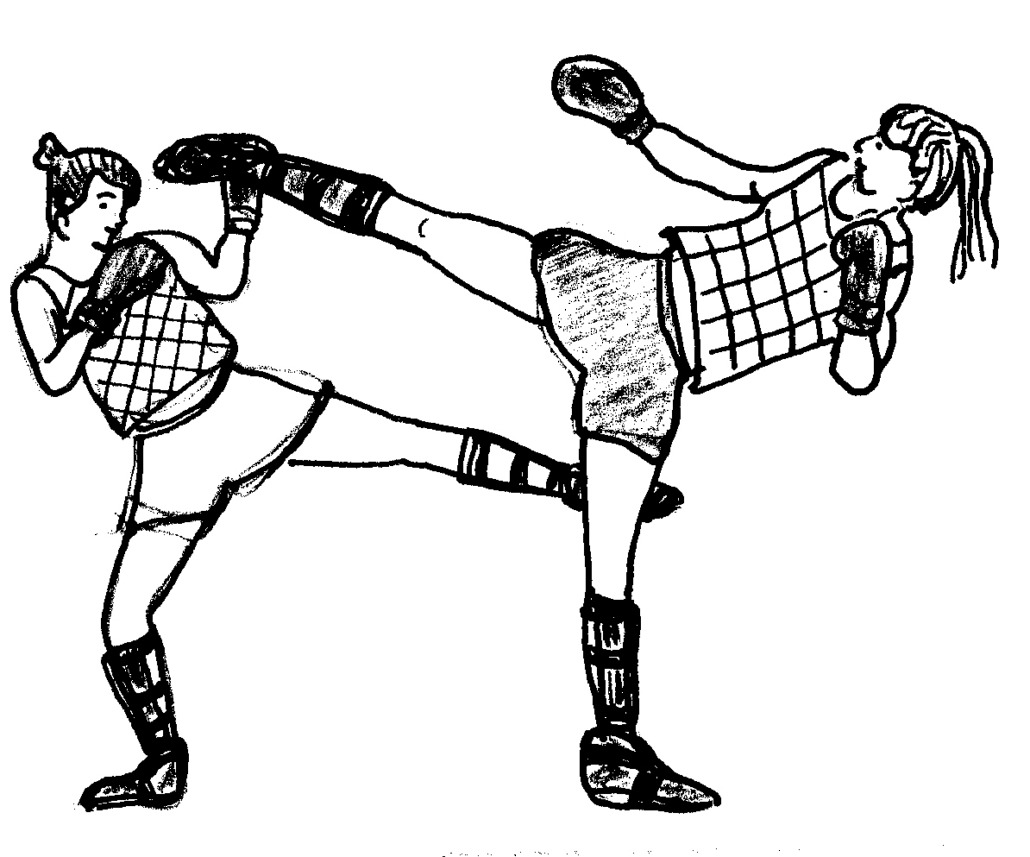
During the first week of my freshman year at USC, I joined the Trojan Boxing Club. As a 5-foot-4, 120-pound, 17-year-old, Chinese-Canadian girl with no experience in the sport — and little experience in most other sports — I was terrified to take up space among the taller, older and seemingly stronger guys that filled the training room.
Yet, one year later, I represent and compete for USC at the collegiate level.
The sports community is a wonderful one, especially as a young person. When your body is still changing and your confidence is forming, being part of that group can positively shape how you see yourself. Improvement feels natural, and community keeps you accountable.
Unfortunately, this community excludes more people than it inspires.
A report by the American Academy of Pediatrics in 2024 found that 70% of kids quit sports by age 13, with girls dropping out of clubs at nearly twice the rate by 14 for reasons far beyond injuries, according to research done by the Women’s Sports Foundation. According to this systematic review, many young athletes say they left because they never felt they fit the image of what an athlete was supposed to be.
Many of us grow up with a narrow mental picture of athleticism and who gets to be an athlete. Popular sports media and even physical education often spotlight a narrow ideal — athletes framed as tall, lean and hypermasculine — which can make anyone outside that template, including myself, feel less legitimate in athletic spaces.
Growing up without an athletic identity, I used to imagine “sports people” as a completely separate category of individuals. In late high school, I began lifting weights and running, but I had never envisioned participating in a competitive sport.
Starting in college, I was encouraged to pick up Pilates, an exercise with relatively low stakes and commitment, as it seemed most fitting for a girl with minimal athleticism and an interest in matching workout sets.
However, “fitting” was what stopped me from trying out for sports teams in high school. “Fitting” kept me in research labs and quietly lifting light weights. “Fitting” limited me from — and thereby punished myself with — who I could have become.
It stopped me from seeing all of the possible, yet unfulfilled, versions of myself. I needed college to be where and when I learned how to handle the discomfort and self-doubt that come with trying new things. Luckily, USC’s club sports have built something radically inclusive.
Clubs like Trojan Boxing and USC Wrestling allow you to progress from beginner to true competitor. Each person in the ring or on the mats has a different reason for being there — building fitness, representing our school or simply learning a new skill — but we all share the same starting point: We chose to show up before we felt ready.
I was searching for a space where I could experience fear and then learn to swallow it — to get punched and then build resilience. Before each practice at the start, my hands shook, my stomach hurt and I spent way too much time wondering which outfit would make me look the most serious.
It wasn’t until much later, after committing months to physical conditioning, partner drills and sparring, that I considered, perhaps, my greatest opponent was myself. Once I committed to showing up for myself — to the expectation of small, steady improvement — the nerves simmered away.
I learned physical skills, but, more importantly, surrounded by peers chasing their own versions of strength, I learned that “athlete” isn’t a brand. Fundamentally, to be an athlete is not for the label, just as fights are not for a title. To be an athlete is to practice courage, discipline and, most significantly, the belief that you can be whoever you work to become.
Every match, those six minutes in the collegiate boxing ring demand total commitment: to be fully present, to give everything you have and to trust the work you’ve already put in. Each round is proof that discipline creates resilience and that effort compounds into growth. Challenge becomes the catalyst for change and, in my humble opinion, there is no proof of life without change.
What makes Trojan club sports so special is that, whether you compete in an individual or team sport, you’re never alone. There is an entire team — a family — that cheers you on through blood, sweat and tears.
For anyone who has ever felt like they are “not a sports person,” these spaces show that you don’t have to arrive as an athlete to belong. You just have to start where you are and keep stepping back into the ring, field, court, pool or studio, and trust that your athletic identity can be something you build, not something you’re born with.
In the end, the question isn’t who gets to be an athlete — it’s whether you’ll give yourself the chance to become one.
Soefae Chen is a sophomore writing about health and fitness culture in her column, “Vital Signs,” which runs every other Friday.