‘Pretty Lethal’ is pretty unexceptional
The horror film’s premise is fun, but brought down by corny dialogue and flat characters.
For fans of:
“Dance Moms”
2.5
By THAMRA HUSSAIN

The horror film’s premise is fun, but brought down by corny dialogue and flat characters.
“Dance Moms”
2.5
Ballet is on the minds of many in the world of entertainment — thanks to a certain high-profile actor’s recent comments on the dance form — making it the perfect timing for the release of “Pretty Lethal.” The film is an action-thriller from director Vicky Jewson and writer Kate Freund, released March 13 on Prime Video.
The film follows five ballerinas who have to fight to survive a life-threatening detour on their way to a showcase in Budapest. After their car breaks down, they find themselves at the sketchy Teremok Inn, run by the cold and mysterious Devora (Uma Thurman), once a ballerina herself.
When one of the guys hanging around the bar, Pascha (Tamás Szabó Sipos), shoots and kills their dance teacher (Lydia Leonard) after she rejects his advances, the story takes a bloody turn.
We’re introduced to a promising ensemble of ballerinas from the start: The cast is full of actors with great past projects. Unfortunately, it’s almost immediately clear that the characters are one-dimensional cliches.
Bones (Maddie Ziegler) is a talented-but-apathetic dancer who’s less well off than the others. Her conceited rival, Princess (Lana Condor), hates her for having a solo. Avantika Vandanapu plays Grace, a religious, ditzy personality. Millicent Simmonds plays Chloe, a more serious dancer who’s hard of hearing, and Iris Apatow plays her sister Zoe, who doesn’t have much of a role besides being her sister’s interpreter.
Bones is portrayed as the only level-headed dancer. The others are either freaking out, complaining, high or simply not there. The majority of the main characters are underdeveloped, making it difficult to become invested in their individual stories, something essential for an ensemble cast. This isn’t helped by weak and predictable dialogue.
The girls need to escape from Pascha, as he sends assassins after them because they were witnesses to the murder. It’s looking grim, but as Bones puts it, “these guys are drunk and out of shape and we’re prima fucking ballerinas.” It’s one of many corny one-liners that plague the film’s dialogue.
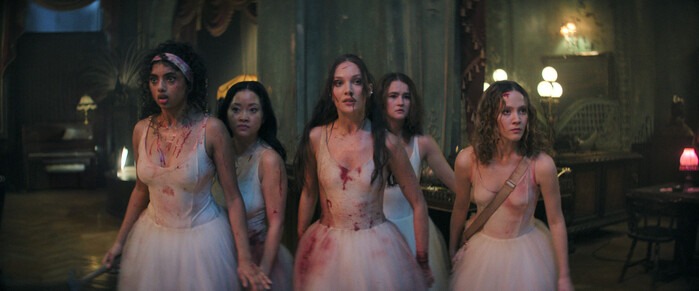
After the assassins arrive, the film’s first major fight scene begins as the ballerinas fight back. It’s a fun sequence, involving plenty of high kicks, sharp hairpins and even a couple of impressive pirouettes. They put up a good fight and take the men down. Oh, and they’re dressed in their tutus and tights the whole time, a silly visual detail.
Although the fight scene was entertaining, it’s important to note that pretty much since arriving at the inn, Chloe has not been with the rest of the dancers. It was a strange decision to omit one of the core five dancers from a major scene. It’s especially sad this happened to Chloe, as it’s already rare to see representation of hard-of-hearing folks in film.
Eventually, the girls return to the lobby together and Zoe accuses the rest of them of forgetting her sister. It comes off like an attempt to brush over the writer’s bad decision. They attempt to escape, but are caught by Devora’s henchmen.
Now, bonded as a team, makeshift weapons in hand, they get in position and … start performing “Waltz of the Flowers” before attacking the henchmen. It starts corny, but seeing ballerinas kill grown men to the tune of Tchaikovsky is kind of awesome.
Afterward, all seems well until Bones is stopped from escaping again, this time by Devora herself. We learn that Devora lost her leg after her father couldn’t pay Pascha’s father, Lothar (Michael Culkin), back, thus ending her ballet career and leaving her resentful and bitter.
Thurman delivers the film’s best performance here, conveying the anger she feels at losing her chance to be a star ballerina. She leaves Bones to her employee, Doktor (Gábor Nagypál), who almost amputates Bones’ leg, until she is saved by Grace.
As the dancers run, they learn that the building is wired with explosives but have little time to worry before Pascha’s father arrives with his own henchmen, ready to eliminate all witnesses of his son’s crime. At this point, Devora decides to let the girls go, saying, “This is my solo.”
In an epic climax, Devora sets all the bombs off just as the girls escape the inn, the explosion blowing out the windows as they fall out of the building. She gets her revenge against Pascha’s family, and the girls gratefully motorbike to the showcase.
The final scene is a beautiful ballet performance from the five dancers, still in their bloodied clothes. This contrast from all the action makes it a great way to end the film. Working together, the girls have bonded and gotten over their differences, and the audience is brought back to the art and dance form that brought the characters together in the first place.
The film had its ups and downs. It was definitely fun to see ballerinas kill henchmen using blades they use to prepare their pointe shoes — the storyline was unique and fresh, definitely something not seen before. In addition, the action sequences that combined dance and combat were special and super engaging.
Unfortunately, the sheer lack of character depth for most of the main characters as well as uninteresting and sometimes cringey dialogue definitely brought it down. What could have been a complex action film that showcased the art of ballet through character growth was instead a more surface-level story with eye-roll-worthy dialogue.
It might have been great if it went full over-the-top comedy or thriller, but nonetheless, it’s a fun, campy watch, and might be the second-best publicity ballet has had in a while.
The girls need to escape from Pascha, as he sends assassins after them because they were witnesses to the murder. It’s looking grim, but as Bones puts it, “these guys are drunk and out of shape and we’re prima fucking ballerinas.” It’s one of many corny one-liners that plague the film’s dialogue.
After the assassins arrive, the film’s first major fight scene begins as the ballerinas fight back. It’s a fun sequence, involving plenty of high kicks, sharp hairpins, and even a couple of impressive pirouettes. They put up a good fight and take the men down. Oh, and they’re dressed in their tutus and tights the whole time, a silly visual detail.
Although the fight scene was entertaining, it’s important to note that pretty much since arriving at the inn, Chloe has not been with the rest of the dancers. It was a strange decision to omit one of the core five dancers from a major scene. It’s especially sad this happened to Chloe, as it’s already rare to see representation of hard-of-hearing folks in film.
Eventually, the girls return to the lobby together. Zoe accuses the rest of them of forgetting her sister. It comes off like an attempt to brush over the writer’s bad decision. They attempt to escape, but are caught by Devora’s henchmen.
Now, bonded as a team, makeshift weapons in hand, they get in position and … start performing “Waltz of the Flowers” before attacking the henchmen. It starts corny, but seeing ballerinas kill grown men to the tune of Tchaikovsky is kind of awesome.
Afterward, all seems well until Bones is stopped from escaping again, this time by Devora herself. We learn that Devora lost her leg after her father couldn’t pay Pascha’s father back, ending her ballet career, leaving her resentful and bitter.
Uma Thurman delivers the film’s best performance here, conveying the anger she feels at losing her chance to be a star ballerina. She leaves Bones to her employee, who almost amputates Bones’ leg, until she is saved by Grace.
As the dancers run, they learn that the building is wired with explosives, but have little time to worry before Pascha’s father arrives with his own henchmen, ready to eliminate all witnesses of his son’s crime. At this point, Devora decides to let the girls go, saying “this is my solo.”
In an epic climax, Devora sets all the bombs off just as the girls escape the inn, the explosion blowing out the windows as they fall out of the building. She gets her revenge against Pascha’s family, and the girls gratefully motorbike to the showcase.
The final scene is a beautiful ballet performance from the five dancers, still in their bloodied clothes. This contrast from all the action makes it a great way to end. Working together, the girls have bonded and gotten over their differences, and we are brought back to the art and dance form that brought them together in the first place.
Overall, the film had its ups and downs. It was definitely fun to see ballerinas kill henchmen using blades they use to prepare their pointe shoes — the storyline was unique and fresh, definitely something not seen before. In addition, the action sequences that combined dance and combat were special and super engaging.
Unfortunately, the sheer lack of character depth for most of the main characters, as well as uninteresting and sometimes cringey dialogue definitely brought it down. What could have been a complex action film that showcased the art of ballet through character growth was instead a more surface-level story with eye-roll-worthy dialogue.
It might have been great if it went full over-the-top comedy or thriller, but nonetheless, it’s a fun campy watch, and might be the second-best publicity ballet has had in a while.