VITAL SIGNS
What are we really training for?
Social fitness apps push us farther than we’d go alone, toward both health and approval.

By SOEFAE CHEN
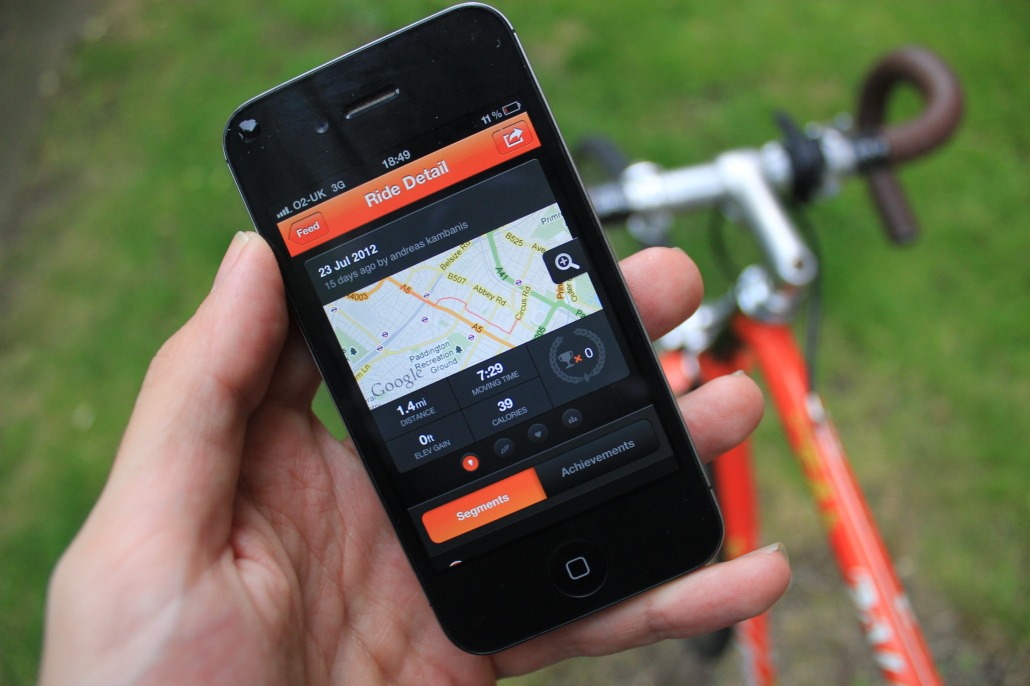

Social fitness apps push us farther than we’d go alone, toward both health and approval.
The other day, a stranger commented under my Strava post, “What are you training for?”
I responded with, “Old age,” and was met with laughter from other commenters.
I’ve been an on-and-off runner since high school. During my off seasons as a boxer, I run merely to stay active and feel alive.
During competition season, when my coaches required that I download Strava to track my cardio, I considered protesting. I enjoyed the extra running, but I have been curating my Instagram profile since I was 10 years old and didn’t want to obsess over yet another form of online self-expression subject to public critique.
With Strava, however, not only was my appearance being judged, but also my effort and results.
Social fitness tracking apps map your workout routes, rank your pace on leaderboards and share these statistics with other users who can like, comment and compare. Strava frames this as encouragement: “Track your progress and cheer each other on,” its website reads.
And maybe, sometimes, it is. Yet, once my previously private routine became visible as data and consumed as others’ content, it also became legible as a performance that requires evaluation. Just as my strong runs felt like proof of life, my slower runs seemed to require justification.
App-based competitions can increase physical activity substantially; a 2017 National Library of Medicine large-scale analysis found a 23% increase in physical activity, particularly among previously inactive users in response to the gamification of exercise through mobile apps.
On the surface, that is a genuine public-health success, but the same mechanism that gets people moving can also redirect them to a narrow, social lens, where the motive behind working out can shift from something intrinsic — like self-care — to something performed.
Michael Li, a sophomore majoring in biomedical engineering, ran the Los Angeles Marathon two weeks ago. He is a mutual of mine on Strava, but I hadn’t realized he was training for it.
A lot of the time, Li said he looks at his Strava account and thinks, “‘Oh, this is not a good run.’”
“If I don’t hit a certain pace, distance, or if I feel really terrible during a run, it puts me off,” he said. “I just private [the post]. It just doesn’t show for [the] public.”
His mindset, he said with laughter, is “PR or ER,” meaning breaking a personal record or going to the emergency room. The joke lands because it’s funny, but only partly. He ran the marathon with only 16 weeks of training as a starting point in his journey into endurance sports..
Before he graduates, Li said he wants to qualify for the Boston Marathon, which has incredibly strict qualifying times. Later, he said he plans to complete an Ironman — a consecutive 2.4-mile swim, 112-mile bike ride and a full 26.2-mile marathon run — and HYROX — a combination of repeated endurance runs and functional strength training — races too.
The ambition and grit required to compete in such races are as admirable as the outcome, but there is also something telling in what doesn’t make it onto the feed. Even before the race, the story of the race is already edited into a version of effort that is clean, upward and self-possessed.
This is where fitness tracking becomes morally complicated.
These platforms are highly effective at encouraging consistency through the external validation of mutuals’ kudos and comments. According to research published in the Children and Youth Services Review in December 2020, highly controlled and intense habits can be reinforced when they align with cultural ideals of discipline and strength, even when psychologically distressing or physically harmful.
Social fitness apps don’t necessarily create obsession, but they give it the structure; they can make sustainable training look identical to unhealthy compulsion: more miles, faster paces, greater frequency. The metrics flatten the difference. They cannot tell whether you are taking care of yourself or pushing past limits because both register as progress.
When progress is defined too visibly and simply, the app can train us to think that only certain efforts count; it can make us ask whether a slow week was still valuable, whether effort matters if it cannot be posted.
And yet, I do not think the answer is to stop tracking altogether or to treat Strava like some kind of moral contaminant. The app merely reveals how quickly we can begin to measure ourselves by what is impressive to other people.
Perhaps the better question is not what we are training for in public, but what we are training for when no one is watching. We train for health, for ambition, for pleasure or for proof that we are still becoming.
Maybe the point is that some efforts are supposed to be bad, some efforts unrecorded — not because they don’t count, but because they already do. The only person it should matter to is yourself.
Soefae Chen is a sophomore writing about health and fitness culture in her column, “Vital Signs,” which runs every other Friday.