The 2016 aesthetic makes it look “fun,” but Los Angeles is more than that.
By SHREYA CHIRRAVURI

The 2016 aesthetic makes it look “fun,” but Los Angeles is more than that.
“2026 is the new 2016!” Plastered over social media pages and digital content, the sentiment has been making rounds since January. From Snapchat filters to the mannequin challenge and 2016 playlists increasing in streams by 71% from 2025 to 2024 according to BBC, we are collectively reverting to a decade-old reality.
Many young internet users recognize this time as a period in which their social media presence was more carefree, simple and minimally micro-managed.
To many people in Generation Z, pop -culture phenomena are something we encounter as we scroll on our study breaks. However, the “2016 aesthetic” trend shapes how students view Los Angeles and may create a glamorized image of the city, and reminds us just how easy it is to ignore its complexity and lower-income communities.
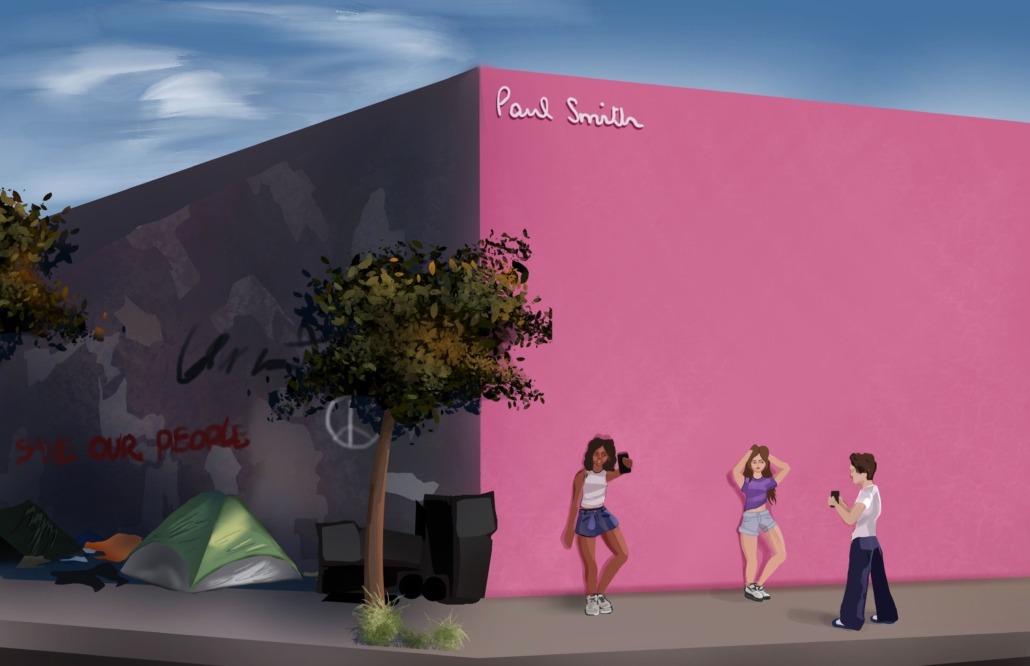
Certain aspects of the 2016 trend finds itself situated in the city of Los Angeles: The often-instagrammed Paul Smith pink wall on Melrose Avenue, ombre-tinged photos of palm trees and the romanticization of Downtown L.A. have all found their way back into the spotlight as the surge in 2016 nostalgia continues.
Toni Albertson, a lecturer of journalism and public relations, said that students may tend to lean into a superficial perspective of L.A. that’s been shaped by social media.
“If [students] are looking at one version of L.A. that appears in the media, no matter where you’re coming from, then they’re really missing the complexity of the city that they’re living in,” Albertson said.
L.A. may often be stereotyped as upscale, trendy and abundantly wealthy. While social media, pop culture and other digital media act as the birthplace of this idea, the popularized 2016 aesthetic only reemphasizes those beliefs, and it is then driven into our psyche through club parties, Greek-life event themes and even big-brand marketing campaigns.
But where USC sits in South Central L.A. reveals a different picture. According to McKinsey Global Institute, “almost 60 percent of the area’s nearly 60,000 households are low income or below,” with the median household income being “almost 40 percent lower than the median in the city as a whole.”
An observable dissonance is apparent: As we scroll through our TikTok or Instagram, many students fail to consider that an entirely alternate reality exists just yards outside our very own campus.
“My perception of L.A. was fully based on TikTok and Instagram,” said Shalini Mukherjee, a sophomore majoring in behavioral economics and psychology. “I also thought all of the fun, cute, little places that you see are all in the same area.”
Mukherjee came to L.A. guided by what she saw online. For incoming freshmen, the prospect of college and living in L.A. may be exciting after what they see on social media.
Tracey Peng, a freshman majoring in cognitive science, said she observed this phenomenon within the freshman community.
“For the first few weeks when people are going off campus to places like Santa Monica, Culver City or Hollywood,” Peng said, “They see what it looks like online, and then they want to go see it for themselves, and sometimes they’re disappointed because of the image that they thought they had in their minds.”
Daniela Baroffio, a clinical professor of communication and the director of the master’s program in digital social media, said that students tend to get lost in the algorithms and unknowingly feed into this one-dimensional image of L.A.
“[Social media] tends to create these very shiny, pretty little objects. It doesn’t cover that which is uncomfortable,” Baroffio said. “[The algorithms] are very intentional. They’re large language models that are based on picking up and predicting what your future interests will be.”
Mukherjee said that through her perspective as a USC student, most students shy away from the stark contrast in the neighborhoods around USC. For instance, Mukherjee and their roommates often don’t talk about South Central unless it’s to complain about it.
“Every time I go to the beach with my roommates, we’re all talking about, ‘Why can’t we live here? Why can’t USC be here?’” Mukherjee said. “We talk about how almost inconvenient the location of the school is for us, but the school came here after the society.”
Albertson urged students to interact with L.A. as a wider community.
“There’s such an opportunity here to go and see what Los Angeles really is. All these amazing communities and the stories that never make it to the screen, or stories that never even make it on social media,” Albertson said. “If you just stay in this bubble, you really don’t get to experience what L.A. really is, because L.A. is super diverse and just a really interesting place.”
One of the best ways to go out and meet the real L.A. is as simple as going out and talking to your neighbor, Albertson said. There is so much happening in the world that now more than ever it’s important for people to make bonds with their local community.
“You can’t stay in this bubble of friends. You can’t stay in the same world. You’ve got to go out and talk to people,” Albertson said. “I’ve found, especially at USC, that it’s scary for a lot of students to actually leave and go out in communities. But I would always say, ‘Talk to people.’ It’s not that hard. … You have to be open to other mindsets and talking, and not be afraid to walk up to people and have conversations.”
While striking the balance between the glamorized City of Angels and the real thing may prove challenging, there are alternative ways in which the USC community recognizes and gives back to the broader L.A. community, with USC housing several service organizations.
Peng highlighted multiple service organizations at USC that give back to the L.A. community, including Los Angeles Community Impact, a student consulting service that helps social impact organizations. She said this fills a gap in the current infrastructure.
“Because nonprofits don’t have the funds, time or resources to ask for official help, so having students that are willing to help and put their time and effort into benefiting the community around them [is important],” Peng said.
She gave a shout-out to Volunteer Income Tax Assistance, an IRS-sponsored organization that provides free tax assistance to the local community.
“[Accounting students] get a certificate for [helping] people that don’t have the education, knowledge, time or resources to do their own taxes. That’s a great way to give back to the community in a way that also benefits you too,” Peng said.
Baroffio suggested students go out into the community and support local businesses as a way of getting out. As Los Angeles fights against gentrification, USC has changed the neighborhoods around it to the point of being unrecognizable.
“It’s the process of gentrification that has removed all mom and pop stores,” Baroffio said. “[Students] weren’t here six years ago. [They] don’t know a world in which the [USC] Village doesn’t exist, but I do. And it was sweet, and it was quiet. Mr. Lucas would print out my readers for my students, and they would have to go across the street to Mr. Lucas and buy the readers. It’s all gone. Starbucks came in … and then the rest is history.”
Ultimately, social media narratives paired with campus gentrification allows for students at USC to find comfort through being socially sheltered. Nevertheless, as a generation that has grown up oscillating between its screens and surroundings, Gen Z’s consumption of digital media is an inherent part of its daily life. While digital platforms are a primary catalyst for the “trendy L.A. mindset,” social media does prove to have its notable benefits. Its global reach provides access to music and culture from all over the world, allowing us to pick up so many new interests.
“I just see for young people this great opportunity to listen to storytellers and have a global perspective,” Albertson said. “When students are looking at some of these platforms, for example, you discover something like K-pop. All of a sudden, it’s like, ‘I didn’t know I love K-pop, and now I love it.’ … I know there’s a lot of negative stuff out there, but you also find communities that you wouldn’t have found before.”
“Popular culture gives everybody a language of identity. Through music, film, fashion and social media personalities, young people can experiment with how they see themselves and how they present themselves,” Albertson said. “Specifically at a place like USC, where many students want careers in media and entertainment, pop culture becomes a part of their personal identity and their professional inspiration.”
This, consequently, comes with the responsibility to hold ourselves accountable for social media’s control over our personal autonomy. As students at USC, we can both explore L.A. and be cognizant of its unfiltered realities.
It is our duty to reap the benefits of pop culture and social media to continue heightening inspiration, connection and conversation.