Invasion does not mean liberation
The United States exploits feminism as justification for its wars in the Middle East.
By EMMA IBRAHIM
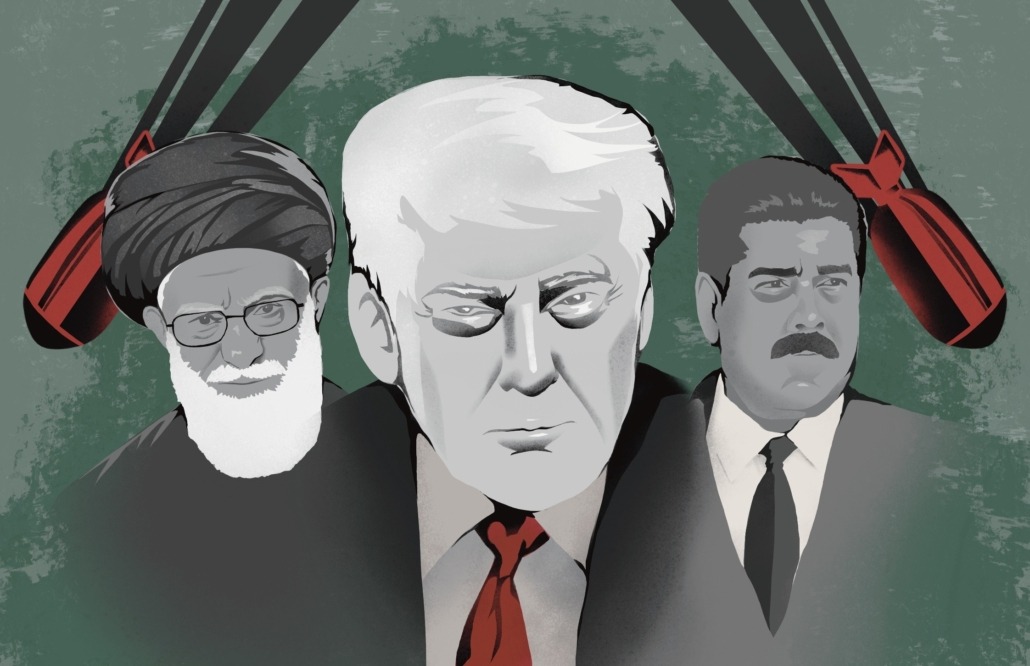

The United States exploits feminism as justification for its wars in the Middle East.
If you start to hear American leaders talk about freeing women abroad, you can brace yourself for another drawn-out, unofficial war in a Middle Eastern or Muslim-majority country.
It’s been over 20 years since the United States military invaded Iraq and Afghanistan, yet with the recent war in Iran, politicians continue to preach the dangerously simplistic idea of bombing for peace, weaponizing feminism to do so.
While there is no uncertainty that the Iranian government is an oppressive force manipulating religion for power, it’s been clear since day one of the war — when the U.S. bombed an elementary school and killed at least 175 people, most of whom were young girls — the only plan this administration appears to have is perpetuating the status quo of the war on terror: imperialism disguised as feminism.
In 2001, when the U.S. invaded Afghanistan, former First Lady Laura Bush delivered a radio address framing the oppression of women as central to the fight against terrorism, and thus, to combat terror, the U.S. must assume the responsibility of liberating Afghan women.
“There was an assumption that when the U.S. would topple the Taliban, that Afghan women would be free. And they were surprised when the Taliban was overthrown, and the Afghan women didn’t start wearing mini skirts,” said Evelyn Alsultany, a professor of American studies and ethnicity, in an interview with the Daily Trojan.
In Iran, the death of 22-year-old Mahsa Amini in police custody in September 2022 after the “morality police” arrested her for allegedly failing to properly cover her hair sparked nationwide protests, demanding an end to state-sanctioned gender oppression and patriarchal control.
Iranian women and advocates flooded the streets, igniting a revolution — “Women, Life, Freedom,” or “Zan, Zendegi, Azadi” in Farsi — which drove women’s rights to the forefront of the national conversation.
“In Iran, there is a feminist movement. There are people who can fight their own battles,” Alsultany said. “The idea of the United States even going in there for freedom — it makes no sense.”
On Dec. 28, 2025, demonstrations broke out in Iran over the country’s collapsing economy, which later transformed into a movement for a new system of government. Protesters were met with brutal force by state officials, leading to an estimated 30,000 deaths, local health officials told TIME magazine, as well as mass arrests and an internet blackout.
In January, President Donald Trump urged Iranians to keep protesting and said that help was on its way in a post on Truth Social, one month before joint U.S.-Israeli strikes hit Tehran and assassinated Supreme Leader Ayatollah Ali Khamenei.
But what about when the bombs stop falling, and Iran’s supposed nuclear capabilities are extinguished? Will the U.S. be there to pick up the pieces of a fallen regime, a war-torn country and a people who were promised a real change?
In 2004, former President George W. Bush promised the girls of Iraq and Afghanistan an education, stating that for them, “liberation has a special significance … A lot of young girls now get to go to school.”
“When there is a war … it doesn’t help women. Then women can’t go to school, then women are unemployed, then women don’t have access to food and they don’t have access to health care,” Alsultany said. “It completely destroys their lives and sets them back. It doesn’t help them get ahead.”
In Afghanistan, the U.S.’s longest undeclared war, the U.S. launched “Operation Enduring Freedom” to remove the Taliban. Ironically, after the catastrophic withdrawal of U.S. troops in 2021, the Taliban seized power once again. The supposed freedom granted by U.S. intervention did not endure long enough, as almost 2.2 million Afghan girls are barred from attaining secondary or higher education.
American politicians use women as victimized pawns to manufacture support for sending young men and women abroad to risk their lives and pouring billions of dollars into weapons packages. While appealing to our morality, our nation’s leaders coincidentally overlook past American foreign intervention that shaped these countries into what they are today.
“The Islam in Iran today, and the 1979 revolution that started it, was in response to the United States interfering in Iranian internal affairs for decades,” Alsultany said. “Even our understanding of Islam in its rigid forms should be understood as a modern phenomenon that is the outcome of a response and rejection of Western interference, rather than as the essence of what Islam is.”
From false claims of weapons of mass destruction in Iraq to promises to dismantle the Taliban in Afghanistan, a regime originally backed and trained by the CIA, liberation is rarely the U.S.’s intention. Instead, it is our self-serving interests in oil, recently manifested in Trump’s eyeing of Kharg Island, which is responsible for more than 90% of Iran’s oil exports, and expanding our influence in the region.
But our true intentions are masked as the great American gift of democracy — one neatly wrapped with guns, a bow tied with bombs and a card that reads “women’s rights.”
We have seen this tactic of employing feminist rhetoric to serve American interests before in Iraq and Afghanistan. How many times must we keep bombing for peace until peace is truly won?
With an approval rating of 40%, support for U.S. military action in Iran is largely lacking. We must refuse to accept what our officials tell us at face value. Liberation cannot be delivered through missiles and bombs. It has to arise from a steadfast movement led by the people of a country and foreign support, not military escalation.