Being a feminist does not exempt you from political bias
We must work to overcome internalized assumptions targeting women leaders.
By SHRUTHI NADATHUR

We must work to overcome internalized assumptions targeting women leaders.
If you know me, you know I’m a dedicated feminist. I’m committed to defying traditional feminine norms, and I actively encourage the women around me to prioritize their career and education above all else. I proudly never stray away from opportunities that appeal to my men counterparts and desire safe spaces for everyone, regardless of gender.
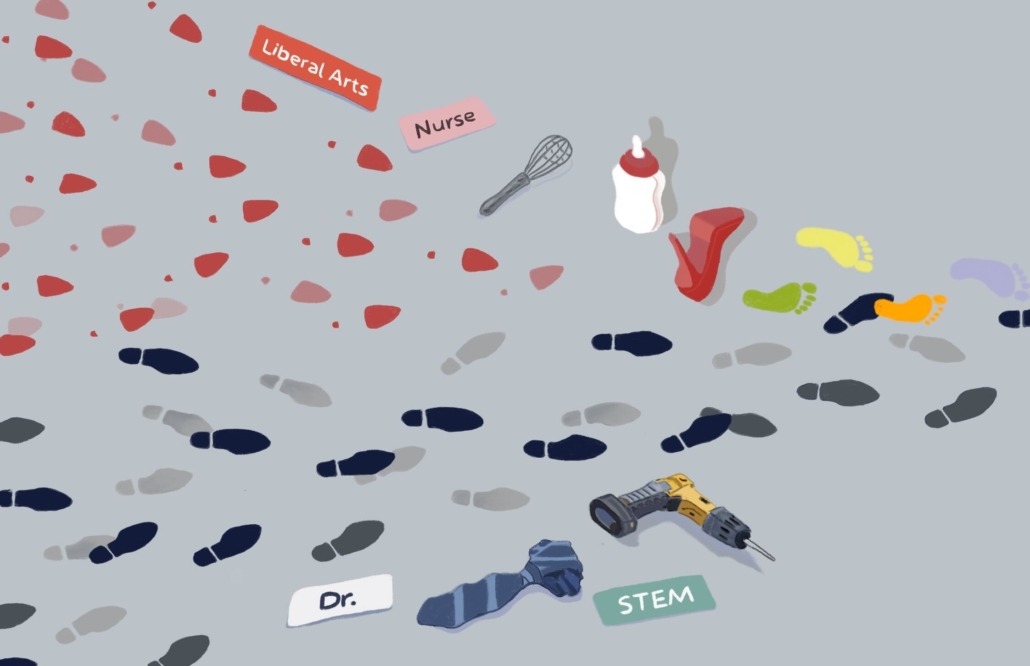
Following a discussion with a friend on the classic case of visualizing a doctor as a man and a nurse as a woman, I took the Harvard Implicit Association Test for gender-career, which measures subconscious biases that associate genders with specific roles, words and career paths. Despite my commitment to dismantling the patriarchy, I scored unexpectedly men-leaning.
Am I sexist? No. My score doesn’t reflect conscious behavior, but rather underlying, structural patterns. I may identify as a feminist, but a mere label doesn’t counteract thoughts that have been conditioned into my daily behavior.
There is a misconception that since women legally have the same rights as men in the United States, gender bias isn’t a pressing issue. Nonetheless, implicit bias affects women in leadership, with their observers scrutinizing them for actions their men counterparts are praised for. The most apparent examples stem from the experiences of women in politics.
In the case of former Vice President Kamala Harris, her presidential campaign was infamous for its humorous spin-offs. The viral “you think you just fell out of a coconut tree” clip dominated TikTok, and videos of her laughing throughout her campaign — which, to me, highlighted her authentic persona — reinforced criticism that painted her as an unserious candidate.
Several media outlets let these implicit biases seep into their portrayals of Harris. In 2021, The Guardian published an article that criticized her wardrobe, calling her Dolce & Gabbana suit a controversial endorsement of the company’s racist remarks. The same week, President Donald Trump was awaiting trial in the Senate for impeachment charges on “incitement of insurrection.” Three years later, Trump won against Harris for the U.S. presidency.
Rather than focusing on criticism of Harris’ policy positions, The Guardian’s scrutiny centers on frivolous characteristics. Commenting on her clothing or her laugh rather than on her 82-page economic policy plan that was endorsed by 23 Nobel Prize-winning economists is a direct reflection of how we are disappointing women in positions of power.
Scrutinizing women in positions of power only hinders efforts to increase women’s political representation. The Brookings Institution terms this phenomenon the “ambition gap,” which analyzes the difference in the public’s interest in women versus men candidates running for office, and was last measured to be a striking 18%.
Gender bias also exists in the way respect is implemented. President Trump isn’t referred to as “Donald,” while Kamala Harris is merely “Kamala.” Using only his last name reinforces authority rather than the approachability that “Kamala” conveys — yet this approachability also raises doubts about her credibility.
From our youth, we’ve been indirectly conditioned to hold gender bias. Girls are told to behave in a nurturing manner to reflect caregiving roles, while boys are taught to be assertive and confident as future leaders.
If we continue to associate women with caretaking and men with providing, even subconsciously, we are also mapping out whose problems get solved. Issues such as reproductive health or maternity leave would simply remain treated as “women’s issues” rather than political ones.
As a student involved in political organizations here at USC, I’m frustrated at the struggles women politicians face. My IAT score isn’t a reflection of my direct opinions, but rather a lifetime of systemic sexism gone unaddressed that constricts women changemakers. As students, while we can’t undo psychological bias in a day, we are responsible for shifting how we uplift women leaders.
Before ridiculing women political figures such as Harris, we must identify whether the lack of seriousness stems from their actual campaign or from their gender. Formulate criticism solely on policy positions and accomplishments, shifting away from underlying bias and toward actionable measures of improvement.
Small steps to deconditioning years of thinking are the key to undoing gender biases that are subconscious and systematically reinforced. Identifying as a feminist isn’t enough; we must translate this label into empowering women leaders.