VITAL SIGNS
You don’t need to buy into the rise of protein-labeled products
As GLP-1 drugs change appetite and weight-loss culture, food companies are selling protein as a lifestyle instead of a nutrient.

By SOEFAE CHEN

As GLP-1 drugs change appetite and weight-loss culture, food companies are selling protein as a lifestyle instead of a nutrient.
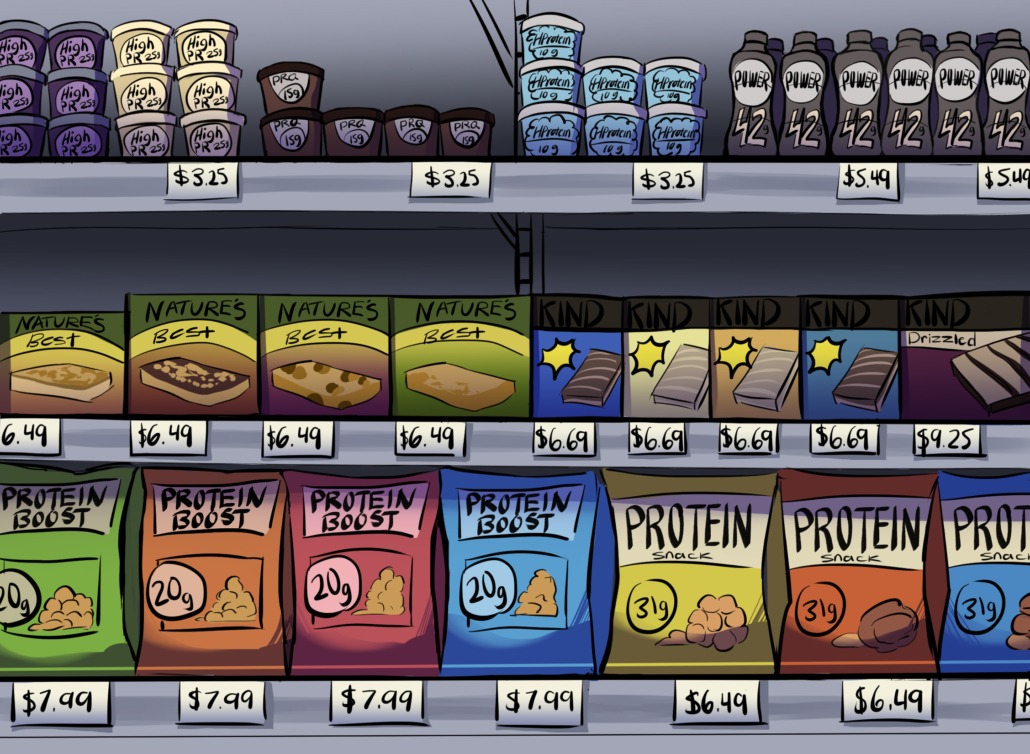
Walking through USC Village, I’m finding it increasingly difficult to miss all the new protein labels popping up on restaurant menus and snack packaging. Insomnia Cookies, next to the USC Village Fitness Center, is selling a new cookie boasting 11 grams of protein! Protein is no longer marketed only in powders and bars, but in smoothies, lattes and even cereal.
According to a 2025 Empower consumer survey, 72% of their sample group said they would pay extra for added protein, despite 55% saying protein-heavy products already cost more. This “protein premium” represents a shift in consumer psychology: we are no longer buying food, we are buying an insurance policy for its theoretical value, regardless of its processing or health.
The problem is that protein does not work like a magic pill.
As GLP-1 drugs like Ozempic and Wegovy propel clinical weight-loss into the mainstream cultural zeitgeist, companies are slapping “protein” onto otherwise unhealthy products and marketing them as the responsible choice.
Because Ozempic is nearing generic status and becoming increasingly accessible, a massive new market is being created: the “medicated consumer.” While GLP-1 drugs are advertised as helping users lose fat, they can cause significant loss of lean body mass — sometimes up to 40% of the total weight lost. Hence, there is a clinical urgency to prevent sarcopenic obesity, where a person loses weight but becomes functionally weaker.
The food industry is capitalizing on this medical anxiety by pushing protein-heavy snacks and junk food as a mass-market trend. This creates a halo effect, where the presence of excessive supposedly healthy protein blinds us to the high sugar or saturated fat content of the ultra-processed vehicle carrying it, conditioning us to see protein as a premium ingredient.
In bodybuilding culture, there is a popular rule that you need one gram of protein per pound of body weight, but this is more extreme than what the average student needs. Research from OSF HealthCare suggests that for active adults, the benefits of protein actually plateau around 0.54 grams per pound. Even for those trying to build muscle, meta-analyses show that the benefits level off well before the one-gram-per-pound mark.
If you eat that extra 10-gram protein Insomnia cookie, your body does not automatically turn it into muscle. If your muscles don’t need those specific building blocks for repair in that exact moment, your body doesn’t just hold on to them for a morning when you missed breakfast. Excess protein is treated like any other calorie: it is broken down, and if it isn’t burned for energy, it is stored as fat.
Furthermore, protein alone cannot build or retain muscle. You cannot eat your way into a toned physique while sitting in a lecture hall. Without a training stimulus, like resistance exercise, to signal to your body that it needs to repair tissue, that protein chocolate milkshake is just an expensive drink.
A protein cookie is still a cookie. A protein smoothie is still a smoothie. And a food being “high-protein” does not automatically make it worth the price or the hype.
This does not mean that protein is bad. It means that protein is not enough on its own.
If your goal is to build muscle, what matters most is consistent, rigorous training and enough overall nutrition. If your goal is simply to enjoy a treat, then enjoy the treat! Do not let a marketing label convince you that you’re making a more functional or disciplined health choice than you really are.
True health requires us to look past the halo effect of clever branding and approach the wellness aisle with the same skepticism we bring to any other industry.
Instead of blindly following the next marketed shortcut, we must reclaim our autonomy by researching before we buy and by prioritizing healthy evidence-based habits, such as hydration, whole foods and exercise.
Soefae Chen is a sophomore writing about health and fitness culture in her column, “Vital Signs,” which runs every other Friday