USC’s 143rd commencement — night of many firsts
Kash Amos was the first Black man to be USC’s student commencement speaker.
By DAVID RENDON

Kash Amos was the first Black man to be USC’s student commencement speaker.
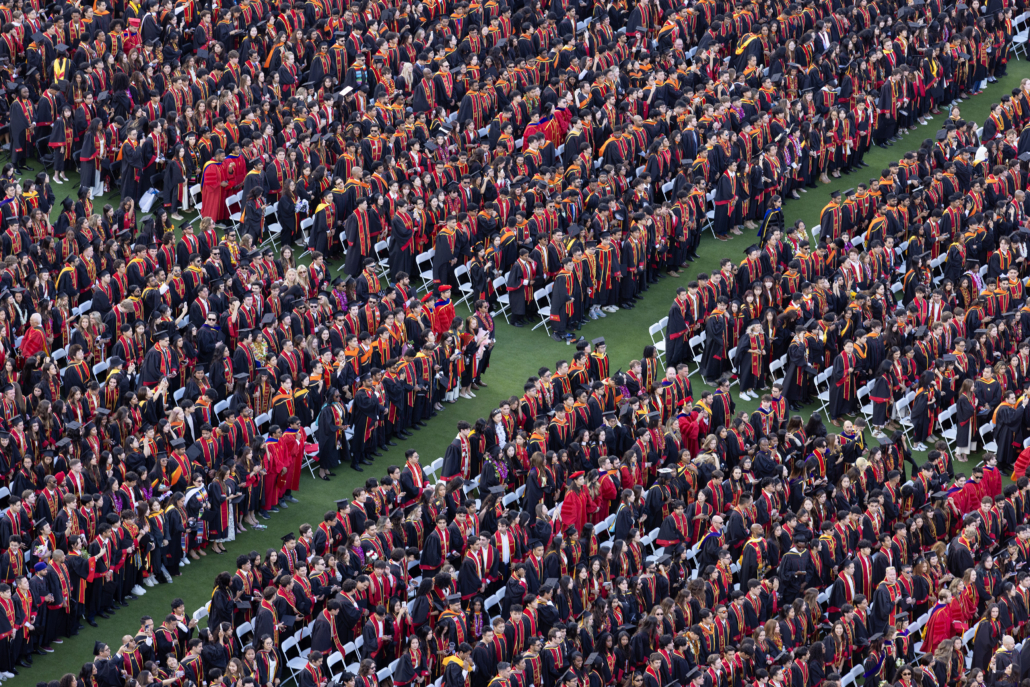
On Thursday evening, the Class of 2026 gathered at Los Angeles Memorial Coliseum for their Main Stage Ceremony, marking a key first for many.
One of those firsts belonged to USC’s newest president, Beong-Soo Kim, who addressed the graduating class at his first USC commencement ceremony since being named president in February.
“Doing something for the first time can be exciting, but I have to admit that, as I thought about what to say tonight, I’ve also experienced some self-doubt,” Kim said. “What could I say that you might actually remember? Was I ready for this moment, and what if no one cheered? All of this got me thinking about what it means to be first. ”
In the past year, Kim said that USC racked up many wins. From the women’s water polo team claiming yet another NCAA title to having multiple alums play in the Super Bowl, USC has come in first in many ways. But Kim said that’s not the only type of first that matters; being willing to go first matters too, like graduating Trojan Lucy Westlake, the youngest American woman to summit Mount Everest.
“Whether you ultimately end up at the top of a mountain or on the floor of the 9-0, your willingness to go first and to push past the natural insecurities we all feel will create opportunities you couldn’t have imagined,” Kim said.
Kash Amos made history as the first Black man to be the University’s student commencement speaker, just five years after Tianna Shaw-Wakeman was the first Black student to be valedictorian.
Last year, the University switched from having a valedictorian speech to selecting student commencement speakers. The change came a year after the University barred valedictorian Asna Tabassum from speaking at commencement, citing safety concerns. Over 50 student organizations wrote a letter protesting the decision, and hundreds marched to “let Asna speak.”
Amos began his speech by reminding students that they made it; no matter what people said, they completed four years at USC, and every moment students spent being challenged was a way of sharpening and helping them grow.
“Today isn’t about one story; it’s about a collective becoming. If there’s one theme that defines us, [it’s that] we didn’t just survive USC; it became a testament of our legacy,” Amos said. “We became disciplined; procrastination almost won. We became resilient when life outside the classroom tested us.”
After four years, students will have already been through the worst of it, Amos said — they shouldn’t be scared to send emails or have hard conversations. They have weathered the storm and should be prepared to go first.
“We didn’t just survive these years; we were shaped by these moments,” Amos said. “If we keep fighting with purpose, humility and courage, victory is not a question of if, it’s a matter of when. And I know firsthand, because my whole life I’ve been told I’d be a product of my environment, but look at me now, a product of my decisions.”
Yannis Yortsos, the outgoing dean of the Viterbi School of Engineering, presented an honorary doctor of science degree to Marcia McNutt, the president of the National Academy of Sciences of the United States.
USC’s mainstage commencement speaker, Gustavo Dudamel, the music and artistic director of the Los Angeles Philharmonic, was presented with an honorary doctor of music degree before he began his speech to the graduating class.
In his speech, Dudamel said the world is now a messy and chaotic place. Too often, people are disjointed and lost in all the shouting and noise of their lives, and they never have the chance to take a second and truly listen to others.
“Many people repeat often today that difference and diversity are a problem. I disagree with that concept. Diversity is not a problem. The problem is not listening to one another,” Dudamel said. “Diversity is not a threat; it is a power. Solidarity is not for the weak; it belongs to those with the courage to be better.”
Dudamel told students that as they leave USC, they have to remember that with their education, they can change the world for so many people; they need to find out how they can use what they’ve learned at USC and create something valuable.
“Go out into the world, dear USC graduates. Class of 2026, dream the absurd and achieve the impossible,” Dudamel said. “Let’s listen together to leave behind a more beautiful and harmonious world.”
The night ended with Dudamel conducting the Trojan Marching Band through USC’s alma mater, “All Hail.” And for the very first time, Kim played his cello alongside their performance, sending the Coliseum audience into a frenzy.
“As you leave here tonight, we at USC hope you come in first many times,” Kim said. “We hope you win and win big, but there’s something we wish for you even more than all that: not just that you come in first, but that you’re willing to go first.”