Trans athletes aren’t unfair, you’re just afraid
The talk around transgender athletes is based on transphobia, not concern for women.
By ANNA JORDAN
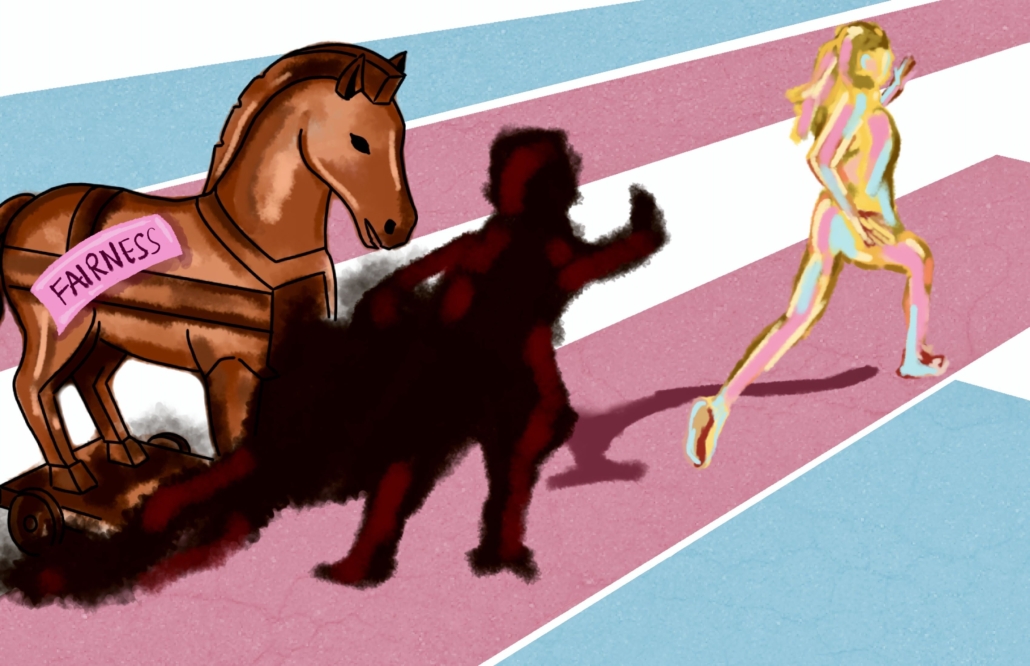

The talk around transgender athletes is based on transphobia, not concern for women.
Women’s sports are currently a nationwide hot topic because everyone is freshly concerned about the matter of “fairness” in women’s athletics regarding transgender athletes and their equitable access to sports teams — or intentional lack thereof.
Athletes like the WNBA’s Sophie Cunningham and tennis champion — and outspoken trans ally — Coco Gauff have added fuel to the fire, with the latter citing concerns about “trying to protect the fairness in women’s sports” despite clarifying that she does not condone the “attack that [the conversation] is creating.”
The “protections” for women from trans people take the form of bans toward transgender athletes; however, these bans have absolutely nothing to do with fairness or even safety. They have everything to do with fear.
Aside from the fact that trans women are, in fact, women, and should therefore have access to women’s sports, a 2022 study from the Journal of the Endocrine Society found that “there does not seem to be any reason to expect advantage for transgender people prior to puberty of or for transgender people whose gender-affirming treatment begins at the onset of puberty.”
Beyond puberty, trans women who choose to physically transition experience the physical side effects of the transition, including losing muscle and lung capacity, among other traits that contribute to athleticism.
Still, the Alliance Defending Freedom, a conservative Christian advocacy group, argues that “the very notion of female privacy is also at risk: in locker rooms, restrooms, homeless shelters, prisons, and on school trips.”
As the ADF put it, “What happens on the field is just the beginning.” But this isn’t the beginning of “unfairness” in sports. Unfairness is the name of the game.
Like cisgender people, trans people vary in athleticism. And despite trans people making up about 1% of the national population, less than 0.002% of U.S. collegiate athletes and less than 0.001% of Olympians, they were still the impetus for over 745 anti-trans bills introduced across the nation’s state legislatures as of March 2025. It looks less and less like trans athletes are the problem.
The ADF is right that what happens on the field is just the beginning — it’s paving the way for anti-trans rhetoric to permeate the United States’ justice system and preventing people from realizing that “biological advantage” isn’t anything new to athletics.
At any level, sports are about three things: natural-born talent, mindset and training. Within collegiate, professional or even high school athletics, natural-born talent takes on a larger emphasis as recruitment plays more of a role in athletes rising through the ranks.
Take, for example, the most decorated Olympian in history: swimmer Michael Phelps.
Phelps earned his 23 golds, three silvers and two bronzes for a lot of reasons.
To name a few, he’s 6-foot-4, has a wingspan greater than his standing height, bodily proportions conducive to hydrodynamics, massive hands and feet, twice the average lung capacity of an average adult man, and produces less lactic acid than the average Joe. He also had the resources, training and discipline necessary to achieve the highest — and currently unmatched — level of athleticism possible.
Take also, for example, two cisgender women at the tops of their respective fields: Katie Ledecky and Simone Biles. Both women were born with the genetics possible to produce an optimal build for their sports and have used time, energy and determination to make those advantages mean something when competing.
Even the USC women’s basketball team has bias toward those who are genetically taller: No Trojan on that team is under 5-foot-8 — about 4.5 inches taller than the average woman in the United States.
The reality is, most people don’t fear trans men entering men’s sports, because they believe that men are inherently stronger. They simply fear trans people. They fear a threat to a gender binary that uplifts cisgender men.
A study from Purdue even indicated that the people surveyed who were concerned about trans-inclusive policies in athletics cared more about their negative bias toward trans people than about women’s safety.
By making sports less inclusive and “protecting” women from a nonexistent threat, these policies both deny trans people the truth of their reality and paint women as a population who have no choice but to be saved from the strength, power, joy, community and agency that athletics can provide thanks to the concerned men in power.
Women don’t need to be protected from other women; they need to be supported in their fight to be understood as equal to men — and for that fight to be in any way meaningful, trans women need to be uplifted as part of that process.
Believe in women’s sports and support women athletes — all of them. Because a fight against the rights of trans women is a fight against the rights of all women.