CHAI SOCIALIST
Blue burqas are not your feminist clickbait
A decontextualized social media trend pitying Afghan women dehumanizes Muslim women.

By ANAHITA SAXENA
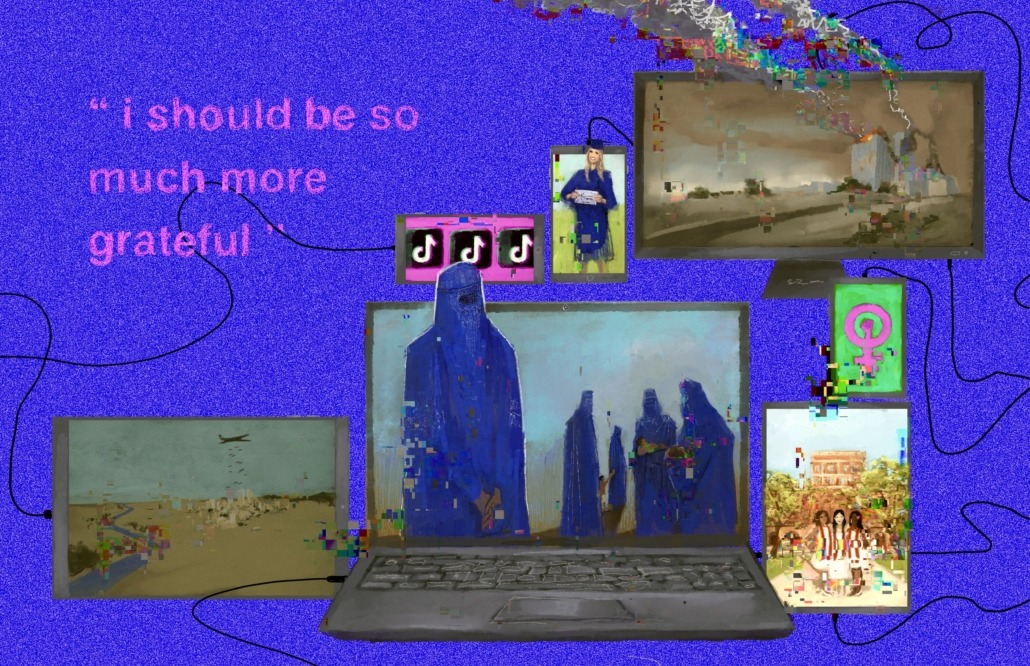

A decontextualized social media trend pitying Afghan women dehumanizes Muslim women.
There is a trend going around on social media in which a woman from “the West” posts a photo of herself next to a woman in a blue burqa to “Pearls” by Sade, and it’s seen as a groundbreaking feminist statement that garners millions of views and likes.
These posts vary in wording — whether arguing that the poster must study because a woman elsewhere cannot, or speaking for Afghan women by making assumptions about them based solely on their veil.
While these videos are mostly well-intentioned, seemingly portraying an emotional, powerful sense of female solidarity, they perpetuate a clear orientalist worldview by simplifying complex histories into a binary.
“Every time we perpetuate this myth that one side is ahead and the other one isn’t, we’re not really helping the women that we want to help because we’re stereotyping and generalizing in ways that don’t necessarily benefit them,” said Faiza Hirji, a professor of communication studies and media arts at McMaster University.
These posts leave no room for context. They leave out the more than $20 billion that the CIA and Reagan administration gave to the Afghan Mujahideen — militant Islamist groups — to train and arm them to fight the Soviet powers. They leave out the brutal civil war that ensued after the Soviets retreated, and how the faction of the Mujahideen that rose to power was the Taliban.
These posts reinforce the same narratives that helped Americans justify the 20-year-long war in Afghanistan that cost $2.3 trillion and hundreds of thousands of lives, all for the Taliban to remain in power. The constant effort to paint Muslim women as victims of their religion and the men around them reduces them to a method of propaganda.
“[The 2001 war in Afghanistan] relied heavily on this imagery of Afghan women wearing burqas, and that image implies so much without necessarily needing a lot of text or a lot of context around it,” Hirji said.
The danger of this trend is that the blue burqa becomes shorthand for oppression. These posts are not fighting the silencing of these women by the regime they live under; they are perpetuating a narrative that makes these women pawns in a Western woman’s expression of feminism.
One June 19 Instagram post with over a million likes juxtaposed a photo of a girl and her degree with text overlay reading, “i choose a wrong degree,” against a girl in a blue burqa with text overlay saying, “you mean… education was a choice?”
A comment under the post read, “I am a muslim girl and I also wear hijab and burqa. I also have rights and opinions in my society. Please stop spreading propaganda. You have no idea about us.”
This is not to say that women in Afghanistan aren’t facing brutal oppression by the Taliban regime. Millions of girls are banned from attending school past the primary level, more than 80% of women working in media have lost their jobs and the women’s literacy rate remains at 30%.
But the rhetoric these posts create –– that women are defenseless to this system, and that they must be saved and fought for by others –– is not a groundbreaking feminist statement. It does not deserve millions of likes.
These posts do more to serve the women who post them than the Afghan women they depict. They garner them likes and assure them of their empowerment at the expense of the veiled woman’s oppression.
Furthermore, it dehumanizes these women into political talking points. It makes them seem like faraway victims of unimaginable sexism. These posts alienate brown women.
Media like this, trends like these and narratives that persist tirelessly in Western society about the unknown “other” teach people that they do not belong. That is because they are painted as the opposite: on the other side of the binary of the educated, privileged white woman who pities them in their extremist society.
“Almost every young woman who wears a hijab has a story to tell of somebody who has made some kind of assumptions about her,” Hirji said.
We should know better than this. We should not be so quick to consider ourselves superior. Privilege is not about rubbing it in the face of those with less. It takes less than five minutes to learn why the CIA’s ousting of Prime Minister Mohammed Mossadeq influenced the rise of Ayatollah Khomeini, or why the Taliban has gained power due to the $20 billion that gave the Mujahideen access to legitimate violence.
Feminism is not about a split-screen comparison; it is about fighting the forces that diminish women with powerful knowledge. Don’t fall for the simplistic narrative; do your research and bring in the context.
Anahita Saxena is a junior majoring in political science and journalism who writes about politics, identity politics and the internal issues of the Democratic Party in her column, “Chai Socialist,” which runs every other Monday.