USC students rescue stray cats around campus
Cats of USC offers care for stray cats by conducting trap-neuter-return procedures.
By APRIL MAO
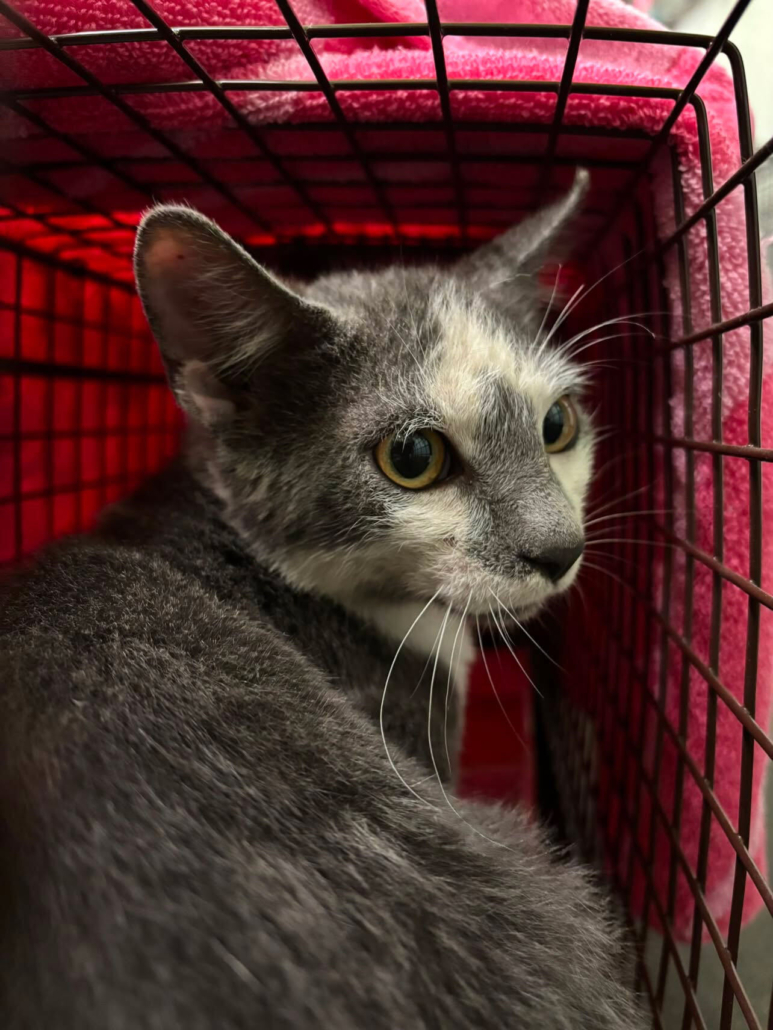

Cats of USC offers care for stray cats by conducting trap-neuter-return procedures.
When Montserrat De Allende Silva moved into a new apartment near USC in August 2025, she found herself surrounded by stray cats. Among them, Tito stood apart. He was unusually friendly despite having a pink nose that had been so damaged by skin cancer that part of it was missing. De Allende Silva wanted to help, but she didn’t know who to call, where to take him or how to afford his treatment.
“I quickly realized how much of a disconnect there is between wanting to help a stray cat and actually being able to,” said De Allende Silva, a second-year Ph.D. student studying geological sciences and the president of Cats of USC.
Although Tito has since died, his story became the catalyst for Cats of USC. The student-led organization connects community cats around the University Park Campus with trapping, adoption, fostering and veterinary resources.
De Allende Silva, who co-founded the student organization, said that the group aims to protect cats while making the complicated rescue system easier for students to navigate.
“The first [mission] is to make sure that cats around and on USC campus do not end up like Tito, because they are living beings that are worthy of respect and deserve a chance at a long and healthy life,” De Allende Silva said. “The second mission is that we are able to connect all of the resources that we have at our disposal with all of the students that want to help with that first mission.”
A common question stray animal rescue groups, like Cats of USC, get is why animals are neutered. De Allende Silva said this is because the stray cat community is experiencing an “overpopulation crisis.” Through trap-neuter-return, commonly known as the TNR process, stray cats can return to their territories without the risk of possibly having to give birth in the future.
“We have definitely seen [the immediate] effects, especially [for] the pregnant females that we’ve TNR’d. [They go from] that whole stressful process of [pregnancy] and then taking care of all the kittens, to all of a sudden being released of that burden,” De Allende Silva said. “The males that get neutered become less territorial and less aggressive, so they get into less fights.”
Normally, seeing an ear tip, which is the removal of about one centimeter of the tip of an adult cat’s ear, indicates that the cat has already undergone TNR. Nora Rakoci, a senior majoring in journalism and the co-vice president for Cats of USC, said students who encounter an untipped cat should notify them by submitting an online form so the information can be recorded.
“You go to our website, and you would fill out the request TNR form, and that’s where we have our database,” Rakoci said. “That’s when we would go out with a trap with our ‘trap queens.’”
Not every outdoor cat needs rescuing. A fixed, unsocialized stray cat may already belong to an established colony where community members regularly provide care for them.
“A lot of stray and feral cats, even though they may seem shy and closed off, tend to have a lot of love from their community, and people will often leave food bowls and water,” De Allende Silva said. “A spayed or neutered cat can be very successful and live a long life outside.”
Currently, the Cats of USC website has documented 31 cats that have undergone TNR, with four more waiting. However, rescuing kittens always requires more attention.
“Kittens have [a] 75% mortality rate under the age of six months … If anyone ever finds kittens, and they seem to be okay, leave them alone,” de Allende Silva said. “If there’s one kitten by itself that looks really sick, and you watch it for hours, and there’s no sign of mom, then maybe you can start being concerned and talk to some people and make some calls.”
Even when the correct course of action is clear, carrying it out can be difficult. Alaina Werge, a junior majoring in cinema and media studies and co-vice president of Cats of USC, said getting around the city and finding people who can foster the cats with care are big challenges for the organization.
“Transportation, adopting and fostering capacity has been difficult. We know that a lot of people live in student housing, so it’s not easy for people to be able to take in cats,” Werge said. “Transportation is huge. We don’t have vet services or shelters that are extremely close. As we all know, [Los Angeles] is a very spread-out city, and none of us have cars, and so that’s really tricky.”
Even with all the obstacles, the stray cat rescue organization is still striving to educate people with practical knowledge and spread awareness for how to responsibly care for stray cats.
“I’m super grateful to be part of this community that literally is coming together purely for their love for animals,” Rakoci said. “I’ve always been an animal lover … Literally all of us are here because we love cats … As much as we have complained about the money and the time and everything, it’s totally worth it.”