Lucas Museum of Narrative Art opens to public
The new museum highlights the creative process and illustration history.
By DUO YANG

The new museum highlights the creative process and illustration history.
The Lucas Museum of Narrative Art officially opened to the public Tuesday. Founded by filmmaker and the museum’s namesake George Lucas and his wife, Mellody Hobson, the museum “explores how images move us and shape our collective memory,” according to its website. The museum is the latest addition to the slew of museums at Exposition Park just minutes away from University Park Campus.
Opening 15 years after Lucas initially pitched the idea, the museum was funded by Lucas and Hobson, fueled by Lucas’s desire to create a museum dedicated to illustration, which he felt was often left out of such institutions. Though originally proposed for San Francisco, Chicago was also considered to house the museum before Lucas finally settled on Los Angeles.
Although the museum will not usually be open on Tuesdays, the opening was a special event for which museumgoers waited in online queues months in advance.
Ailene Ignacio was at the opening with family to celebrate her husband’s birthday, as well as their 9-month-old daughter’s first museum visit. Both she and her husband are big “Star Wars” fans, as well as fans of Lucas and Hobson, and had been anticipating the opening since watching the construction of the spaceship-like structure while driving along Interstate 110.
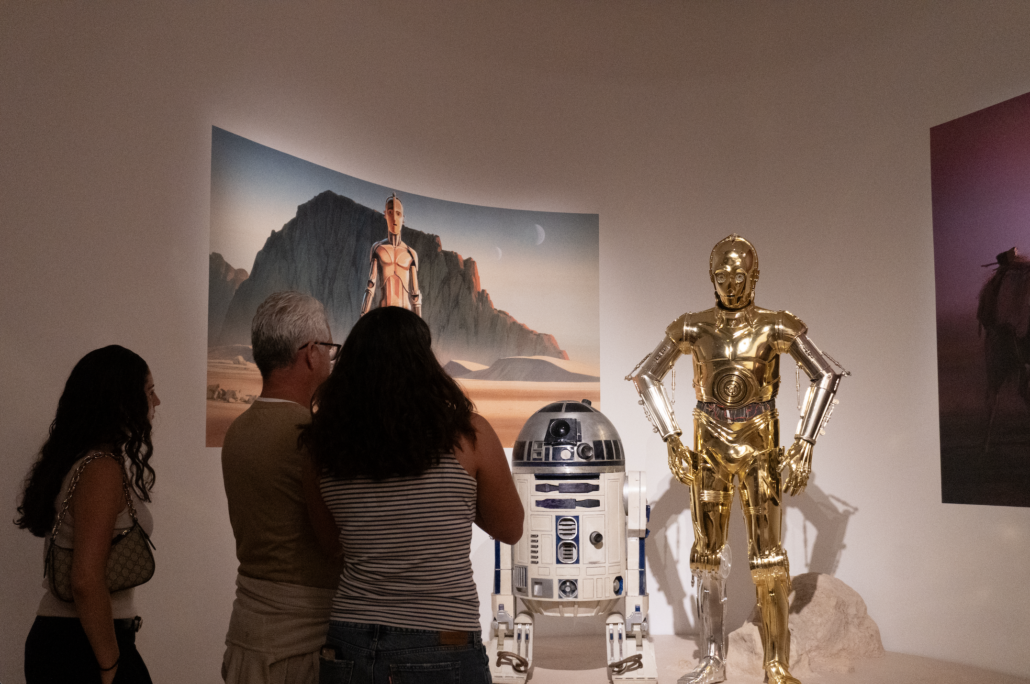
Ignacio’s favorite part of the visit was taking a picture with the life-size recreation of R2-D2 from the “Star Wars” franchise, which wears a badge as an official museum employee.
“I definitely love not just the museum space, but the garden space as well,” Ignacio said. “[I’m] really excited to see all of the different amenities and activities that the space has to offer as time continues to go on.”
Although “Star Wars” was a major attraction for Ignacio, she also found the rest of the museum novel in its approach to structuring and curating other artists’ work.
“As somebody who didn’t frequent museums growing up, I really appreciate how the exhibitions are categorized by type, from manga to children’s stories to romance,” Ignacio said. “It was easier to navigate pieces and understand different themes.”
Erika Hawkins and Shane Patterson, “Star Wars” fans, had already spent three hours at the museum before speaking with the Daily Trojan — which they said wasn’t enough time to see everything they wanted to.
“We still have yet to see any cinemas,” Patterson said. “We haven’t seen the library across the way. We didn’t go to Skywalker [Grill] today because it was pretty booked out.”
Patterson said that there was a good variety of exhibitions, out of which the Norman Rockwell exhibit was the most extensive. Some of the other exhibits include children’s art, sculptures and an exhibit including a costume from “The Wizard of Oz” (1939). One is dedicated to MAD Architects, the architectural firm behind the museum’s futuristic design, which shows architecture across different cities.
Hugo Stevenson, an animation professional, said he wanted to see how Lucas would develop a museum compared to other museums globally. For Stevenson, the theme of narrative art clearly shone through.
“It’s completely different than any museum anywhere in the world,” Stevenson said. “It’s more focused on illustrative art. My favorite part of the whole thing is the children’s art. … To me, that’s more fascinating, because that’s never art you would expect to see in a museum, let alone anywhere else other than private collections.”
Stevenson said that while artists like Rockwell, KAWS and Takashi Murakami can be found in other museums, the Lucas Museum presents manga and comics alongside works from such artists despite the styles not typically being considered fine art. In that sense, the museum highlights the illustrative thought process rather than strictly fine art, he said.
“That’s the unique thing about [the art shown]: It was considered more expendable, whether it was a comic book page, art for a magazine cover or a children’s book. That was all art that was, for more intents and purposes, never considered to be museum art,” Stevenson said. “It was dismissed more [often] than it was cherished.”
Patterson said the Lucas Museum is a “good” addition to the Los Angeles community, with Exposition Park hosting several other community spaces, including museums, parks and Los Angeles Memorial Coliseum.
“It’s a good experience. It’s cool [and] it’s good for L.A. You got the Natural [History] Museum right here. You got [the Lucas] Museum,” Patterson said. “The more we get, the more art there is, the better it’s going to be for everybody.”
Correction: A previous version of this article gave photo credit to Adilene Gomez Santiago. The article was updated online on Sept. 23 to reflect that the photo was taken by Thanawarun Suvannacheep. The Daily Trojan regrets this error.