Annenberg celebrates East Asian autumn festivals
Students celebrated with food, performances and cultural sharing.
By DUO YANG
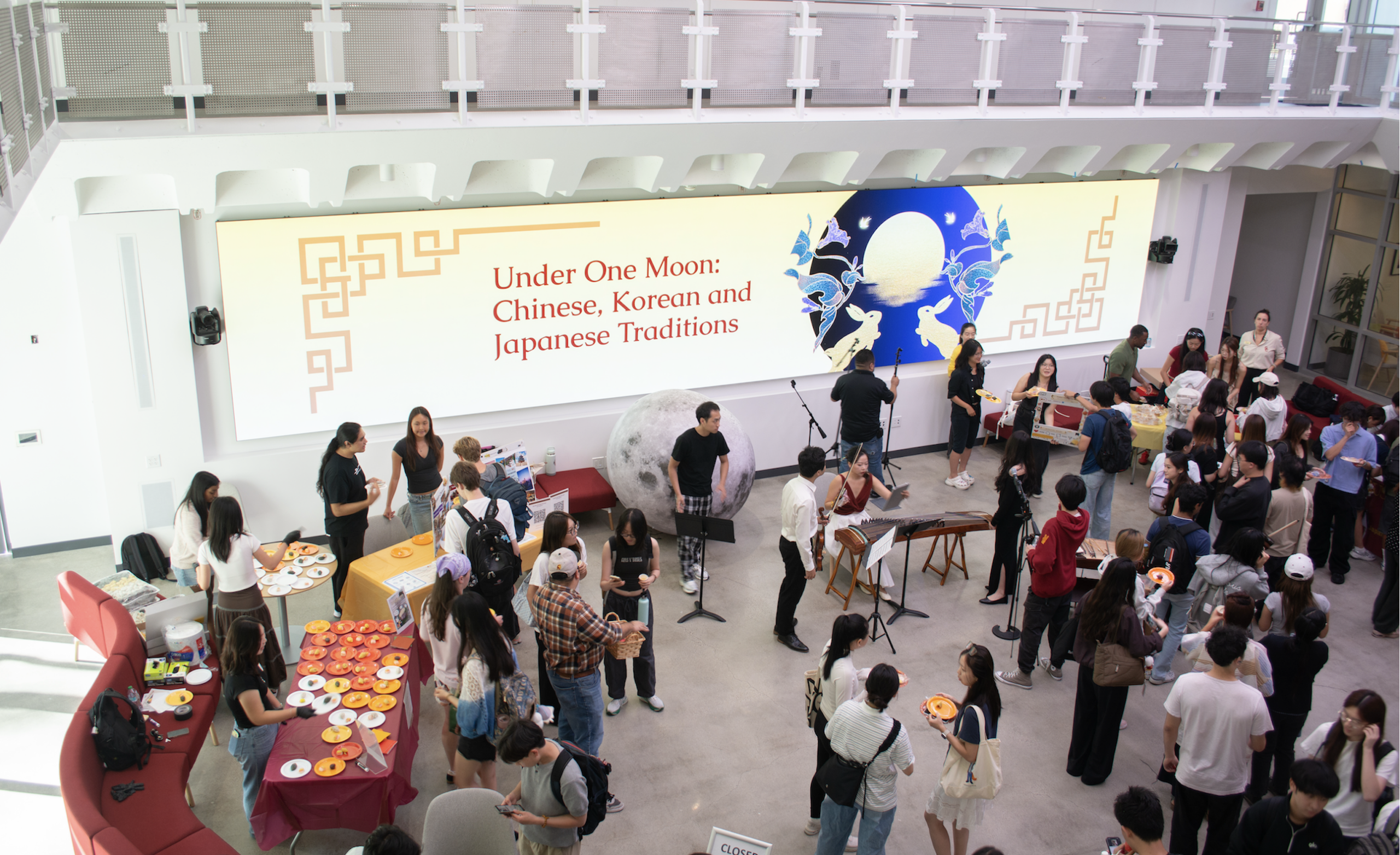

Students celebrated with food, performances and cultural sharing.
On Thursday, the Annenberg School for Communication and Journalism’s Student Services hosted an Mid-Autumn Moon celebration in Annenberg School for Communication’s East Lobby. Organized by the USC United States-China Institute and the Department of East Asian Languages and Cultures, “Under One Moon: Chinese, Korean and Japanese Traditions” celebrated the festivals with traditional food, arts performances and educational and recreational booths.
The event took place a day before the middle of the autumn season according to the lunar calendar. Variations of mid-autumn celebrations, which share the same date, are observed in a variety of Asian cultures. Festivities typically center on celebrating harvest and family, and commonly include moon-viewing. While Chinese cultures celebrate the Mid-Autumn Festival, Chuseok and Tsukimi are celebrated in South Korea and Japan, respectively.
Katherine Shi, a program specialist for the USC U.S.-China Institute, said cultural celebrations on campus are very important for fostering belonging and community, especially for international students and students away from home. Her experiences as an international student inspired her to work at the institute so she can help students feel more at home today.
“When I was a student, having those events and experiences really made me feel like [I fit in] here, because I came all the way from China to here and I [could] still celebrate my own cultural tradition during those special times,” Shi said. “A lot of students [tell] us they really enjoy these events, and they can connect to staff and other students or even faculty during this kind of event, so it’s a very special occasion for them.”
Starting at 3 p.m., guests lined up for traditional holiday desserts — mooncakes, songpyeon and dango in a variety of flavors. Participants could visit different student life, academic and cultural booths, including study-abroad opportunities, academic programs and classes offered by the EALC department. Cultural booths poured tea and folded origami, among other activities.
Soon after, performances began in the middle of the room. Groups included the USC Chinese Music Ensemble, USC Traditional Chinese Dance and Trogons A Capella.
Among the Trogons, a “language corner” is common during meals and gatherings. Members often teach each other their native languages. Kaylin Xie, a junior majoring in dramatic arts and a member of the Trogons, said joining this club is also a way for her to connect more with her culture.
“Since I grew up in [the United States], I actually grew up speaking Cantonese, but then I lost the language, so I only understand it now,” Xie said. “It’s been really nice to reconnect with my Chinese culture, and it’s nice to sing songs that, when my parents listen to the showcase, they’re like, ‘Oh, you can actually speak Chinese.’”
Katherine Yan, a senior majoring in psychology, volunteered at the event because her previous calligraphy teacher asked her to help out. For her, Chinese calligraphy classes are also a good way to connect with her culture, especially as many Chinese students taking the class are away from home.
Beyond Chinese classes and celebrations, Yan said she enjoyed how a multitude of cultures were celebrated at the event.
“People are meeting together. [The event brought the cultures] of Chinese, Korean and Japanese, [many] East Asian cultures, so we can connect more,” Yan said. “I myself [am] a fan of Korean culture also, so I can know [more about both] Chinese and Korean culture at the same time in this event.”
Giovanni Huang, a sophomore majoring in international relations, also volunteered at the event. He said learning Chinese through the Dornsife College of Letters, Arts and Sciences’ program is fun and the professors are supportive. However, he said outside-the-classroom cultural celebrations are less promoted than they could be.
“I found out [about this event] through my Chinese classes, but outside, I didn’t see a Dornsife advertisement for it,” Huang said.
For Xie, she plans to eat mooncakes and Chinese food to celebrate the Mid-Autumn Festival. Last year, her roommate, although not Chinese, also celebrated with her, sharing in the culture. Xie said that while she misses celebrating at home, celebrating Mid-Autumn at school is still nice.
“It’s definitely different because I’m used to celebrating [the holiday] with family, but now I’ve kind of celebrated it with my found family here,” Xie said. “I still feel the love, but in a different way.”