‘Ser Oaxaqueña Es…’ examines identity, community
The student exhibit explores Oaxacan culture across mediums.
By PABLO RODRIGUEZ
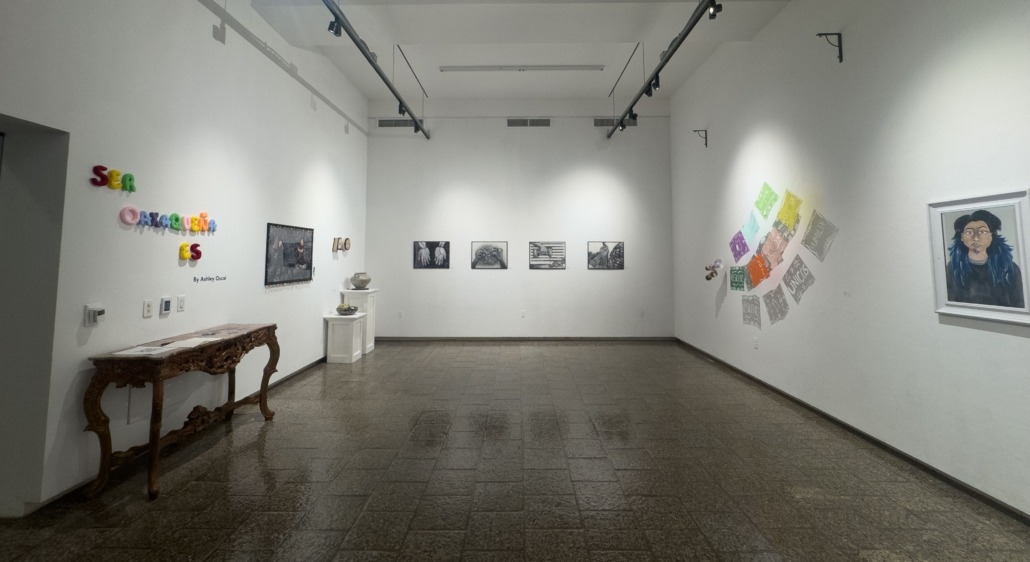

The student exhibit explores Oaxacan culture across mediums.
A bowl of salsa, a bracelet and the hands of family members; these items and more become larger than life and the focus for several pieces in the exhibit “Ser Oaxaqueña Es…” Through these pieces, Ashley Oscal — a senior majoring in art — explores culture from the Mexican state of Oaxaca and invites viewers to explore what being Oaxacan means for her.
Taking up half of the Helen Lindhurst Fine Arts Gallery, viewers start on their left and view the pieces clockwise. The pieces tell the story of how, as Oscal grew up, she gradually embraced her identity, learning to accept who she was. Now, she uses her art to speak out for her community.
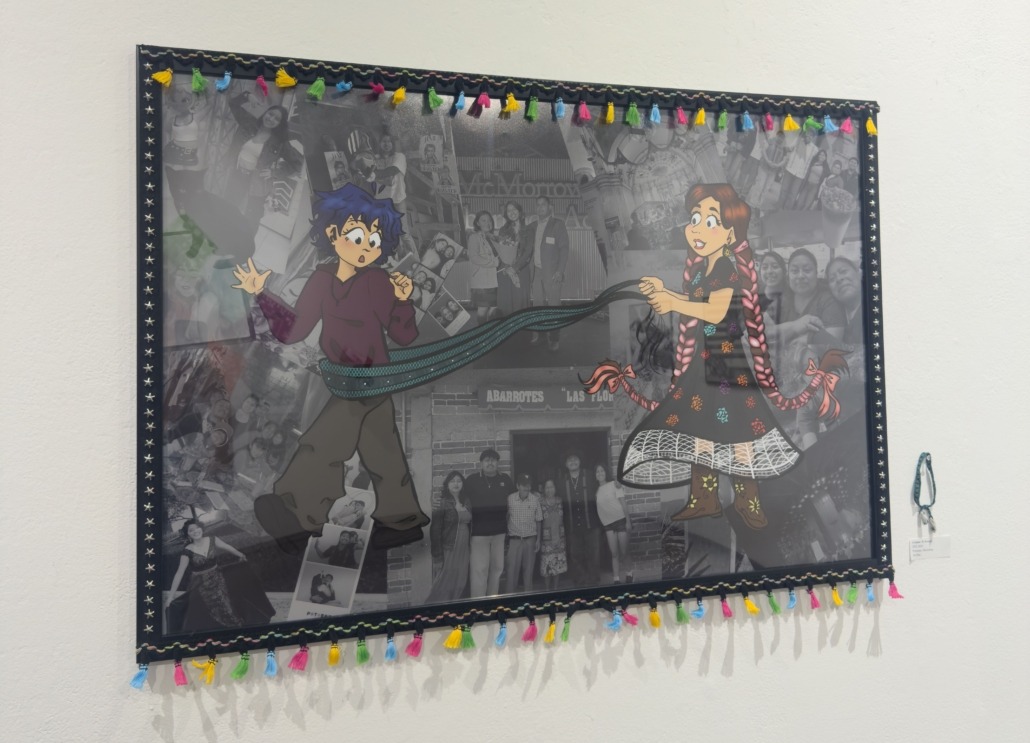
One of the first pieces in the gallery, “Aceptar (To Accept),” is about the beginning of Oscal’s journey of acceptance. Made with Procreate and Photoshop, the piece portrays two women in front of a collage of pictures from Oscal’s life. The woman on the left, Oscal, is wrapped in a large bracelet by the woman on the right, who represents Oaxaca. Oscal explained that she needed community to accept her identity as represented by the bracelet.
“Growing up, there’s a lot of judgment from where you come from,” Oscal said. “There was a time where I was a little embarrassed to be Mexican. … You really need that community to be able to feel accepted, and with this bracelet, it made me feel that.”
The bracelet in the piece is based on a real bracelet Oscal received when she was younger and the feelings it evoked. Oscal has worn that bracelet almost every day for most of her life. The only exception is that the bracelet is now on display next to the piece.
Near the beginning of the exhibit, “Salsa De Mama (Mom’s Salsa)” is placed on a stand. For this ceramic piece, Oscal created larger versions of ingredients used in her mother’s salsa and placed them in a bowl. The large size of the ingredients not only represents the importance of the recipe in her family, but also the importance of food in her culture, she said.
“When I [go] to Oaxaca, the first thing they ask you is ‘Ya comieron?’ or ‘Ven a la mesa,’” Oscal said, which means “did you eat” and “come to the table” in English. “[The salsa is] constantly there at the table; you can’t live without it.”
Although this piece is grounded in a specific cultural dish, Edgar Arceneaux, associate professor of art and Oscal’s current “Painting II” professor, connected deeply with the piece.
“It was a monument to the generation after generation after generation of the kind of sustenance that the mother would always make sure was there for the family,” Arceneaux said. “[It’s] something we might take for granted. If somebody freezes it in clay, it makes you think about it … critically as opposed to just shoving it in your mouth.”
Four pieces near the middle of the exhibit fall under a series called “The Soil In The Hands.” Oscal explained that the idea was to showcase Oaxacan hands and get to know their story.
“I wanted to show that our hands, which are usually called dirty, useless, gross, that they’re not really like that,” she said. “They do more than just what everyone else says.”
“The Soil in the Hands: The Eldest” features Oscal’s hands. Unlike the rest of the series, which was made with charcoal, Oscal used the charcoal tool on Procreate. The medium, along with the drawing of Oscal’s hands spread open, represents the artist’s artmaking and her flexibility in the craft.
The other three pieces — “The Homemaker,” “The Builder,” and “La Mano Santa (The Holy Hands)” — are all different people in Oscal’s family: her mother, her stepfather and her uncle, respectively. In each, Oscal illustrates how these people create something physical that leads to something deeper.
For example, Oscal’s mother, Rocio Nunez, makes floral arrangements, but beyond that she builds relationships and creates memories with her clients, Oscal said. She also ties this piece to Nunez’s role as a mother.
“The mothers are the ones that build the home,” Oscal said. “I [made] the background white on purpose, because I wanted to bring out the idea that mothers bring nothingness to life.”
Despite being the model in the piece, Nunez purposefully waited until the exhibition opened to see it alongside the other pieces.
“She showed me a preview, but I also didn’t want to see it,” said Nunez. “I wanted to see the end result.”
Nunez said it made her more aware of how proud Oscal was of her family and heritage.
“I saw what [the hands] meant for her, and it made me feel very proud of my daughter,” Nunez said. “She inherited that love [of] Oaxaca.”
By the end of the exhibit, the pieces reflect that Oscal has accepted her identity and found community, so much so that she now fights for it.
“This is what I’m doing now at 21. I’m trying to use my artwork to speak about times like these,” said Oscal.
In the piece, “We Are Human Too,” Oscal showcases papel picado — a Mexican craft made with colorful paper and cut out intricate designs — coming out of a megaphone, offering words of encouragement and empowerment to a community affected by the United States Immigration and Customs Enforcement raids.
“She’s proud of where she’s from,” said Nunez. “She’s speaking out, and she’s not afraid. It makes me very proud.”
“Ser Oaxaqueña Es…” will be on display inat the Helen Lindhurst Fine Arts Gallery atin Watt Hall until Oct. 13.