“Diva Manifestation Ritual” reframes women’s bodies
The Roski Exhibit features perspectives of women’s bodies in various styles.
By ASH DUNLAP
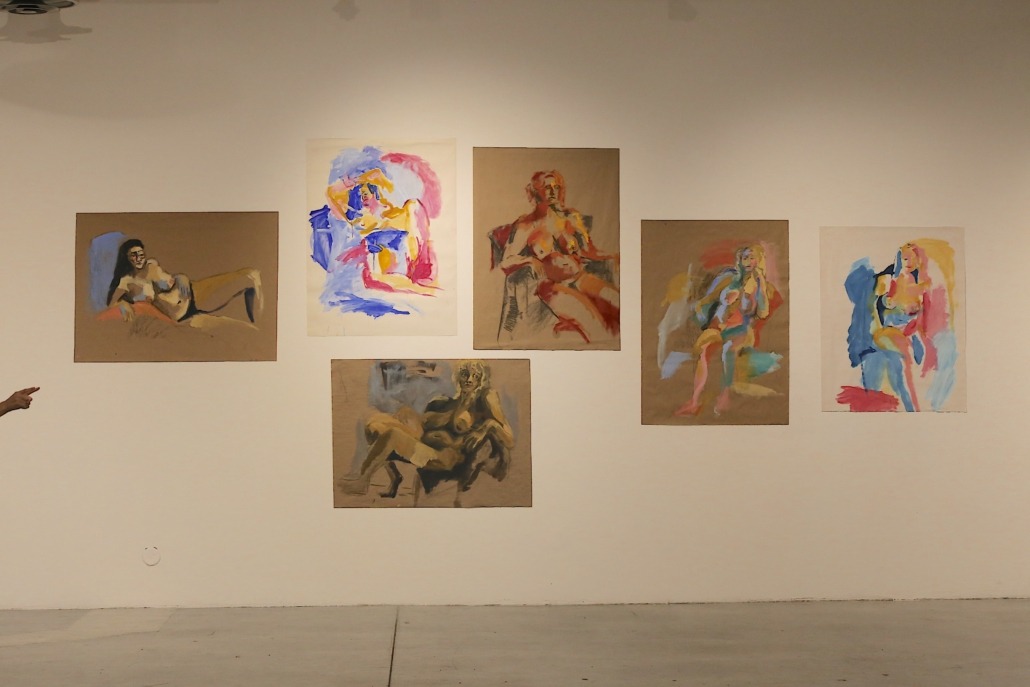

The Roski Exhibit features perspectives of women’s bodies in various styles.
From wall to wall, portraits of women’s bodies adorn the Roski Gallery, presenting a variety of colorful expressions, intricate details of fingerpainting and vivacious representations of nude subjects.
“Diva Manifestation Ritual” by Alden Kisner, a junior majoring in fine arts, comments on topics of consent, bodily autonomy, feminine expression, and challenges traditional misogynistic artistic styles and themes.
Edgar Arceneaux, an associate professor of art at the Roski School of Art and Design, mentored Kisner and helped develop “Diva Manifestation Ritual,” from aiding in concept development to coordinating the exhibit gallery design.
“She’s thinking through not only how the female body is seen, but also through these different art histories, and then juxtaposing [them] to each other around the room, which I think is a smart way of handling the idea of how women are seen,” Arceneaux said.
A majority of the exhibit, which opened on Sept. 24, featured a large wall of paper-backed, color-streaked pieces that captured a number of female models’ bodies and expressions in exaggerated shaping and vibrant color strokes. All the pieces on this wall were the oldest in the exhibit, dating back to late 2024 and 2025.
Makena Parker, a junior majoring in art, witnessed the creation of pieces in Roski painting classes years before they reached the exhibit.
“[The exhibit] felt like a culmination of what I’ve seen [Kisner] developing before she even knew of the concept or how it was all going to tie together,” Parker said. “She always gravitated towards loving the figure and self-portraits, so her show was a perfect tying of a bow on all of that.”
In her exhibit’s event description, Kisner described the process of creating the pieces for the show as a ritualistic “private act” that revealed an eccentric persona in her artwork.
“When I started painting these figures on paper, I was having the time of my life,” Kisner said. “I chose quantity over quality, and I do them pretty fast, so they’re spontaneous, and then I can pull out which ones … and start piecing them together.”
Kisner began synthesizing this project by sketching live female models, a habit that allowed her to evolve her artistic practices in figure painting.
“When I was [younger], I was able to see how a woman’s body could really dominate a room and dictate how people move around them,” Kisner said. “I was really envious of that at the time, so I kept digging into how I can expand that practice.”
Following her exploration of the female form, Kisner illustrated concepts of power and perception of female subjects through the framing of her paintings. In her featured piece “Self-Intimacy,” the portrayal of a self-inserted Kisner is the subject, with the figure lying on the riverside.
A continuation of this piece is seen in the featured work “Stranger on the Hillside,” where her self-inserted subject again appears in a pastoral field, but with a stark difference in mood.
In contrast to the tendency to portray women as subversive subjects in paintings of Western art history, Kisner is assured and in a state of power, with the subject’s gaze meeting the viewer’s.
“People could be able to recognize that it’s a woman in power, and maybe feel empowered by that,” Kisner said. “I hope people can start to understand how I’m trying to put these concepts of voyeurism from Western art history and rewrite them in a way where the woman is in power.”
The most recent painting of Kisner’s, “Mystery Work,” hung alone on the first wall of the exhibit, depicting three different women, all gazing directly at the viewer. “Mystery Work” featured a contrast of style, color and mood, with the model as the primary subject of the painting, as she sits in front of another woman captured in a decorative painting, both glaring at the audience.
However, the model and painted lady are not alone, as on the edge of the image, the reflection of a self-inserted Kisner painted in black-and-white realism has a transfixed gaze on viewers, showing the meeting of all these subjects’ sightlines.
“She’s the artist, and she’s the observer. She’s both of those things at the same time, and that means that she might be the oppressor and the oppressed,” Arceneaux said.
Kisner said she was inspired by cases where people don’t believe a woman could be behind good art; she wanted something to cement her claim on her art.
Kisner’s “Diva Manifestation Ritual” is on display by appointment through Oct. 13 at the Roski Gallery.