Stevie Wonder’s Wonderlove visits USC Thornton
The iconic band spoke to a sold-out crowd ahead of the “Songs in the Key of Life” 50th anniversary.
By KAILEN HICKS
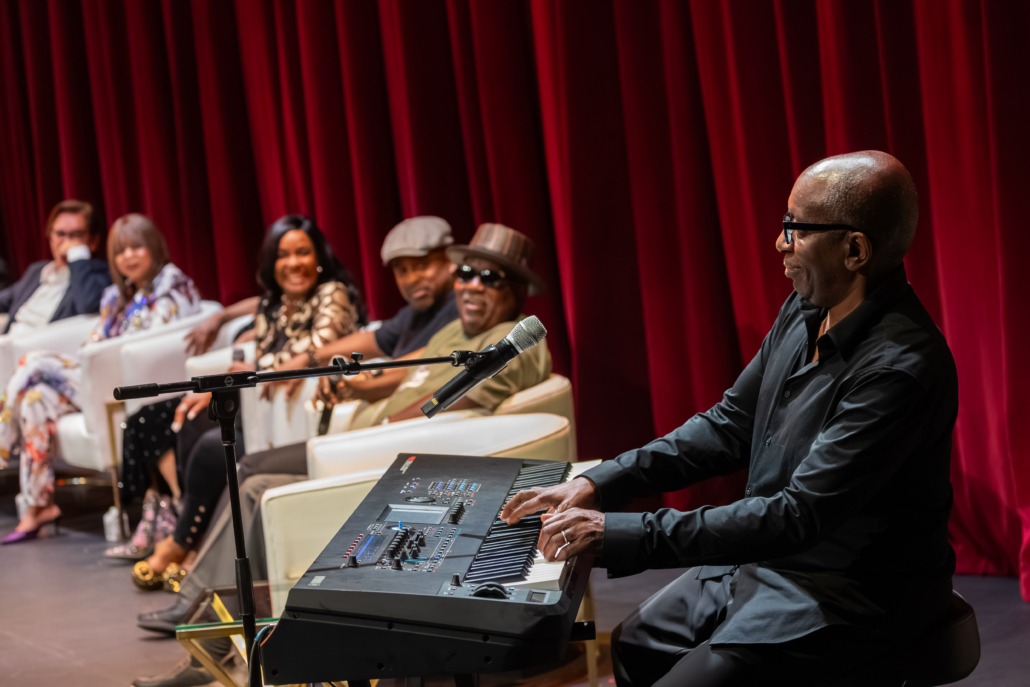

The iconic band spoke to a sold-out crowd ahead of the “Songs in the Key of Life” 50th anniversary.
On Thursday night, 10 of the Wonderlove instrumentalists, producers and background singers on Stevie Wonder’s “Songs in the Key of Life” gathered in front of a sold-out crowd at Bovard Auditorium to speak about the Diamond-certified album ahead of its 50th anniversary.
“Magic. Everything that Stevie did was magic, right?” said Herbie Hancock, the electric pianist on Wonder’s “As.” “It was like he could turn the poison into medicine.”
Thursday night’s speakers reflected on a composition period that encouraged innovation and excellence. The nearly three-hour conversation was moderated by Thornton School of Music Dean Jason King.
In between reflective stories, banter and the occasional live performance, the Wonderlove speakers spoke about the intensity of working on a project before the software-driven era of modern music production. Everything had to be engineered from scratch, and aspiring collaborators of Wonder had to beat out hundreds of other specialists for their roles, according to vocalist Deniece Williams.
“They had scared me to death,” said Williams, who began her award-winning career as a background vocalist for Wonder. “I came in ’76, and they were saying they auditioned 400 girls. I’m thinking like, ‘Oh Jesus, I’m going back home to [Washington,] D.C.’”
Once each band member was selected, they often spent late nights working with Wonder on albums.
“[Wonder] would be calling you at 2 a.m., … talking about ‘Come to the studio,’” Williams said. “I’m a mother first. I said, ‘I gotta take care of these babies,’ and he was still calling me at 3 a.m. talking about [how] ‘He just wrote something.’”
These Wonderlove musicians — specialists in their crafts — were meticulous in their work, and relayed many of the musical techniques and revisions they implemented to produce the classics on “Songs in the Key of Life” and other songs in Wonder’s broader discography.
They pulled the curtain back entirely, giving details on how the guitar-like sound on “Superstition” is actually emulated using a clavinet and walking audiences through the creative processes that produced R&B staples like “Contusion,” “Joy Inside My Tears” and “Pastime Paradise.”
“I’m kind of a music nerd, so I like hearing how things come together, how the songs are written and how they’re engineered,” said Jacque Edmonds, a fan at the event. “I always assumed those [sounds in “Superstition”] were strings.”
Guitarist and Grammy Award winner Michael Sembello, who began his career by working on “Songs to the Key of Life,” also spoke to Wonder’s perfectionist attitude. While recording “Contusion,” Wonder stayed up until 6 a.m., cycling through different keyboardists, re-layering styles and melodies until he finally felt it was right.
“We recorded so many versions that I had a T-shirt made that said, ‘Let’s record ‘Contusion’ again,’” Cembello said.
While the musical pedigree and techniques associated with Wonderlove were a prominent topic of discussion on Thursday, their stories about community stole the show. The group of colleagues-turned-lifelong friends reminisced about their favorite memories.
“Contusion” keyboardist and current Thornton professor Greg Phillinganes was just 18 years old when he first began working with Wonder. Outside of Wonder’s creative eccentricities, Phillinganes described his time with the human behind the art with reverence, joking that he had to be “the most visually-oriented blind person I’d ever met.”
“I have seen him with my own eyes do a spot-on impersonation of Jackie Wilson,” Phillinganes said. “Not only the voice … he did that, but then I actually saw him drop to his knees.”
Wonderlove finished off the night with a series of playbacks and musical demonstrations for audience members to enjoy. They cycled through “Songs in the Key of Life” classics like “Supersition,” “As” and “Sir Duke,” often isolating specific instruments on tracks while the musician behind them walked audiences through the gradual development, musical technique and story behind these pieces.
Audiences were even treated to live performances of songs, including Phillinganes’ notoriously fast keyboard solo on “Contusion” and a performance of Williams’ part on “Ordinary Pain” from the same album. Hearing these performances after so much time touched dedicated fans.
“The first time I heard it was in my 20s, and it was probably like 30 years after it was made,” said Bakari Bernard, a fan at the event. “Let me tell you, I listened to it all day on repeat.”
Bovard was lined with a plethora of attendees: from older fans who were around when “Songs in the Key of Life” had just been released to younger USC students who were born decades after.
“It was so beautiful to watch them talk about when they were 17, 18, [in their] early 20s, and see that they were so young and making such prolific music, but they were also just having fun together and building their art and craft,” said Maya Proulx, a freshman majoring in jazz voice.
The show concluded with a playback of Wonder’s “Isn’t She Lovely,” which the entire auditorium sang along to.
“I literally cried,” Bernard said. “I went through so many emotions because it touched me, and it just changed something on the inside of me.”