SPORTS FOR DUMMIES
Can we say ‘bye’ to buy games?
USC’s spending habit isn’t new, but these matchups are hard to justify in its Big Ten era.

By JULIA HO
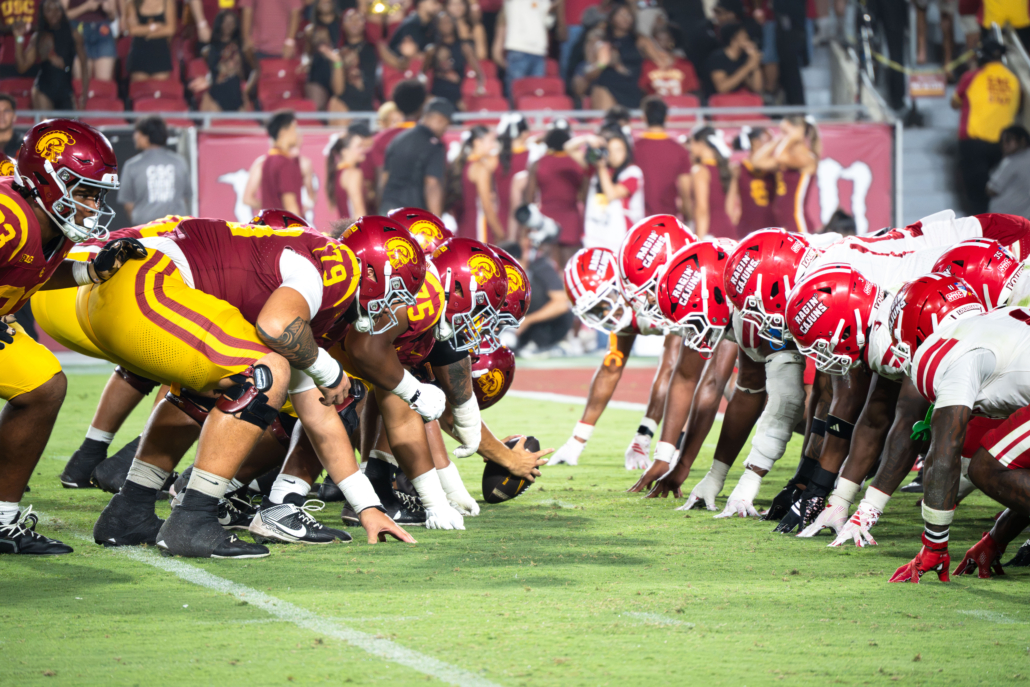

USC’s spending habit isn’t new, but these matchups are hard to justify in its Big Ten era.
USC’s move to the Big Ten was always touted as a logical step up, a big fish moving to a bigger pond. Unfortunately, it made Trojan football both more expensive and less fun in the same motion.
The last time I set foot in Los Angeles Memorial Coliseum was Fall 2024 — the first season of USC’s new life in the Big Ten. The Pac-12 conference I’m yearning for, the one actually within driving distance, had expired a year earlier during a freshman fall I was too green to savor.
Back in my day, a road trip meant traveling to Tempe or Palo Alto. Teams on the schedule were, if nothing else, familiar: programs USC had shared a conference with since 1922, a full century of accumulated grudges. Two years removed, the Trojans are lossless and ranked — for now — and, by my count, at least $4.4 million poorer.
Surprisingly, that sum is not the result of anyone’s salary. That figure is the combined cost of USC’s first three opponents — the going rate for an engineered nonconference slate so the Trojans couldn’t lose. They paid the University of Louisiana at Lafayette alone a $1.3 million guarantee to fly to Los Angeles, absorb a beating and go home.
For the uninitiated, this is called a guarantee game, or, less politely, a buy game. The arrangement is explicit: A wealthy program writes a smaller one a six-or-seven-figure check to schedule a loss. The benefit is a tune-up and a practically ensured win without the risk a real opponent might carry — an appetizer to fatten up the record before the main course of ranked teams. Three checks bought our season’s opening three weeks: $1.4 million to San Jose State University, $1.75 million to Fresno State University and $1.3 million to Louisiana.
Buy games are nothing new; USC and other universities have bought themselves easy wins for years. In 2024, the 48-0 Utah State shutout came bracketed by LSU in Las Vegas and longtime Trojan rival Notre Dame at home; in 2025, the Missouri State University and Georgia Southern University buy games were paired with a road trip to South Bend. These paid-for wins at least shared the schedule with one game that promised something: a lively viewing experience culminating in a glorious win or a devastating loss.
This fall, with the Notre Dame series on hiatus, USC didn’t replace that vanished marquee with another big name — leaving its nonconference schedule barren, boring and brutally underattended.
Barren and boring attributes aren’t just the buy games’ fault: They’re what’s left when a conference change stamps out nearly every heated rivalry. The money was half of what the Big Ten took — the other half was history, or a lack of it. Oregon, which USC hosts Sept. 26, is at least a familiar face, though only because the Ducks fled the same sinking Pac-12 ship as the Trojans. The handful of Big Ten opponents USC actually knows are fellow refugees.
As for the rest of the conference, USC either scarcely knows its opponents or used to meet them on only the grandest stage — “the granddaddy of them all,” the wondrous Rose Bowl — and the Big Ten has leeched the occasion out of both.
USC has played Ohio State 24 times since 1937, almost always at the Rose Bowl — the kind of blue-blood collision you used to circle on a calendar in ink. Though the Trojans and Buckeyes haven’t met since 2017, the programs’ upcoming matchup doesn’t bring much fanfare; Oct. 31 is just another conference game.
Penn State, which the Trojans met all of 10 times between 1922 and their move to the Big Ten, will resurface Oct. 10 as a conference rotation. And on Nov. 14, USC will travel to Bloomington to play Indiana, a program it last faced in 1982 — a series so old that the Trojans’ spotless 4-0 record against the Hoosiers predates the World Wide Web.
None of that is quite enough to be a rivalry. A rivalry thrives on grievance and repetition — a team you see every fall, whose obnoxious fans you can picture without trying, and a furor that is collective for your team, your community. The beauty of rivalry also lies in its intergenerational appeal; crops of Trojans, old and new, bore witness to USC’s iconic Pac-12 rivalries and subsequently passed those sentiments — the loyalty and the loathing — down the family line.
What made those previous Rose Bowl meetings electric was their scarcity: two national powers colliding once a decade, if even that, with everything on the line. Thanks to USC’s fledgling Big Ten presence, the Trojan Family is left to slow-burn new grudges with newfound peers, cultivating from scratch the ones it just discarded.
It helps to remember what a reason to show up used to look like. The last time USC football was worth the campus-long trek to the Coliseum, then-quarterback Caleb Williams was improvising touchdowns on his way to the 2022 Heisman Trophy. He’s a Chicago Bear now, the No. 1 pick of the 2024 NFL Draft, gone the same spring USC bolted for the Big Ten — the star and the old league gone with the same tide.
So no, I haven’t been back to the Coliseum, but maybe I’ll return for the USC-UCLA marquee showdown at the end of the season — it’s the only relic of USC’s rivalry series I have left to savor.
Julia Ho is a senior writing about sports for newcomers and skeptics alike in her column, “Sports for Dummies,” which runs every other Wednesday. She is also a chief copy editor and the staff development director at the Daily Trojan.