‘The Love Hypothesis’ has the right formula, but fails to use it correctly
The adaptation of the romance novel is a fun watch, but lacks the depth of the source material.
3
For fans of:
“People We Meet on Vacation,” “Set It Up” (2018)
By SOPHIA KANG
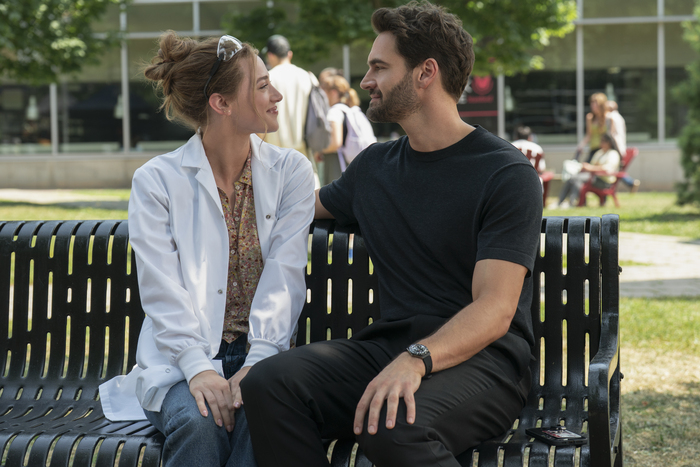

The adaptation of the romance novel is a fun watch, but lacks the depth of the source material.
3
“People We Meet on Vacation,” “Set It Up” (2018)
When it comes to book adaptations, a lot is at stake — not only for the readers who are hoping to have their vision of the pages accurately translated onto the screen, but also for the actors and directors who must live up to fans’ expectations. For fans of author Ali Hazelwood, “The Love Hypothesis” will not be a perfect watch, but will entertain in a similar vein as the book.
The film follows Stanford University doctoral candidate Olive Smith (Lili Reinhart), who is hoping to receive a grant in order to further her research on pancreatic cancer. When her best friend, Anh Pham (Rachel Marsh), refuses to date their mutual friend Jeremy Langley (Nicholas Duvernay), because she’s under the impression that Olive has feelings for him, Olive lies to Anh and says that she is dating a mystery man.
After Anh nearly catches Olive hiding away in her lab instead of being out on a date, Olive unthinkingly kisses the first man closest to her, only to realize that the man in question was Dr. Adam Carlsen (Tom Bateman), Stanford’s toughest professor who is infamously dubbed “Dr. Evil” by her peers.
Adam, whose funding is being threatened by the university as he is considered a “flight risk,” proposes an arrangement: the two pretend to be in a relationship so Olive can prove to Anh that she doesn’t have feelings for Jeremy, while Adam can prove to the university that he is committed to staying in California.
“The Love Hypothesis” hits the nail on the head in terms of character chemistry.
Lili Reinhart stands out as Olive, making her character endearingly awkward and shy. Paired with the hilarious Rachel Marsh as Anh, whose confidence perfectly balances Olive’s cautiousness, their scenes feel like watching real interactions between best friends. Jaboukie Young-White as Malcolm Browne, Olive’s close friend and roommate, also contributes to the closeness and comedic dynamic of the group.
Tom Bateman plays the uptight and slightly socially inept Adam Carlsen fairly well, but his comedic abilities were the true surprising highlight of both his character and the movie as a whole. Bateman and Reinhart play off each other’s social awkwardness perfectly and enhance the ridiculousness of their forced romantic interactions.
For example, in order to make their relationship more public, the pair attends a student and faculty picnic together where Anh insists that Olive help sunscreen her boyfriend. Olive pretends to laugh hysterically and Adam smiles stiffly while she lathers a ridiculous amount of sunscreen onto his shoulders to the horror of her friends. Soon after, Adam walks away, and the audience sees that absolutely none of it was blended in.
However, contrary to the success of the film’s comedy, the romantic elements fall short. Reinhart and Bateman have good enough chemistry to make the progression of Olive and Adam’s relationship enjoyable, but it’s not entirely convincing. The pacing of the film is too quick; on their second public date at a faculty dinner, Olive immediately confides to Adam that she wants to study pancreatic cancer because of her late mother.
The two hold hands as she shares a story that she refused to detail to any of his professional peers when pitching her research, illustrating their developing closeness. But for a character that is allegedly so reserved that she has difficulty opening up to her friends or even speaking in public, it seems hasty to have her spill her guts to a man she barely knows. This development was poorly done compared to the book and came seemingly out of the blue in the film.
For the rest of the film, pacing continues to be a problem. A montage is shown of Adam spending time with Olive and hanging around her friends. Despite his supposed constant presence in her life, Malcolm, Anh and Jeremy continue to show animosity toward their relationship. The montage also replaces any scenes of Adam and Olive actually getting to know each other; the most the audience is shown that he knows of her is that Olive likes sugar.
On a technical level, the film is unpleasant to look at. Several shots of the movie look as if a cloud was covering the camera and the settings all look extremely gray. The lighting of the film both washes the actors out — making them look sickly — and makes fun moments feel dull. The bad visuals are further emphasized when the occasional well-shot scenes appear, only to be immediately followed up by another visually bland moment.
The music choices emphasize comedic moments, but also the cringier ones. Whenever Adam appears onscreen, a menacing score plays in the background, which only adds to the humor of students cowering at the sight of him. Conversely, the song choices during romantic or tender moments are often unbearable. The sex scene in particular played Selena Gomez and benny blanco’s song “Cowboy,” where Gomez sings, “Ride it like a cowboy,” as Olive does just that.
Additionally, the ending was disappointing and unsatisfactory. After building up the stakes of their relationship, with a second-act breakup and Olive nearly losing her career’s work, Olive and Adam’s reunion is mediocre.
They confess their love for each other in science terms before immediately kissing and making up. The film then cuts to a comically short two-year-later epilogue in which the two barely hold hands before Olive enters her classroom as a professor.
Like Adam and Olive’s relationship, “The Love Hypothesis” adaptation is an experiment gone slightly wrong. But the humor and character relationships make up for what the film otherwise lost in terms of following the novel’s formula to create a fun and easy watch.