USC researchers receive expanded funding in $20 million AI institute renewal
The institute plans developments for AI-assisted tools for energy systems, supply chains and manufacturing.
By CHARLOTTE PALLANDT
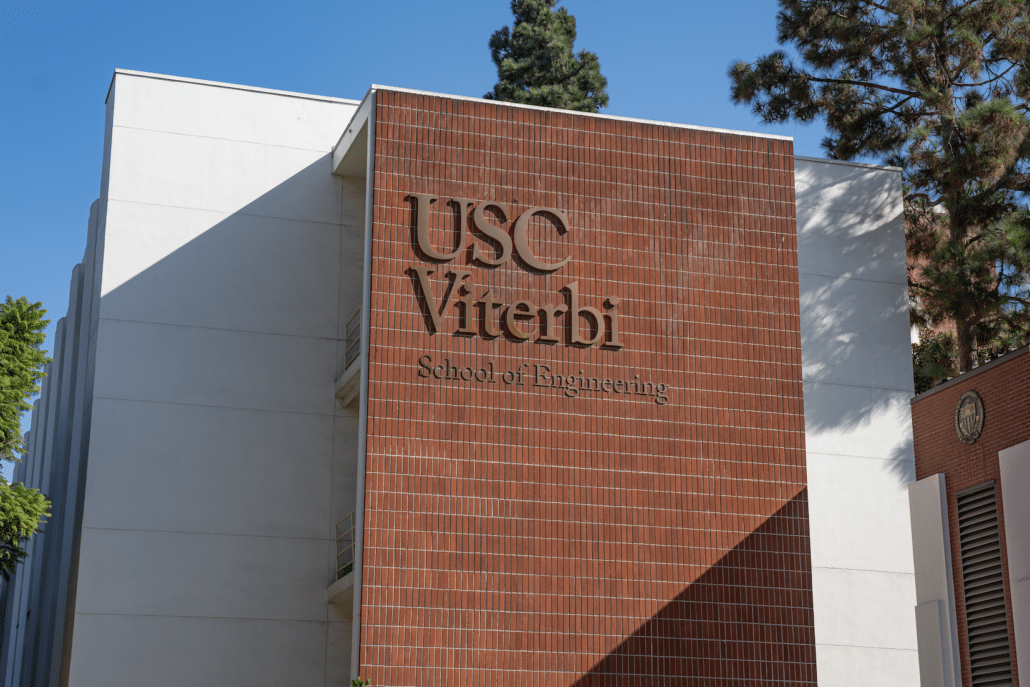

The institute plans developments for AI-assisted tools for energy systems, supply chains and manufacturing.
The National Science Foundation announced Aug. 27 the renewal of the Artificial Intelligence Institute for Advances in Optimization through 2031, awarding $20 million to support five more years of AI research and education at USC and other universities.
The national institute, led by the Georgia Institute of Technology, includes USC and UC Berkeley as core partner institutions. Of the $20 million in new funding, USC will receive $5.6 million — more than twice the amount the University received during AI4OPT’s first phase, according to the Viterbi School of Engineering.
“NSF’s decision to renew the institute reflects its strong track record in both research and education,” wrote Gretchen Johnson, an AI communications officer at Georgia Tech, in a statement to the Daily Trojan.
The first phase of AI4OPT began in 2021, when USC’s team consisted of only two researchers. During the first phase, researchers produced more than 250 publications, completed 12 technology transfers and created new research datasets, according to Viterbi.
Johnson wrote that USC researchers have been “valuable contributors” and will continue to play a leadership role within AI4OPT during the renewal period.
In this second phase, USC will lead AI4OPT’s research into using AI to accelerate optimization, while also contributing to work on AI training, supply chains and manufacturing. The research will use two fields,- AI and mathematical optimization,I to help decision-making systems solve complex optimization problems more quickly, allowing them to respond to changing conditions in milliseconds, such as adapting electrical grids or managing logistics.
“What we are doing by fusing AI and optimization is building the technology for actually solving these extremely large problems and extremely complex problems,” said Pascal Van Hentenryck, director of AI4OPT.
Van Hentenryck, who is also a professor of computer science at Georgia Tech’s Stewart School of Industrial and Systems Engineering, said some of these problems have become more difficult because the systems involved have grown larger and more interconnected.
“Most of these problems are getting way bigger than they used to be because of globalization and because of the complexity of the systems,” Van Hentenryck said.
With the increased funding, USC plans to expand its AI4OPT team to five researchers from Viterbi, the Stevens School of Computing and Artificial Intelligence and the Marshall School of Business.
The institute’s next five years of research will be organized around four areas: AI for optimization, optimization for AI, energy systems, and supply chains and manufacturing. The first two will focus on foundational research, while the latter two will apply that research to practical problems, according to Viterbi.
Bistra Dilkina, an associate professor of computer science, will lead USC’s team and the institute’s AI for optimization research area.
Specifically, Van Hentenryck said Dilkina’s team will also work to develop methods that can learn across multiple applications instead of functioning only within an individual case study.
“[Dilkina] is focusing on trying to make these techniques as general as possible,” Van Hentenryck said. “She is trying to see how she can accelerate some of these existing solvers, in particular mixed-integer programming solvers.”
In its second phase, AI4OPT will also examine how large systems interact with their smaller components, Van Hentenryck said. Van Hentenryck described one part of this approach as “control-aware optimization” — for example, a supply-chain model could account for robotic systems operating within it.
Beyond just work at USC, the University also plans to introduce AI4OPT education programs for middle and high school students in the Los Angeles area. The institute will also expand its availability through online courses that schools can incorporate into their curricula.
“It’s not just research; it’s very much impact,” said Kevin Dalmeijer, managing director of AI4OPT. “It’s very much [about] education and building this community of people and organizations solving problems with AI together.”
When asked what technical and ethical challenges could prevent AI4OPT’s research from working as intended, Van Hentenryck said the uncertainty inherent in research makes it impossible to guarantee the institute will achieve all of its proposed results.
“Research is very difficult to predict,” Van Hentenryck said. “It’s aspirational. You don’t know if you’re going to get the results you want.”
Van Hentenryck said this uncertainty also makes it important to consider reliability and ethics throughout the development process.
“We are trying to be trustworthy, reliable and ethical by design,” Van Hentenryck said.
Van Hentenryck said the institute’s research could eventually affect consumers through electricity costs, food distribution and supply-chain reliability. He said he thinks manufacturing is an area in which AI and data-driven methods could improve increasingly automated production lines.
Van Hentenryck also said that in the second phase, publications alone will not determine AI4OPT’s success. Success in 2031 would mean that companies and other organizations had adopted the institute’s technologies.
“We want to show [that] if we were not there, these companies would be much less efficient, or they would not be able to solve the problems they need to solve,” Van Hentenryck said. “That’s, for me, success.”