
Prosperity Market connects Black vendors
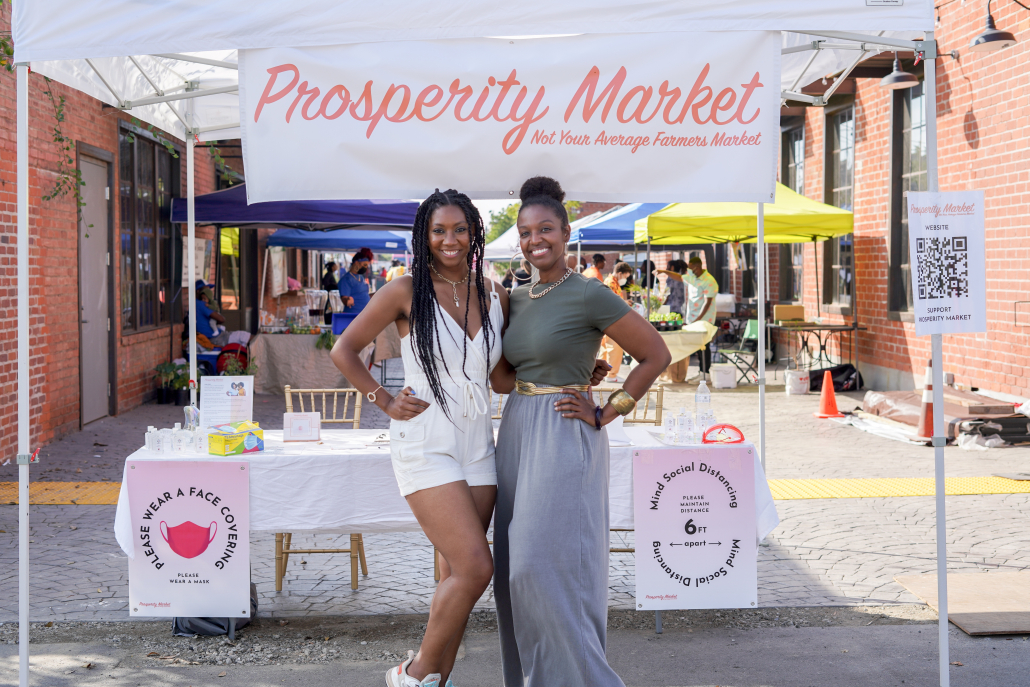

The return of the Trojan Farmers Market to campus has been met with cheer from students and vendors alike, along with consideration of the role such markets play in Los Angeles. The last two years with the pandemic have only exacerbated challenges, such as finding healthy options in food deserts and keeping resources circulating in local communities, which many believe markets can address.
Prosperity Market, a mobile farmers market featuring Black owned businesses, farmers and artisans, has combated those problems by hosting monthly pop-up markets around L.A. for the past year.
This past Saturday, the organization held its one year anniversary market outside the California African American Museum, minutes south of campus. The market featured more than 30 vendors — farmers, chefs, artists and small businesses — with a focus on providing a space to those usually marginalized by the market system.
“It’s difficult to get into farmers markets,” founder Carmen Dianne said. “There’s a reason that you don’t see very many Black farmers in existing markets because it’s really just a lot of hoops. Our goal was to make it easier for [vendors], to be a bridge, so they can start with us.”
Dianne and her co-founder Kara Still had no experience in food when they started the market one year ago, but they sought to create support for Black farmers and small businesses.
“Prior to this, I’m a makeup artist, [Still’s] a fashion designer, not in the food space at all,” Dianne said. “But we saw the need over quarantine. We wanted to create a way to circulate the dollar in our communities for longer. There’s a stat that [says] $1 stays in Black communities for six hours, which is a crazy statistic.”
That lack of circulation is stark in comparison to the United States’ “Black buying power” of $1.6 trillion annually, Dianne said.
“We have this buying power, but $1 stays in our community for only six hours,” Dianne said. “There’s a huge disconnect there. What I deducted was [that] we need more Black businesses but also essential Black businesses. And that led us to food.”
The issues surrounding food in L.A., Still explained, became more obvious during the pandemic, under which Black Angelenos were disproportionately affected. In addition to worsening food deserts, 41% of Black owned businesses closed during the pandemic, Still said.
“The pandemic really shined a light on the supply chain and how food was affected,” Still said. “If you look at areas that [didn’t] already have a lot of food or grocery options, those areas are even more impacted … So you look at the economic impact of business, you look at the health and economic impact of food … And we [wanted to] create something that addresses both at the same time.”
They created Prosperity Market with the intention of purchasing a trailer to build a mobile farmers market, as well as hosting monthly pop-ups and virtual markets, seeking to spread its vendors’ goods as widely as possible.
“Being able to expand the reach of our vendors, to go into different areas that are most in need of quality food, and to help businesses grow was also part of the reason we developed the mobile business model — because everyone needs to eat, everywhere,” Still said. “Why be stationary in this pandemic world? We want to be able to go where we can be most impactful.”
The impact the market has had on the business of vendors and the various areas of L.A. they’ve served has been profound.
“[Prosperity Market] brings a lot of enterprise for Black owned businesses,” said Taylor Lindsey, founder of The Plant Plug, the first outdoor curbside nursery in L.A. “They’re bringing marketplaces to places where you wouldn’t normally see it, especially in South Central. They’re creating a hub and an incubator to where there was more of a sense of community.”
Other vendors, like Dominique Burrell, emphasized the essential work Prosperity Market does to connect communities with access to healthy food. Burrell founded Blacker the Berry Juicery, a handmade juice business, to address food apartheid and food insecurity within Black and brown communities.
“South Central was one of the big [shifts] that occurred with redlining,” Burrell said. “All the healthy food options were pushed more toward the north midcity Hollywood zone … It means a lot for me to give back to the community and say, ‘Hey, there’s other things out there, and you don’t have to travel elsewhere, we have it in your community.’”
In addition to the Market’s important common mission, many vendors expressed its welcoming atmosphere helped inspire behind their initial involvement.
“They were so transparent with their process,” Lindsey said. “Usually [markets are] just a transaction, ‘Sell your tomatoes, Get out of here, Bye,’ but I feel so connected to the whole process. It’s like a big party. We’re having a good time.”
A big party, indeed. With more than 30 vendors, a DJ blasting danceable Kaytranada and Isaiah Rashad tracks and some gorgeous L.A. weather to boot, it was a phenomenal introduction to Prosperity Market for the University Park community, who turned out en masse to enjoy the day.
“I definitely wasn’t expecting this many people,” said Adriana Gasaway, founder of ACE Naturals, a handmade organic skin and hair care boutique. “I sold out on most of my soaps, I have [only] a few more body butters left, and yeah, it was a good day.”
As the Market’s one-year anniversary, it was also a special day for Dianne and Still, who had hoped to one day host a market at CAAM.
“We have wanted to go to the CAAM for a very long time, so it felt great to be there,” Dianne said. “And to be there, during Black History Month, and on our one-year [anniversary], it was perfect … It was special to be there to celebrate Black history as we are making history with this new thing that we’re doing.”
While the pair works to help make history with its vendors, they’re also looking toward the future. At the event, they announced $12,000 of their $20,000 funding milestone to create its mobile market trailer had been raised since beginning its crowdfunding campaign on Feb. 15. They foresee opening their mobile marketplace to further expand vendors’ access to the community — and the community’s access to healthy products.
“The impact that we’re having now, it will just like multiply exponentially because we can operate daily … [Vendors] can use their time to grow food, make food, go to other markets, whatever they need to do to grow their business, we free up their time, we expose them to new [customers], we’ve expanded their reach, and we’re all growing,” Dianne said.
While they will continue to host monthly pop-ups, the pair also aim to grow their reach with these trailers, one day reaching other cities across the country.
“It’s really about impacting the local ecosystem,” Still said. “It really is built on having an impact with whatever that city’s local food, local agriculture and local businesses are … This is a way for [local] entrepreneurs and the people in each area to say, ‘This is something we want to support and help grow and expand.’”
As Prosperity Market pursues its total crowdfunding goal of $100,000, it plans to continue connecting with vendors, providing areas with healthier options and working to support Black businesses across L.A. through its monthly pop ups, a manifestation of community with which they’ve fallen in love.
“I love that people can feel the intention that goes into this because everyone who comes to the market really feels it, they get the vibe, the energy,” Dianne said. “They’re happy, all of the vendors are happy. I love that the first time you come to a market you feel that, it’s noticeable.”
Prosperity Market’s next event will be at the Hollywood Farmers Market, on Sunday, March 13 from 8 a.m. to 1 p.m. The crowdfunding campaign for the Market’s mobile trailer can be found on their website.