Kim says USC is ready to ‘leap ahead’ amid labor, funding strain
In response, postdocs and activists argued that some issues remain unresolved.
By JACKSON MILLS

In response, postdocs and activists argued that some issues remain unresolved.
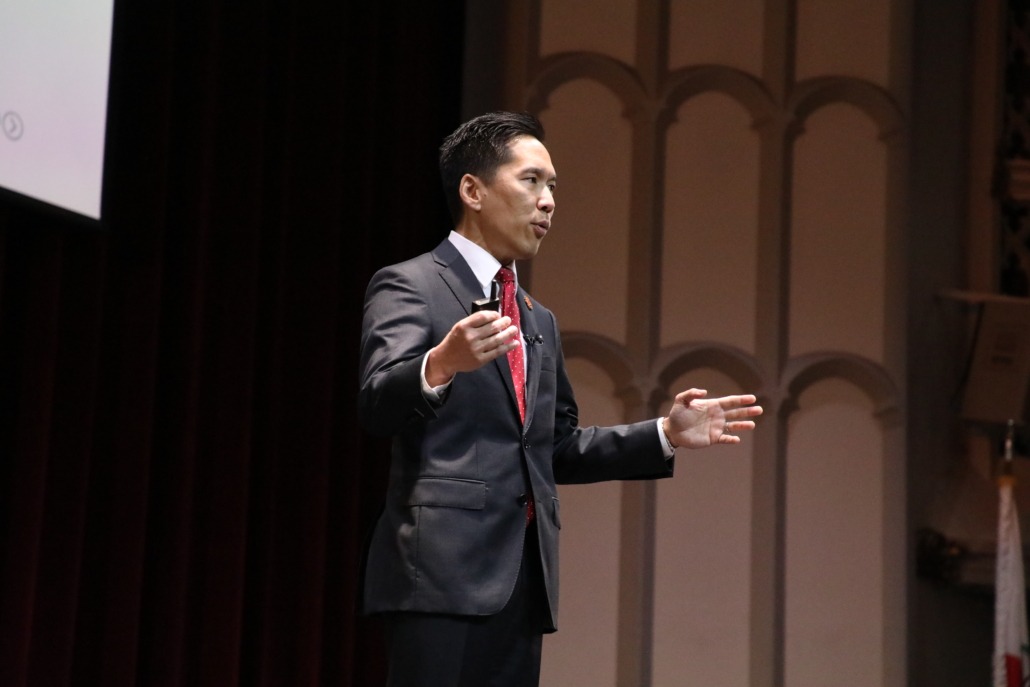
As Beong-Soo Kim walked onto the stage to deliver his first State of the University address at the University Park Campus as president of USC, he spoke to a campus still navigating months of hiring freezes, layoffs and debates about USC’s financial footing. But Kim said he was sure USC could overcome it.
“The question that I wake up asking myself is, ‘With all of these challenges … what are the opportunities for USC not just to tread water, but to actually leap ahead and extend our impact?’” Kim said during his address. “I am 1,000 percent confident that we can do it.”
During the address Tuesday at Bovard Auditorium, Kim said he planned to bolster the “financial foundation” of the University, which he said was weaker than it needed to be.
Kim paired the fiscal updates with signs of strength elsewhere, including fundraising totals that he said could make this one of USC’s best years in advancement and long-term growth for the University’s endowment. Kim also recognized staff, who he said felt the brunt of the over 1,000 layoffs last semester.
Nickey Woods, associate dean of student life and community engagement at Gould School of Law, said Kim’s speech resonated with her because of his emphasis on faculty members working together across schools.
“I’m really inspired by his message,” Woods said. “Collaboration is important to me as a professional on this campus, so to hear him highlight collaboration and innovation, that really spoke to me.”
Kim addresses federal funding cuts
Kim said external pressures could reshape how research universities like USC operate, citing concerns regarding the University’s reliance on fewer professors and principal investigators than peer universities despite how much money they bring in.
In an interview with campus media after the address, Kim said USC needs to diversify where its research funding comes from and look for ways to work with other universities to advocate for stable reimbursement structures.
When asked how USC would protect researchers facing federal funding cuts due to their work mentioning diversity or discrimination, Kim said the University had been a part of litigation in Boston involving the Association of American Universities, a group focused on national-level lobbying and advocacy related to research funding.
In USC’s Fiscal Year 2025 financial statement, auditors wrote that the University was “not aware of any significant loss of federal funding, nor any pending or threatened investigations,” that would affect its consolidated financial statements. Kim said in the interview that despite federal pressures, research at USC remained “resilient.”
“While these issues are very important to individual faculty member[s] who might be impacted, our research enterprise has proven to be quite resilient,” Kim said. “We continue to get grants, and are heartened by the fact that the recent appropriations bill does give good funding to a number of the agencies that we work closely with.”
President justifies ChatGPT subscription
Kim has faced criticism over the University’s partnership with OpenAI, with some faculty saying that the decision to spend $3.1 million per year on the software calls into question the University’s financial priorities after over 1,000 layoffs last semester.
During his address, Kim said the artificial intelligence strategy committee would focus on listening to and acting on a multitude of perspectives across faculty, staff and students. He also said during an interview with campus media that the University pursued the lowest-cost option to make ChatGPT available across the board.
“We wanted to make sure that we were giving access to by students and faculty and staff to this version of ChatGPT on an equitable basis,” Kim said. “We’re not saying everyone needs to use ChatGPT or think it should be used as a substitute for the classwork. Our focus is on making sure that students are coming out of USC prepared for what’s to come with AI.”
Postdocs question transparency
In a Q&A portion of the address, Priscilla Chan, a postdoctoral student studying regulatory and clinical affairs, asked Kim how the University would bargain with and jointly agree upon a mediator between itself and postdoctoral researchers and scholars. On Oct. 11, 2025 the postdoc union rejected the University’s “last, best and final offer” after months of back and forth negotiations.
Kim said USC remains committed to bargaining in good faith, and said he understands and acknowledges the cost-of-living pressures that postdoctoral scholars face.
After the event, Chan said that while she appreciated Kim’s focus on transparency and communication, many postdocs are frustrated by what they view as a lack of movement. She said that the “last, best and final offer” offered little to no change in the postdocs’ contract.
“I understand [Kim] has people he needs to answer to, but postdocs are a group of people he needs to answer to [as well],” Chan said.
Kim, during an interview with campus media, said that the University agreed to a federal intermediary in postdoc negotiations. David Helps, a postdoctoral teaching fellow and member of the union’s bargaining team, said to the Daily Trojan that the University had not responded to the union’s proposed mediator, and said that they have seen no steps taken by USC to assign a federal one.
When asked if salary raises were on the table for future negotiations, Kim did not give a direct answer, and said that the University will have a merit increase pool for the coming fiscal year to respond to cost-of-living pressures. In Spring 2025, USC paused merit-based raises, citing an ongoing structural deficit.
Faculty hold alternative University Address outside
Faculty for Justice in Palestine — an advocacy group not affiliated with the University — hosted an alternative State of the University address outside of the Bovard Auditorium. Tara McPherson, a professor in the School of Cinematic Arts, said she intended the alternative address to push USC to “stand with so many organizations protecting human rights around the world against genocide in Gaza and everywhere.”
McPherson said she hopes USC will be transparent about where its investments intersect with militarism, end its practice of selling cadavers as reported by Annenberg Media to the U.S. military for Israel Defense Force surgeon training, and be more responsive to student and faculty protesters.
“We hope that, with a new president, USC will rethink its attacks on free speech and the right to dissent on campus,” McPherson said. “[We hope they will] address the shameful expulsion of students that have happened over the last three years.”
Inside Bovard, Kim said that he encourages faculty to protest and supports open dialogue for students and faculty at USC, but did not speak about USC’s relationship with the IDF or United States military.
“There are some faculty members who were outside protesting [and] expressing their points of view on issues,” Kim said. “That’s great. We’re a university. We should treasure dialog like that.”