Kim’s presidency begins with a test of USC values
The tenure will show how far USC’s commitment to open dialogue extends if it challenges the university.
By ATHENA BAUTISTA

The tenure will show how far USC’s commitment to open dialogue extends if it challenges the university.
A year before Friday’s investiture ceremony, then-interim President Beong-Soo Kim rejected the Trump administration’s Compact for Academic Excellence in Higher Education. In his rejection letter, Kim wrote that tying federal research benefits to the compact would “undermine the same values of free inquiry and academic excellence that the Compact seeks to promote.”
This established a precedent for Kim’s presidency: Even facing political pressure, USC would protect open dialogue and expression. However, declaring open dialogue an institutional value is easier than maintaining it –– especially when expression creates tension within the institution itself.
As Kim formally begins his presidency, his administration must balance its commitment to open dialogue with the challenges that come when students and faculty use that same freedom to challenge USC.
Kim developed the Open Dialogue Project the same month he rejected the compact, facilitating conversations of different political viewpoints. However, it is one thing to create spaces for disagreement and another to decide what an institution does when those disagreements directly challenge its actions.
After Kim publicly rejected the compact, several instances have tested how USC upholds open dialogue. USC faced criticism and protests in response to surrounding Keck School of Medicine’s military cadaver contract and pushback against its handling of ongoing non-tenure track faculty unionization efforts.
While these situations are not identical, nor do they necessarily demand the same responses from USC, together they demonstrate how difficult it is to turn open dialogue from an institutional value to something that is practiced. Supporting freedom of expression does not mean agreeing on every issue. But if open dialogue is going to remain a value of Kim’s administration, it must also withstand moments when that dialogue becomes uncomfortable for USC itself.
This challenge is exceptionally timely as midterm elections approach. USC is already navigating this tension after it canceled the planned California gubernatorial debate after facing criticism over criteria that excluded several candidates of color.
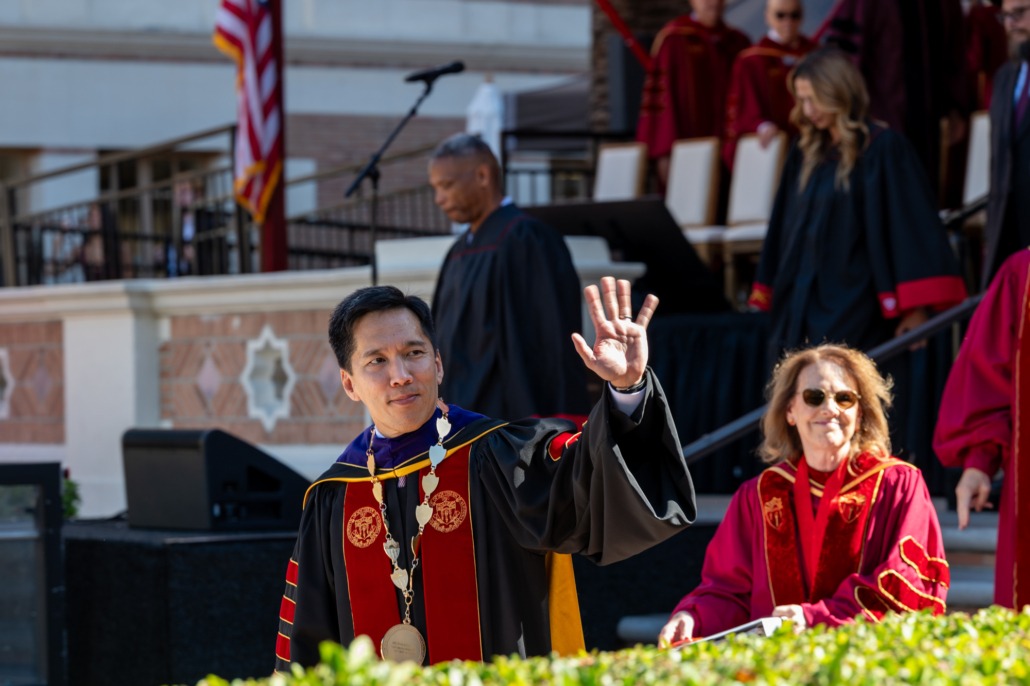
In fact, this tension was visible at Kim’s investiture. Right outside of the ceremony, protesters criticized Kim and his administration, holding signs that read “Open dialogue… unless you’re Palestinian.” Leaflets were placed on chairs related to the non-tenure track faculty union. Friday celebrated the official beginning of Kim’s presidency, but the political demonstrations surrounding it showed what his administration will have to navigate moving forward.
Meanwhile, speakers at the investiture described leading USC as an act of stewardship. That definition raises its own question: What exactly is a USC president being asked to steward? The institution’s finances and reputation? Its academic excellence and research? Or the students, faculty and staff whose disagreements can make the institution uncomfortable with itself?
Realistically, these needs must be addressed all at once, even when protecting one makes addressing the other more difficult.
During the ceremony, Dean of Religious Life Varun Soni offered a useful way to think about that “stewardship,” describing how a cello depends on tension to make music. As cellos need tension for the strings to make sound, a president relies on tension to lead a good university.
Disagreement and tension do not have to represent failures of open dialogue; they may be evidence that it exists. Perhaps the harder responsibility for an administration is determining how much tension it is willing to hold when disagreements are directed back at the University.
Similarly, Kim acknowledged that strengthening the Trojan Family will require these choices.
“Great universities do not become greater by trying to do everything,” Kim said. “They ask where and how they can be extraordinary and honestly confront where they cannot.”
But USC’s journey being “extraordinary” also includes decisions about what it is unwilling to sacrifice. If open dialogue is a value, then tension cannot only be welcomed only when it is convenient or contained within a panel discussion. It has to be confronted when students protest, faculty organize and Trojan family members challenge decisions the University makes.
As Kim officially begins his presidency, maintaining open dialogue will be more than defending USC from external pressure to limit expression. It will require Kim’s administration to balance challenges placed on the institution by community disagreements with its commitment to foster disagreement.
In pursuit of being a “great university,” the voices that produce tension should not be the ones USC sacrifices when confronting where it cannot be “great.” Upholding open dialogue as an institutional value also means creating a responsibility for University administration to protect it when it becomes uncomfortable or difficult to control. Open dialogue cannot only describe the conversations USC is willing to facilitate and platform; it must also mold how the University responds to voices that contest it.