USC Peace Garden blooms in new site
The new location improves on size, accessibility and sustainability despite questions of permanence.
By CALLAGHAN MCGEE
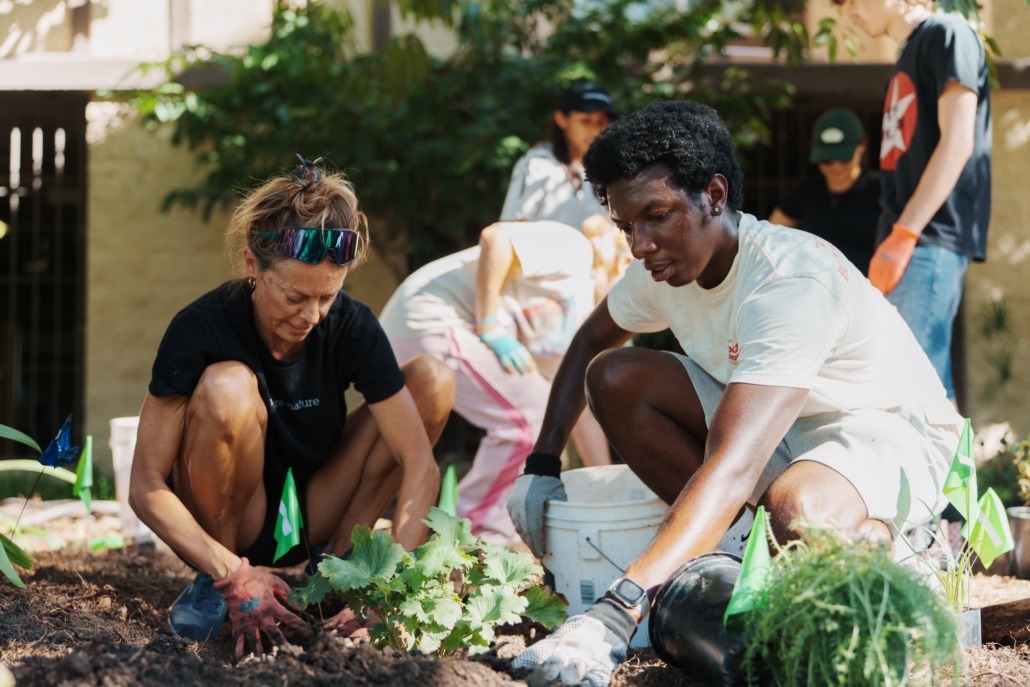

The new location improves on size, accessibility and sustainability despite questions of permanence.
The USC Peace Garden has taken root again at a larger, more accessible site after its closure, which sparked student and community outcry, including a petition that garnered over 1,300 signatures.
The new, roughly quarter-acre landscape will include California native and climate-adaptive plants and 17 raised vegetable beds. Similar to the original Peace Garden, the new space is intended to support community gathering, event programming and outdoor education.
Its original location closed in June 2025 after USC’s Real Estate and Asset Management team made plans to sell the land it was built on. When the Daily Trojan reached out to the University for comment at that time, it did not detail its reasons for the sale. The Peace Garden is now located in Kerckhoff Hall’s lawn.
But the green space is making a comeback after community pushback, according to Camille Dieterle, Peace Garden founder and associate professor of clinical occupational therapy.
“Students were really upset by the closing, and so they rallied,” Dieterle said.
Dieterle said she first applied for a grant in 2022 during the COVID-19 pandemic to respond to the lack of local green spaces and the health issues it presented.
“I got the grant, so that’s what kicked it off,” Dieterle said.
When the garden closed, USC surveyed community members about what they wanted from its replacement. Dieterle said respondents were particularly vocal about having community programming, sustainable landscaping and shaded, quiet areas.
Anne Skold, Peace Garden design intern and a graduate student studying urban planning and landscape architecture, visited the original space following its closure and spoke with its previous visitors and stakeholders.
“Something I really intentionally wanted to do was reach out to people who had known the prior Peace Garden, [and] really capture the essence of what had made that a strong garden,” Skold said.
Some elements of the old garden that Skold hoped to carry over included leaving space for art installations, as well as growing tea and herbs to revive the popular events where people could have tea in the garden. Skold nonetheless acknowledged that no two places are ever the same.
“There are always memories of an old place and an old time,” Skold said. “You can never really recreate that. You can just try to honor that.”
With more space, 24-hour accessibility and significantly more shade thanks to heritage trees that dot the garden, the new space features improvement from the old one, according to Skold and Dieterle.
The same heritage trees that provide shade also complicate the space’s design — their roots make parts of the ground difficult to dig through, and their dense canopies limit sunlight to other growing plants. For that reason, the garden features a “planting palette” of native and climate-adapted plants that require less sunlight and water.
A rain garden will be irrigated with runoff from a nearby residential building, but the garden will otherwise be watered by hand, which Skold said encourages volunteers to slow down and interact with each plant. She also selected plants with different scents to make the garden a sensory experience.
Skold is one of four peace garden interns in the President’s Sustainability Internship Program, which offers students paid, co-curricular opportunities to advance USC’s sustainability goals. Interns for the Peace Garden maintain plants, prepare soil, promote events and guide volunteers through gardening activities.
Lexi Davin, Peace Garden intern and a graduate student studying urban planning, said the garden helps people disconnect from their everyday stressors.
“There’s something really nice about being able to unplug and turn your mind off for a few hours and just be out here,” Davin said.
For Davin, however, the test for the project’s success will be largely dependent on its longevity. As a University of Oregon alum, she watched its urban farm close and relocate to make room for campus development.
“I would really hope to see that this will stay here for a really long time and just be preserved,
Davin said. “I hope that this place still exists even when I’m gone.”
For Skold, success would mean seeing people passing time in the garden even when no formal event is scheduled. She said she is excited to see the plants eventually growing together as they mature, with fruit trees, garden beds and pumpkin patches all ready for harvesting.
“I always love the transition of when plants go from being tiny little babies to being fully grown and touching one [another],” Skold said. “They’ve grown so full that it becomes one unit of lots of different species coming together, and you can’t see where one plant starts and the other stops.”