
Swift missteps in withdrawal from Spotify
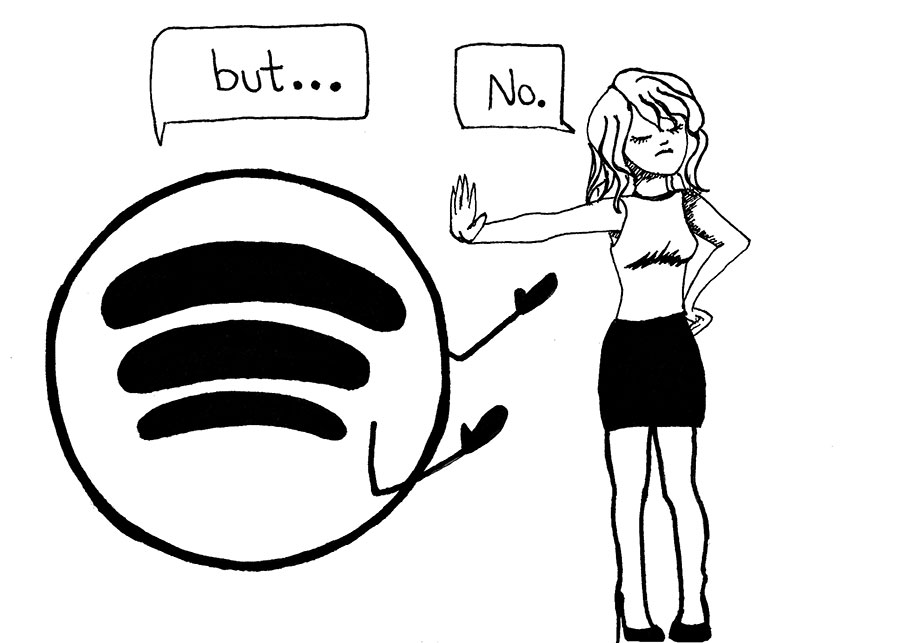
Shake it off? More like shake it up. On Nov. 3, Taylor Swift pulled her first four albums — Taylor Swift, Fearless, Speak Now and Red — from the Spotify catalog, sparking heated discussion among fans and critics. Swift, who is in the midst of promoting her already record-breaking album, 1989, has always been vocal about her opposition to digitally streamed music. In her Wall Street Journal op-ed published July 7, Swift criticized music streaming services. “Music is art, and art is important and rare. Important, rare things are valuable. Valuable things should be paid for,” she wrote. Though Swift’s argument against streaming services presents valid points, she has a faulty understanding of the payment process and the current music climate.
Elizabeth Cutbirth | Daily Trojan
I truly believe musicians should be financially compensated for their work. I can only imagine the countless hours of dedication most musical artists spend in the studio producing their songs; thus, there must be a financial transaction between consumers and those putting out the product. It’s basic economics. Yet, it seems like Swift asks for a little too much. According to Billboard, she earned almost $40 million just last year. Swift’s profits have stemmed from her musical ventures — CDs, tours, etc. — and promotional events such as her CoverGirl sponsorship. Therefore, she is rewarded for her work, and it is a hefty reward at that. Spotify is one other avenue from which Swift generates money, and though it might not be the most lucrative form of profit at $0.006 to $0.00084 per stream, it is still money that is collected and deposited into her bank account. Though Swift uses her op-ed to criticize third-party music distributors for allowing users to listen to and download music for free, she does indeed receive payment for her “valuable thing.”
Swift, in her op-ed, then goes on to state, “It’s my opinion that music should not be free, and my prediction is that individual artists and their labels will someday decide what an album’s price point is.” As a profitable artist, having that amount of control over the product is unrealistic. Swift fans come from different backgrounds, but one thing that unites them is the era they live in, this technological age. They listen to her songs via streaming because this is the nature of the Internet — it makes everything more readily available. Swift is denying the trends of the web and fighting a losing battle. Like radios in the 1940s, music streaming is a novelty on the rise that will be here for a long time. On Nov. 6, in an interview with Yahoo, Swift further detailed her reasoning behind pulling her albums — “[A]ll I can say is that music is changing so quickly, that everything new, like Spotify, all feels to me like a grand experiment.” With the influx of technology powerhouses like Apple and Beats developing their own radio services, it seems like music streaming is here to stay.
But Swift isn’t the only artist not on Spotify. According to music magazine Spin, other artists including Garth Brooks and Led Zeppelin have also said no to streaming services, citing similar reasoning that Swift does. Swift’s actions obviously aren’t unique, so perhaps Spotify can modify the model in which they pay these musical artists. Independent music artists just starting out are clearly benefitting from the exposure from Spotify but aren’t awarded enough royalties for their work. If music streamers developed a system in which listeners paid a small amount extra across the board, the money could be funneled toward musical artists.
Ultimately, it is still shocking that Swift would leave Spotify. She’s getting the recognition she deserves from critics and consumers alike, cleaning up award shows and establishing record-breaking songs. On top of that, she’s getting compensated for her work, making more in a year than a lot of people would in an entire lifetime. Spotify is quickly becoming an essential, so Taylor, you should’ve known.
Danni Wang is a sophomore majoring in psychology. Her column, “Pop Fiction,” runs Mondays.