
Google searches for answers in China
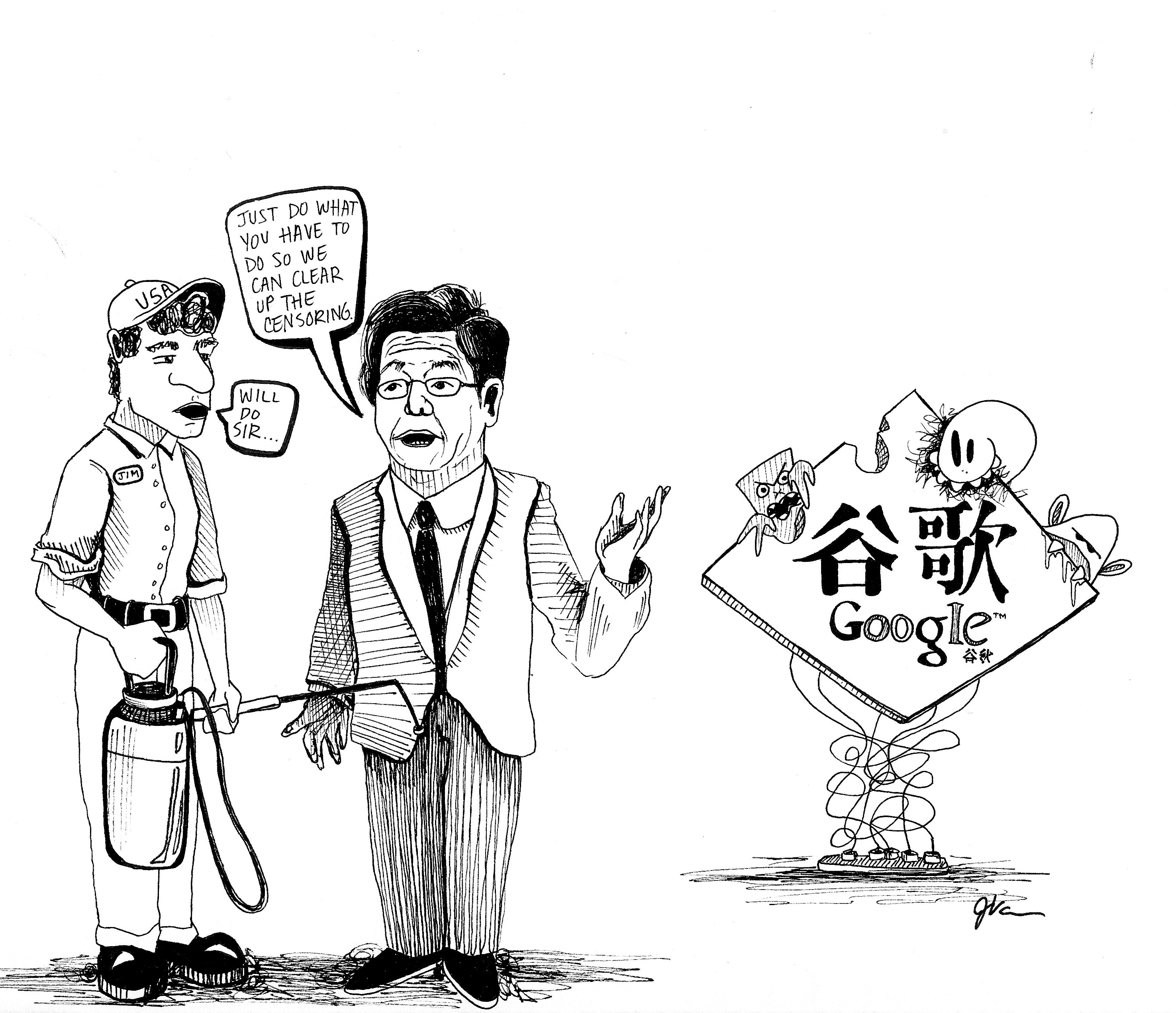
Last Tuesday, Google rocked cybersphere when it announced it would no longer be conforming to the “sanitized searches” endorsed by the Chinese government on
Julia Vann | Daily Trojan
Google.cn. China’s long history of media censorship was extended to search engines when Google made its multimillion dollar deal with the country’s dictatorship back in 2005.
In what many are now calling the web’s Berlin Wall moment, Google decided to rise up against Chinese censorship law in response to a hacking incident, which the search engine conglomerate has suggested was sponsored by the Chinese government. Competitive Internet giant Yahoo also stepped forward, using decidedly politicized language when it stated that it would be “aligned” with Google on the issue of Internet privacy. Even the U.S. Department of State decided to get involved, issuing a statement last Friday saying that it would demand a formal explanation from the Chinese government.
It is unclear at what point Google security became an issue of national importance — perhaps even national security — but what is certain is that this issue extends far beyond the rights of the everyday Chinese Internet user.
For Google, this was probably more of a scare tactic attempting to show the Chinese government who’s boss than an actual threat to close Google’s China enterprise; despite the very public fallout, Google only dropped its censorship controls on Google.cn for a number of hours. And, despite the high-and-mighty claim that Google would no longer collaborate with political oppressors, the company has returned to business as usual for the time being.
Google’s moral posturing seems somewhat questionable for several reasons. For one thing, if they really cared so much about so-called political oppression, then why did they agree to impose censorship models when they signed their initial contract? Some argue that Google’s CEOs were actually very worried about that issue from the beginning, yet felt that it would be better to provide some access to external world views than none at all. No doubt the thought of accessing more than a billion new potential users was also a strong incentive.
Furthermore, Google’s decision to take a strong stance probably has a lot more to do with protecting its assets (and its image) than the company’s political values. If the Chinese government was able to access Google’s highly lucrative intellectual property, the company could potentially face billions of dollars in losses. Equally important, if Google’s business clients fear that switching to Google Apps will compromise their security, it will be very hard to lure those important investors back out from behind their secure corporate servers.
Since the Chinese Communist Party conducted a business transaction with Google, this case creates several interesting questions from a political perspective. Google was essentially able to break Chinese law, without incurring any political consequences — because from Google’s perspective, the issue wasn’t Chinese law, but the terms of the Google.cn contract. China hacked first, so Google simply retaliated; the worst China can do is break its contract with Google.
This raises the second interesting point: If Google is able to break Chinese law without consequences, then does that make the company more powerful than the country? Probably not, but no doubt the Chinese government is livid that Google was able to take such swift and damaging action, not because of the company’s net power, but because of its technological superiority.
The political element only really came in when the U.S. Department of State decided to get involved. It’s possible that the State Department was simply using the Google issue to remind China that America still disapproves of Chinese political ideology. But the other, scarier possibility is that the State Department is actually worried that national security could be compromised via Chinese hackers on Google servers.
Technology has gone a long way toward meshing all areas of modern life in a way that’s never been seen before. But for businesses, business will always come first, and governments will always dwell mainly in politics. Though the two worlds have been brought into close collision, their interests are essentially aligned: As long as Google can make a profit off China, and China can modernize its country through Google, the two will continue to interact.
Either way, one thing is certain: China will now be more nervous than ever to tap into those technological assets, in whatever way they can.
Rosaleen O’Sullivan is a junior majoring in creative writing and international relations.